
Introduction
A manufacturer needs to move a 14-foot-wide assembly line component from Ohio to Texas. Simple enough, until the permit paperwork starts piling up.
There's no such thing as a single "national oversize permit." Each state sets its own width, height, and weight thresholds, and a load legal in Ohio might need an entirely different escort setup in Texas.
Miss a requirement, and you're looking at fines, delayed delivery, or a truck pulled off the road mid-route.
This guide breaks down what qualifies as a wide or oversize load and how state permitting actually works. You'll also find the compliance requirements you can't skip, plus why many shippers bring in a heavy haul partner instead of managing this alone.
Key Takeaways
- Loads wider than 8 feet 6 inches generally require a state-issued oversize permit
- Permits are issued at the state level, so multi-state routes need multiple approvals
- Compliance requires specific signage and escort vehicles, plus restricted travel windows in many states
- A heavy haul partner like Sims Global Solutions manages state-by-state permitting and routing, keeping loads compliant and on schedule
What Is a Wide Load? Understanding the Legal Definition
A wide load is a legal classification, not just an industry term. It applies to any vehicle-and-cargo combination that exceeds a state's standard size limits for width, and often height, length, or weight, while traveling on public roads.
The federal government sets a National Network width standard of 102 inches, or 8 feet 6 inches. Anything wider than that generally needs authorization before it can move legally. From there, states layer on their own rules:
- Width: Over 8'6" typically triggers permit requirements
- Height: No federal limit exists, but most states cap it between 13'6" and 14'6"
- Length: Varies by trailer configuration and state, though federal rules block states from setting semitrailer limits below 48 feet on the National Network
- Weight: Interstate limits sit at 20,000 lbs per single axle, 34,000 lbs per tandem axle, and 80,000 lbs gross, subject to the Federal Bridge Formula

Once you know these thresholds, the terminology matters too: "wide load" and "oversize load" get used interchangeably in the trucking world. Technically, wide load refers only to width. Oversize is the broader term, covering any dimension that exceeds legal limits.
What Is a Wide Load in the USA?
Here's the part that trips up a lot of shippers: there's no single nationwide width limit. All 50 states set their own definitions and permit rules independently.
The Federal Highway Administration maintains a state-by-state reference, but it's a starting point, not a substitute for checking each state's current regulations before you move a load.
Wide load hauling also overlaps heavily with heavy haul trucking. Most oversize shipments need specialized equipment (think RGN trailers, step-decks, or multi-axle configurations) just to move the freight safely.
What Qualifies as an Oversize or Wide Load Shipment?
Certain cargo categories show up on permit applications constantly. If your shipment falls into one of these buckets, plan on securing a permit:
- Construction equipment – cranes, bulldozers, excavators
- Manufacturing equipment – assembly line sections, industrial generators
- Agricultural machinery – combines, large tractors
- Prefabricated or mobile homes – modular units, manufactured housing sections
- Large vehicles or boats – yachts, RVs, oversized trailers
The Indivisible Load Rule
Not every oversized item needs a permit. If a load can be broken down into smaller pieces that fit within standard legal limits, states often won't classify it as permit-eligible at all.
Federal guidance defines a load as nondivisible when separating it would destroy its value, compromise its intended use, or take more than eight workhours to dismantle with proper equipment.
Shippers claiming nondivisibility carry the burden of proof and should keep this documentation ready:
- Engineering drawings showing the load's structure
- Dismantling labor estimates confirming the time required
- Intended-use evidence confirming the equipment's function
This concept shows up constantly in industries like aerospace and defense, material handling, and medical device manufacturing, where components often can't be broken apart without compromising function. Sims Global Solutions regularly moves freight for shippers in these sectors, where oversized, single-piece cargo is simply part of doing business.
How Wide Load and Oversize Load Permits Work
State-by-State Regulation, Not Federal
The federal government publishes reference guidance but doesn't issue oversize permits. Every state along your route requires its own separate approval.
Some cities and counties add local permitting requirements on top of the state permit. Identifying and securing those falls on the shipper, not the state DOT.
A five-state route can easily mean five state permits plus additional local ones, depending on where the freight passes through.
Permit Costs and Insurance Requirements
Permit fees vary widely by state, width, weight, and distance traveled. Pennsylvania's 2025 fee schedule offers a useful real-world example:
| Permit Type | Fee |
|---|---|
| Single trip, under 14 ft wide | $46 base |
| Single trip, over 14 ft wide | $97 base |
| Overweight component | $0.04 per ton-mile |
| Superload preliminary review | $68 + $12 per county |
There's no universal national insurance minimum for oversize freight. Requirements vary by state, route, and whether the load qualifies as routine or superload, and some states add certificates specific to over-dimensional hauling.
Shippers moving similar loads repeatedly can cut per-trip costs and paperwork by:
- Setting up a state permit account for faster repeat filings
- Applying for annual permits instead of paying per trip
- Confirming any state-specific certificates before the load moves
How to Apply for an Oversize Load Permit
Every application needs the same core information: exact route, dimensions, weight, and origin/destination. Many states now handle this through automated online systems, such as Texas's TxPROS, New York's HOOCS, or Florida's PAS portal.
Beyond the oversize permit itself, watch for additional credentials that operate independently:
- New York Highway Use Tax (HUT): Required for vehicles over 18,000 lbs gross weight
- IFTA fuel permits: Apply to qualified interstate vehicles based on axle count and weight
- Unified Carrier Registration (UCR): Covers interstate carriers operating vehicles at 10,001 lbs GVW or more

An oversize permit doesn't replace any of these. Skipping one because you assumed the permit "covered it" is a common and costly mistake.
Sims Global Solutions' heavy haul team tracks these requirements alongside the oversize permit itself, so shippers don't discover a missing HUT or UCR filing at a weigh station.
Compliance Requirements for Wide and Oversize Load Shipments
Signage, Flags, and Lighting
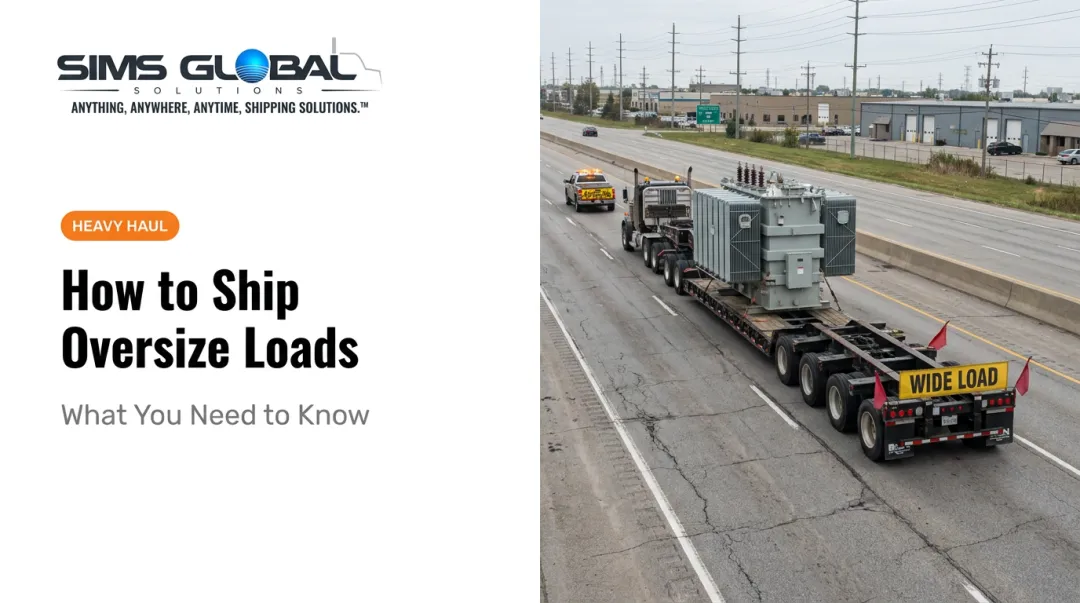
Most states require a yellow "Oversize Load" or "Wide Load" banner mounted front and rear, plus red or orange corner flags marking the extreme edges of the load. Exact dimensions vary. Washington, for example, specifies a banner at least 7 feet by 18 inches with black lettering at least 10 inches tall.
Nighttime or low-visibility travel typically adds further requirements, such as:
- Amber warning lights mounted on the cab
- Rotating beacons visible from multiple angles
- Reflective tape along load extremities in some states
The specific permit issued for your route sets the actual requirements. General rules of thumb don't apply once a permit is issued.
Escort and Pilot Vehicle Requirements
Escort requirements kick in once a load crosses certain width thresholds, though the exact trigger varies by state. Texas requires one escort past 14 feet wide and both front and rear escorts past 16 feet. Superloads can require law enforcement escorts entirely.
Escort costs get billed per mile, plus fuel, lodging, and incidentals for multi-day hauls. Underestimating this line item is one of the fastest ways to erode margin on an oversize shipment.
Travel Time and Route Restrictions
Most states limit oversize travel to daylight hours, with added curfews around weekends, rush hour in urban areas, and major holidays. Ohio, for instance, generally prohibits movement between sunset and sunrise.
Pre-approved routing matters more than most shippers assume. In 2013, a permitted truck carrying a 15-foot-9-inch load struck the Skagit River Bridge on Interstate 5 in Washington, collapsing a span and sending vehicles into the river.
The permit itself stated it didn't guarantee clearances. Confirming actual bridge and utility clearances before the load moves is the carrier's job, permit or no permit.
Why Work With a Heavy Haul Logistics Partner for Permit Compliance
Coordinating permits, escorts, insurance, and equipment across multiple states adds up fast, especially for shippers who don't move oversize freight often enough to justify an in-house compliance team.
Sims Global Solutions' Heavy Haul Trucking division handles this complexity directly, running a structured five-step planning process on every load:
- Equipment selection
- Route creation
- Route survey and review
- Permitting
- En route coordination

That process is backed by SimsTrak, the company's proprietary Transportation Management System, giving shippers real-time visibility into where their freight actually is, not just where it's supposed to be.
That process supports oversize freight needs across several demanding sectors, including:
- Aerospace and defense
- Material handling
- Medical device manufacturing
Serving those industries takes more than paperwork; it takes the right equipment. The company maintains its own trucking assets alongside a network of 150,000+ carriers, giving it flexibility that a pure brokerage often can't match on complex heavy haul moves. If your next shipment needs a partner who handles the permitting maze so you don't have to, reach out to Sims Global Solutions for a heavy haul quote.
Frequently Asked Questions
What is the meaning of wide load?
A wide load is cargo or a vehicle-and-trailer combination that exceeds standard legal width limits on public roads. It generally requires a special state-issued permit to travel legally.
What is a wide load in the USA?
In the U.S., a load wider than 8 feet 6 inches is typically classified as a wide load. Exact thresholds and permit rules are set individually by each state.
Do I need a permit for every state I drive through?
Yes. Permits are issued at the state level, so a separate permit is required for each state on your route, plus any applicable city or county permits.
How much does an oversize load permit cost?
Fees vary by state, width, and weight. For example, Pennsylvania's 2025 schedule runs $46 to $97 per trip for width-based fees, plus overweight charges per ton-mile. Frequent haulers can cut costs with annual permits.
When are escort vehicles required for wide loads?
Requirements vary by state, but escorts commonly kick in once a load exceeds roughly 14 feet wide, with additional escorts required at greater widths or for superloads.
What happens if I don't get the required oversize load permit?
Non-compliance can result in significant fines, shipment delays, or having your vehicle pulled from the road entirely. Repeat violations can also jeopardize future permit privileges.