Introduction
Equipment hauling touches nearly every corner of American industry — construction sites, manufacturing floors, aerospace facilities, and material handling operations all depend on it. And rates have shifted noticeably in recent years. U.S. on-highway diesel averaged $4.99/gallon in 2022 before falling to $3.66 in 2025, and those swings flow directly into hauling costs through fuel surcharges that carriers apply on every move.
Price volatility is only part of the challenge. Equipment hauling rates vary dramatically depending on:
- Load weight and dimensions
- Haul distance and route complexity
- Trailer type required
- Permit requirements for oversized loads
- Current carrier availability in the lane
Misreading even one of these variables leads to underbudgeting, last-minute carrier scrambles, or surprise add-on fees that blow past the original estimate.
This guide covers realistic pricing ranges by haul type, what drives costs up or down, and how to build an accurate budget before you request a quote.
TL;DR
- Equipment hauling ranges from a few hundred dollars for short local moves to tens of thousands for long-distance or oversized loads
- Key cost drivers include load weight, dimensions, distance, trailer type, permit requirements, and fuel surcharges
- Standard loads on simple routes attract the lowest rates; oversized, over-dimensional, or time-sensitive moves carry significant premiums
- Matching carrier capability to load complexity — not defaulting to the cheapest option — consistently produces better outcomes
How Much Does Equipment Hauling Cost?
Equipment hauling has no fixed rate. Every haul is priced individually based on load specs, route, trailer requirements, and what carrier capacity looks like at the moment you're booking. Shippers who treat this like commodity freight — expecting a clean per-mile figure that applies universally — end up with underspecified quotes, trailer mismatches, and invoices that don't resemble the original estimate.
Typical Rate Ranges by Haul Type
That said, rate benchmarks do exist by haul category — here's what each tier typically looks like and where pricing gets complicated.
| Haul Type | Equipment Examples | Rate Reference | Key Cost Drivers |
|---|---|---|---|
| Standard | Forklifts, compact tractors, small machinery within federal legal limits | $2.03–$2.19/mile flatbed spot linehaul (DAT, mid-2025), excl. fuel | Fuel surcharges, load/unload access |
| Mid-range | Excavators, skid steers, larger construction equipment | Quote-specific; no verified national benchmark | Permits, lowboy or step-deck trailer, possible escort vehicles |
| Heavy/Oversized | Cranes, transformers, industrial machinery, superloads | Quote-specific; varies by load, route, and state regulations | Multi-axle trailers, mandatory escorts, multi-state permit stacks, route surveys |
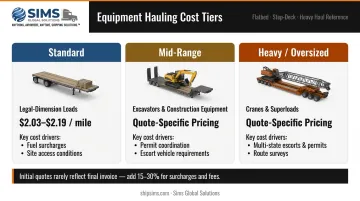
The DAT figures for standard hauls are market reference points for legal-dimension flatbed moves — not guaranteed quotes. They establish a realistic floor for equipment that doesn't require permits or specialized trailers.
For mid-range and heavy hauls, no publicly verified national rate range exists. Permit fees alone can run hundreds to thousands of dollars depending on state requirements, and escort vehicle costs compound from there.
One consistent rule across all categories: the initial quote rarely reflects what you'll pay at invoice. Fuel surcharges, permit fees, escort costs, and site-specific accessorial charges are billed as separate line items — often adding 15–30% above the base transport charge.
Key Factors That Affect Equipment Hauling Rates
Equipment hauling rates aren't arbitrary — they respond to load characteristics, route logistics, regulatory requirements, and market conditions. Knowing which factors apply to your shipment lets you anticipate cost before the quote arrives.
Load Weight and Dimensions
Federal limits set the threshold where standard hauling ends and permitted hauling begins:
- 80,000 lb gross weight on the Interstate System
- 20,000 lb single axle / 34,000 lb tandem axle
- 102 inches (8.5 ft) wide on the National Network
- No federal height maximum — state limits generally range from 13 ft 6 in to 14 ft
Loads exceeding these thresholds require state-issued oversize/overweight permits, and potentially escort vehicles. The critical detail: even minor dimension differences can push a load across a threshold. A load that's 103 inches wide doesn't cost slightly more — it triggers a completely different permit and possibly escort requirements that didn't exist at 102 inches.
Distance and Route Complexity
Longer hauls generally cost more in total, though per-mile rates can decrease slightly on longer runs due to better equipment utilization. What overrides distance math quickly: route complexity.
Factors that escalate costs regardless of mileage:
- Urban congestion and restricted travel windows
- Low-clearance bridges or overpasses requiring route deviation
- Bridge weight limits that require alternate routing
- Mountain terrain or unpaved access roads at origin or destination
Trailer Type and Specialized Equipment
The trailer determines a significant portion of the base rate:
| Trailer Type | Typical Use Case |
|---|---|
| Flatbed | Standard-dimension equipment, legal weight |
| Step deck | Taller loads needing lower deck height |
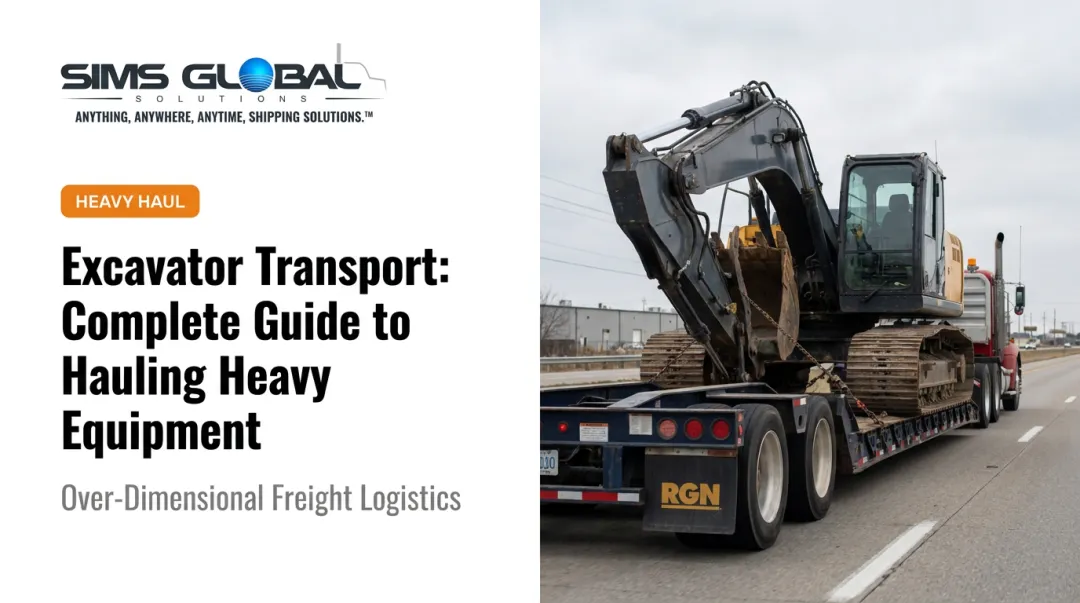
| Lowboy / RGN | Heavy equipment — excavators, dozers, large machinery |
| Multi-axle configurations | Superloads, industrial machinery, cranes |
| Extendable trailers | Long-dimension loads like bridge beams or wind components |
Specialized trailers cost more to operate and require more experienced drivers — expect those costs to show up in every quote.
Permits, Regulatory Compliance, and Escorts
The federal government does not issue oversize/overweight permits — that's entirely a state function. And permit costs vary widely by state: Iowa charges $35 for a single-trip equipment permit; Texas charges a $60 base fee plus weight-based highway maintenance fees starting at $150 for loads between 80,001–120,000 lb.
Texas escort requirements illustrate how quickly complexity builds:
- Width over 14 ft: one escort vehicle required
- Width over 16 ft: front and rear escorts
- Height over 17 ft: front escort with height pole
- Length over 110 ft: one escort; over 125 ft, two escorts
Multi-state moves require individual permits from each state crossed, coordinated around each state's processing timeline. That's a meaningful planning and cost variable on any cross-country haul.
Fuel Prices and Market Demand
Carriers apply fuel surcharges tied to the DOE/EIA weekly national diesel average. With diesel dropping from $4.99/gallon in 2022 to $3.66 in 2025, this has provided some relief — but weekly price swings mean your surcharge can shift between the time you quote and the time you ship.
Fuel volatility compounds with seasonal demand swings. FreightWaves reported in 2025 that flatbed spot rates can climb $0.30–$0.50/mile higher during peak construction season as capacity tightens and load-to-truck ratios rise.
For heavy haul specifically, that tightening hits harder — experienced operators and properly equipped trailers are far less available than standard dry van capacity.
Full Cost Breakdown: What You're Actually Paying For
The initial quote covers the base transport rate. That's rarely the final number. Here's what the complete cost structure looks like:
- Base transport rate: The per-mile or flat-rate charge covering driver labor, equipment depreciation, and standard carrier overhead. Most initial quotes reflect this number only.
- Fuel surcharge: A separate line item adjusted weekly to current diesel prices — typically 10–20% on long hauls. Confirm the surcharge rate and index used before booking.
- Permits and escort fees: State permit fees, pilot car costs, and police escort coordination, billed as pass-through costs. These range from $35 for a simple single-state permit to several hundred dollars or more for multi-state superload moves. Always request estimates before committing.
Accessorial and site-specific charges — additional fees that apply based on your specific situation:
- Limited site access (tight entrances, soft ground, no dock)
- Crane or rigging assistance at pickup or delivery
- Overnight staging when delivery windows don't align
- Tarping requirements for weather-sensitive equipment
- Special blocking, bracing, or tie-down requirements
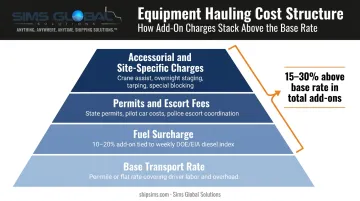
Remote or hard-to-access locations are among the most common reasons the final invoice exceeds the original quote — which is why it pays to walk through site conditions with your carrier before booking.
How to Estimate the Right Budget for Your Haul
Accurate budgeting starts before you contact a carrier. Vague load information produces vague quotes — typically on the low end — that fall apart once the carrier sees the actual shipment.
Have this information ready before requesting any quote:
- Exact dimensions: height, width, and length (measured, not estimated)
- Operating weight (not shipping weight — confirmed on a scale)
- Pickup and delivery addresses, plus site conditions at both ends
- Any time constraints or required delivery windows
- Number of state lines crossed
Then work through these questions:
- Does the load exceed federal limits on weight or any dimension?
- Are there access challenges at origin or destination (no dock, narrow entrance, soft ground)?
- Is the timeline fixed, or is there scheduling flexibility?
- How many states does the route cross?
The answers determine whether you're pricing a standard haul or a permitted, escorted, multi-state move — and the difference in cost between those two scenarios is substantial.
On complex loads, shippers benefit from working with a partner that has both an owned heavy haul fleet and a broad carrier network. Sims Global Solutions connects shippers to over 150,000 vetted carriers alongside its own specialized equipment, and provides itemized cost breakdowns — covering base rate, fuel surcharge, permits, and accessorials — before any commitment is made. That level of transparency matters when the variables carry this much financial weight.
Common Mistakes That Lead to Budget Overruns
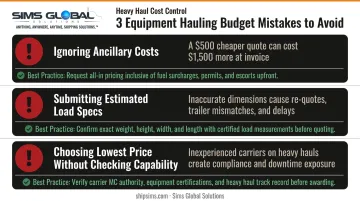
Three patterns consistently produce budget problems on equipment hauls:
- Ignoring ancillary costs when comparing quotes. Fuel surcharges, permit fees, escort costs, and site-specific accessorials are often significant. A quote that looks $500 cheaper on the base rate can easily end up $1,500 more expensive once the full cost picture is complete. Always compare total cost, not just the base rate.
- Submitting estimated rather than verified load specs. "About 14 feet tall" and "approximately 45,000 pounds" produce quotes built on assumptions. When actual dimensions come in different, the result is a re-quote, possible trailer mismatch, or permit correction — all of which delay the move and often cost more than getting it right upfront.
- Selecting the lowest-priced carrier without checking capability. On standard freight, price competition works in your favor. On heavy or oversized hauls, an inexperienced carrier lacking permit expertise or proper equipment creates problems that cost far more in downtime and compliance exposure than the initial savings. Before committing, verify the carrier's permit handling experience and trailer suitability for your specific load.
Conclusion
Equipment hauling rates are shaped by load specs, distance, trailer type, permits, fuel, and market conditions — which is why two loads moving the same distance can quote at very different prices. Understanding the full cost structure, starting with accurate load dimensions and weight, and working with a carrier who has actual capability on your load type are the practical foundations of accurate budgeting.
The lowest quote is rarely the best value when the equipment is specialized, the route is complex, or the stakes of a delay are high. Permits, fuel surcharges, escort requirements, and accessorial fees can add 20–40% beyond the base rate — so plan for the full cost, not just the line-item that shows up first.
Sims Global Solutions operates both an owned heavy haul fleet and a network of 150,000+ vetted carriers, which means they can match your load to the right equipment and capacity rather than fitting it to whatever's available. If you're budgeting a complex or oversized haul, getting a quote from a provider who understands the full cost structure upfront saves time and avoids surprises at delivery.
Frequently Asked Questions
How much per mile to haul equipment?
Standard equipment hauls on legal-dimension flatbed or step-deck trailers typically run $2.00–$2.20/mile for linehaul, excluding fuel. Permitted or oversized hauls are quoted individually based on load complexity, trailer type, and permit requirements; no standardized per-mile rate applies.
What type of trailer is used for equipment hauling?
Flatbeds and step decks handle standard-dimension loads within legal weight limits. Lowboys and RGNs are used for heavy equipment like excavators and large machinery that needs a lower deck height. Multi-axle configurations handle superloads and industrial equipment that exceeds standard permitted thresholds.
Do I need permits to haul heavy equipment?
Permits are required whenever a load exceeds state legal limits on weight, width, height, or length. Requirements and fees vary by state, and multi-state moves require a separate permit from each jurisdiction the load crosses.
How far in advance should I book equipment hauling?
Permitted or oversized moves require advance planning because permit processing timelines vary by state. Texas, for example, requires superheavy permit applications 3–4 weeks out when no approved route is on file. Last-minute bookings on specialty hauls typically carry premium pricing, and capacity is not always available.
What information do I need to get an accurate equipment hauling quote?
Provide exact dimensions (height, width, length), confirmed operating weight, full pickup and delivery addresses, site conditions at both ends, and your required timeline. Estimated or rounded specs produce inaccurate initial quotes that shift once actual load details are verified.
Is equipment hauling more expensive during certain seasons?
Yes. Peak construction seasons reduce available flatbed and specialized carrier capacity, pushing rates higher. Scheduling outside peak demand windows is one of the most practical ways to manage costs when timing allows.