Buyers and project planners often assume "200 ton" describes how much the crane itself weighs, or that it can lift 200 tons anywhere on the jobsite. Neither is true. The rating is conditional, tied to a specific boom length and lift radius, and it changes the moment either factor shifts.
This article breaks down what the 200-ton rating actually means, which crane types achieve it, what these machines can realistically lift, and what it takes to get one to a jobsite in the first place.
Key Takeaways
- A 200-ton rating is the max capacity at ideal boom length, not the crane's weight
- Crawler, all-terrain, and telescopic crawler designs all offer 200-ton capacity
- Capacity drops sharply as boom length or radius increases, per the load chart
- Moving a 200-ton crane requires 6-7 truckloads, permits, and route surveys
- Rental, purchase, and transport costs each need a separate budget line
What Is a 200 Ton Crane?
A 200 ton crane rating describes the maximum load the machine can lift under one specific configuration, not the crane's total weight. Manufacturers define maximum capacity as the load achieved at minimum boom length and the tightest radius, the closest and strongest point on the load chart.
Extend the boom or swing the load further out, and that number falls quickly.
That's exactly why the "200 ton" label confuses so many buyers. The crane itself weighs nowhere near that figure.
Real operating weights land well under the rated capacity. The Link-Belt 248 HSL, rated for 200 US tons at a 12-ft radius, has a working weight of about 349,711 lbs, roughly 159 metric tons. The Liebherr HS 8200, rated for 200 metric tons, weighs near 172 metric tons in its standard heavy-duty configuration.

The Manitowoc Grove GHC200 shows how configuration drives capacity in practice. With its 185-ft main boom, the GHC200 can pick and carry loads at 100% of its load chart on inclines up to 4 degrees, a feature that matters far more on an active jobsite than the peak rating ever will.
US Tons vs. Metric Tons
Not every "200 ton" crane means the same thing. US short tons (2,000 lbs) run about 10% lighter than metric tonnes (2,204.6 lbs). Manitowoc's own MLC200 crawler is labeled 220 USt/200 t on the same spec sheet, a good reminder to check which unit a manufacturer is using before comparing two machines head-to-head.
Why 200 Tons Sits in the Sweet Spot
The 200-ton class occupies a strategic middle ground in the market:
- Too much crane for routine mid-size work (75-150 tons) like building framing or utility installs
- Not quite the super-heavy-lift territory (300+ tons) reserved for refineries, power plants, and the largest wind components
- Flexible enough for bridge girders, precast concrete, and industrial equipment sets that fall between those extremes
The 110-to-200-ton crawler crane range remains one of the most competitive segments in the market. It balances lifting power with jobsite versatility better than machines above or below it.
Types of 200 Ton Cranes
Manufacturers reach the 200-ton mark through several distinct crane configurations, and each one suits different site conditions.
Crawler Cranes
Crawler cranes ride on tracks instead of tires, giving them stability on soft, uneven, or remote terrain where a wheeled crane would sink or slide.
- The GHC200 swings loads a full 360 degrees and reaches a 265.7-ft tip height with its swingaway extension deployed
- Crawlers cannot travel by road under their own power
- Every crawler crane must be disassembled at the yard and rebuilt on-site, which drives the multi-load transport requirements covered below
All-Terrain Cranes
All-terrain cranes combine highway-legal mobility with genuine rough-terrain capability, using telescopic booms and removable counterweights to shift between road and site configurations.
- The Grove GMK5200-1 rates at 200 metric tons with a 210-ft telescopic boom and a 331.4-ft maximum tip height
- Self-mobilizes between sites far faster than a crawler can, with no disassembly required
- Popular choice for infrastructure and renewable energy projects that need quick redeployment
Truck-Mounted and Telescopic Cranes
Truck-mounted telescopic cranes mobilize faster for urban or roadside work, but a true 150-250 ton conventional truck crane is rare. Most manufacturers channel that capacity range into all-terrain or crawler platforms instead.
Sennebogen's 6203 E telescopic crawler crane rates at 200 metric tons with a six-section 56.4-m Pin Boom. It shows a growing industry push to bring telescopic designs into the 200-ton class without giving up crawler-level ground stability.

What Can a 200 Ton Crane Lift?
Yes, a 200-ton crane can lift up to 200 tons. But only at the exact boom length and radius combination specified on its load chart. Move the boom out, or swing the load further from the base, and that number drops fast.
A published Tadano ATF 180G-5 load chart shows the swing clearly:
| Radius | Boom Length | Rated Load |
|---|---|---|
| 9 ft | 43.3 ft | 400,000 lbs |
| 20 ft | 43.3 ft | 229,300 lbs |
| 20 ft | 114.8 ft | 122,100 lbs |
| 33 ft | 196.8 ft | 34,200 lbs |
That's a drop from 400,000 lbs at the shortest reach to a fraction of that at extended radius, on the exact same machine.
Real-world loads in the 150-200 ton range typically include:
- Precast concrete segments for parking structures and stadiums
- Bridge girders — two 250-ton Link-Belt TCC-2500 telescopic crawlers recently handled beams up to 148,000 lbs (67 tons) each
- Industrial equipment sets, tanks, and vessel components at refineries and processing plants
- Wind turbine nacelles and tower sections on smaller turbine models
None of that happens without proper lift planning. Rigging selection, ground bearing pressure, and wind conditions all determine whether a crane can actually hit its rated capacity on a given day. The load chart tells you what's theoretically possible; site conditions decide what's actually safe.
Transporting a 200 Ton Crane
Getting a 200-ton crane to a jobsite is its own logistics project, especially for crawler models that cannot travel by road in one piece.
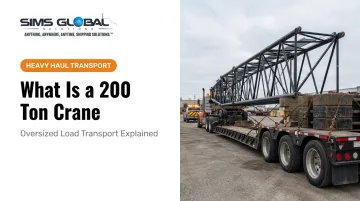
The multi-load breakdown: The GHC200 requires six to seven separate truckloads to move. The carrier, boom sections, counterweights, tracks, and rigging all travel separately, then get reassembled on-site. Sennebogen specifies a comparable seven-unit breakdown for its 6203 E crawler crane.
Permitting and Route Planning
Before any of those loads move, the paperwork has to be in place. There's no single federal permit that covers a multi-state crane move. Every state sets its own oversize/overweight rules, which means planning typically involves:
- State-by-state permits for every leg of the route
- Pilot car or escort vehicle requirements, which vary by load width, height, and length
- Route surveys to flag weight-restricted bridges, low clearances, and tight turns before the loads roll
Skipping any of these steps risks costly delays or a load stopped roadside.
Specialized Equipment and Coordination
Moving a crane carrier, boom sections, and counterweights separately calls for heavy haul trailers built for the job, RGN and lowboy configurations chief among them, paired with tractors rated for the axle weights involved.
This is where a logistics partner with actual trucking assets, not just a load board, earns its keep. Sims Global Solutions' heavy haul trucking division combines its own fleet of specialized trailers with a network of more than 150,000 vetted carriers.
That combination means a crane move needing six or seven separate loads can be sourced and coordinated from one point of contact, instead of pieced together across multiple vendors.
Real-time visibility matters just as much as the trucks themselves. Through SimsTrak, its proprietary TMS, project managers can track each leg of a multi-truck crane move as it happens.
Catching a delayed load early, before it stalls the reassembly schedule on-site, is often the difference between staying on schedule and losing a full day of crew time waiting on equipment.
Cost Factors: Renting, Buying, and Moving a 200 Ton Crane
Rental, purchase, and transport are three separate budget lines. Treating them as one is how project costs blow past estimates.
Rental rates (published benchmarks, not a universal range):
| Crane Type | Rental Rate | What's Excluded |
|---|---|---|
| Operated 200-ton all-terrain crane | ~$705/hour (8-hour minimum), about $5,640/day | Mobilization and permits |
| Bare 200-ton crawler crane | ~$38,000/month | Fuel, taxes, and setup |

Rates shift based on crane type, region, and rental length. Treat these as starting points for a conversation with a dealer, not a firm quote.
Purchase pricing is harder to pin down publicly. Used Liebherr LTM1200-class all-terrain cranes, a related capacity tier, have listed at prices between $370,000 and roughly $1.28 million, depending on year and condition. New-equipment pricing requires a direct OEM or dealer quote.
Sourcing internationally? Pricing swings based on import duties, currency exchange rates, and dealer markups when buying from overseas manufacturers. Factor in freight forwarding, customs clearance, and after-sales support before committing. Ask for a landed-cost quote, not just the equipment sticker price.
The line item everyone underestimates: transportation and permitting. A six-to-seven-load crane move involves multiple permit fees, escort vehicle costs, and heavy haul carrier charges that easily add five figures to a project budget. Build it in separately from day one, not as an afterthought once the crane is already booked.
Frequently Asked Questions
How heavy is a 200 ton crane?
The "200 ton" figure refers to lifting capacity, not the crane's own weight. Operating weights for 200-ton class machines generally fall between 159 and 172 metric tons, depending on configuration.
Can a crane pick up 200 tons?
Yes, but only at the exact boom length and radius specified on its load chart. Capacity drops significantly as the boom extends or the load moves further from the base.
What does it cost to transport a 200 ton crane?
Transport costs depend on distance, permitting requirements, escort needs, and the specific hauling configuration required for the route. A heavy haul carrier can provide an accurate quote once they know your equipment specs and destination.
What is the difference between a 200 ton and a 300 ton crane?
A 300-ton crane typically offers a longer main boom (around 263 ft vs. 210 ft) and greater maximum tip height (roughly 393 ft vs. 331 ft), suiting it to larger, higher-reach lifts like taller wind towers or major refinery work.
How far can a 200 ton crane reach?
Reach depends on the model; the GHC200 hits a 265.7-ft maximum tip height with its swingaway extension deployed. Keep in mind that maximum reach and maximum lift capacity don't happen at the same time.
Do you need a permit to transport a 200 ton crane?
Yes. Oversize/overweight permits are required in every state the load travels through, often alongside pilot car escorts. Heavy haul carriers like Sims Global Solutions typically manage this process end-to-end, coordinating permits and escorts so shippers don't have to.