
That growth comes with real headaches for shippers. Permitting varies by state. Specialized trailers cost more and require trained drivers. One wrong axle calculation or missed permit can mean fines, delays, or worse.
This guide breaks down what actually qualifies as heavy haul freight, the equipment behind it, the biggest operational challenges, and how to pick a transport partner who won't leave you stranded at a weigh station.
Key Takeaways
- Heavy haul freight exceeds legal weight or size limits, requiring permits and multi-axle trailers.
- Asset-based carriers with strong vetting and technology reduce delays and liability.
- Aerospace, energy, construction, and material handling industries all lean on heavy haul capacity.
- Final pricing hinges on weight, route complexity, permits, and escort requirements.
What Is Heavy Haul Freight Transport?
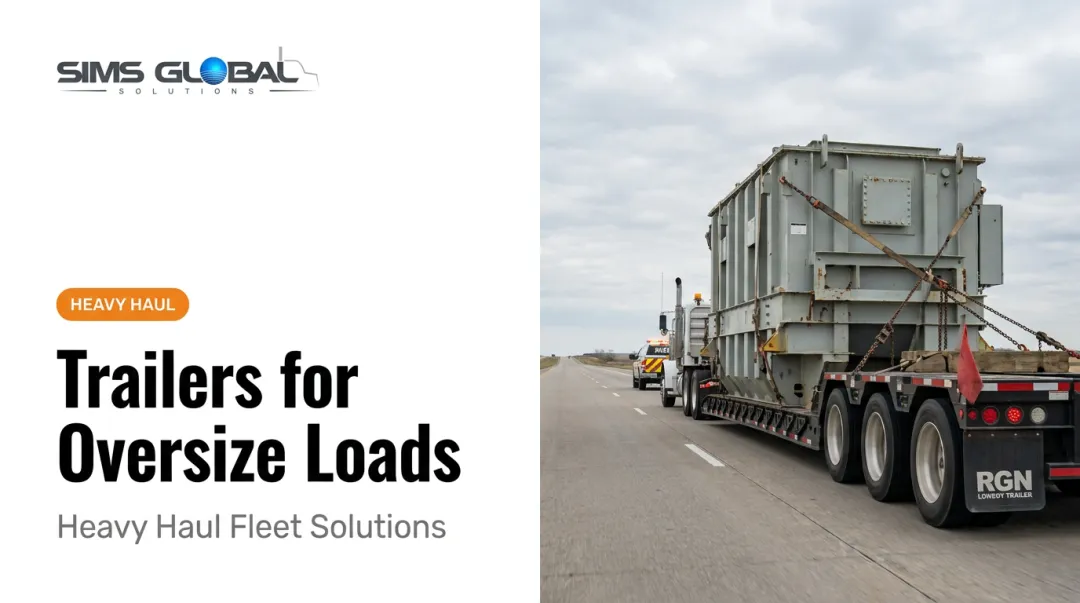
Heavy haul trucking moves cargo that exceeds standard legal weight or dimension limits, sitting apart from typical truckload freight, which stays within normal size and weight allowances.
Federal Interstate limits set the baseline:
- 80,000 lbs gross vehicle weight (unless the Bridge Formula lowers that number)
- 20,000 lbs per single axle
- 34,000 lbs per tandem axle
- 102 inches (8 ft 6 in) of width
Anything beyond these thresholds gets classified as oversize, overweight, or both, according to the Federal Highway Administration's permit guidelines.
Why Multi-Axle Trailers Matter
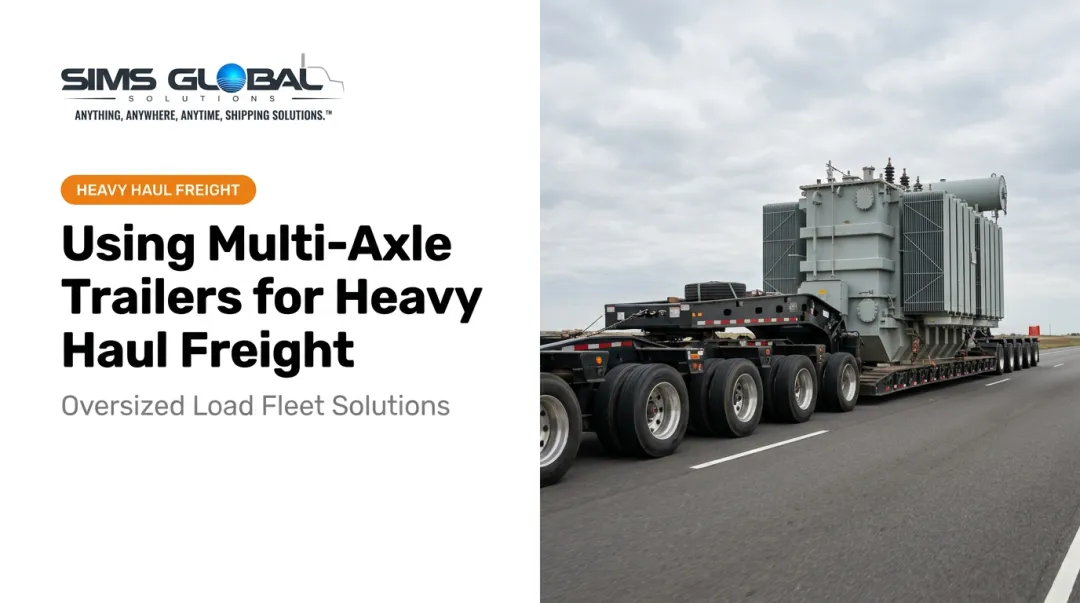
Extra axles spread weight across more contact points on the road. This protects bridges and pavement from damage while keeping the load within legal per-axle limits. A load that would crush a standard trailer's axle rating becomes road-legal once it's distributed across eight, ten, or more axles.
Who Regulates Heavy Haul Loads
- FMCSA oversees federal motor carrier safety requirements
- State DOTs issue the actual oversize/overweight permits (the federal government doesn't issue these directly)
- Each state sets its own width, height, length, and weight triggers
Beyond who enforces the rules, the cargo itself often dictates how complex a permit becomes. Common heavy haul cargo includes:
- Construction equipment like excavators and cranes
- Industrial machinery and material handling equipment
- Wind turbine blades and nacelles
- Aerospace and defense components
At Sims Global Solutions, this is where the company's heavy haul division does its heaviest lifting, moving specialized freight for aerospace, defense, and material handling clients who can't afford a compliance misstep.
Types of Heavy Haul Equipment & Trailers Used
Choosing the wrong trailer for an oversized load isn't just inconvenient. It can be dangerous and expensive. Carriers rely on a handful of specialized trailer types, each built for a different combination of weight, height, and length.
Removable Gooseneck (RGN) Trailers
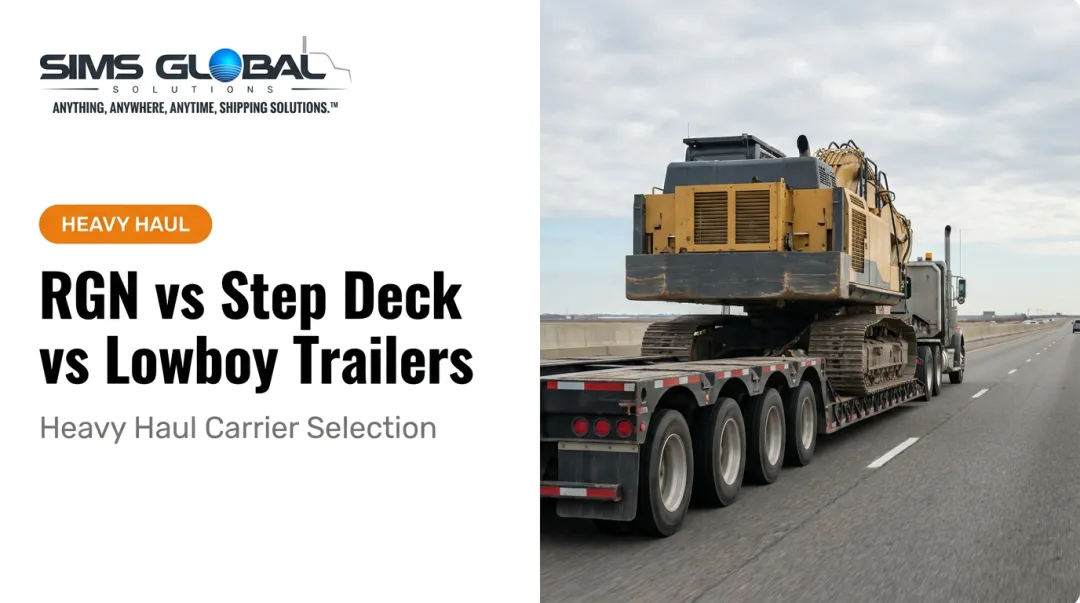
RGN trailers detach at the gooseneck, letting the deck sit directly on the ground for loading. That's critical for tall or heavy equipment that can't be driven up a ramp. Manufacturer models like the Fontaine Renegade N18 carry up to 40 tons evenly distributed, with an 18-inch loaded deck height for extra clearance.
Lowboy Trailers
Lowboys offer the lowest deck height on the market, making them the go-to choice for extremely heavy, low-clearance cargo. Industrial generators and tall construction equipment often exceed legal height limits on a standard flatbed, but not on a lowboy.
Step-Deck and Extendable Trailers
- Step-deck trailers feature a raised neck and lower main deck, adding clearance for taller freight
- Extendable trailers stretch the deck length for long cargo like wind turbine blades or structural steel beams
- Some extendable step-deck models rate up to 150,000 lbs, depending on axle configuration
Carriers match trailer type to the job by evaluating cargo weight, its concentration across the load, loaded height, length, and the specific route's bridge and clearance data. Sims Global Solutions maintains its own heavy haul fleet, which means equipment selection happens in-house rather than through a third-party broker scrambling to find capacity on short notice.

How to Choose the Right Heavy Haul Freight Partner
Not every freight provider can handle a 100,000-pound transformer or a 150-foot turbine blade. Here's what separates a reliable heavy haul partner from a risky one.
Asset-Based Capacity Beats Pure Brokerage
During capacity crunches, brokers relying solely on outside carriers often can't secure equipment fast enough. Owning trucking assets changes that equation.
As Billy, Sims Global Solutions' Corporate Sales Manager for Heavy Haul Trucking, puts it: "Company-owned trucking assets have opened up countless opportunities that a traditional freight brokerage would have a difficult time tapping into."
Vetting, Insurance, and Technology
Asset ownership solves capacity problems, but it doesn't guarantee safety or visibility. A dependable partner should also offer:
- Rigorous carrier vetting with verified insurance coverage for high-value or hazardous freight
- Real-time GPS tracking through an integrated Transportation Management System
- Permit and compliance expertise, since one missed state permit can shut down a route entirely
- Multi-modal flexibility (TL, LTL, intermodal, drayage) for shippers juggling mixed freight needs
Sims Global Solutions combines owned trucking assets with its proprietary SimsTrak TMS and a dedicated 24/7 operations team. This gives shippers in aerospace, defense, and material handling a single point of contact instead of a patchwork of vendors.
Questions to Ask Before Signing
- Do you own your heavy haul fleet, or do you broker every load?
- How do you handle state-by-state permitting for multi-state routes?
- What insurance coverage applies to high-value freight?
- Can I track my shipment in real time?
Common Challenges in Heavy Haul Transport
Even with the right trailer and a solid carrier, heavy haul shipments face obstacles that standard freight never encounters.
Permitting and route surveys. Every state crossed requires its own permit, and route surveys must check bridges, tunnels, and low-clearance areas before the truck ever moves. Skip this step, and a load can get stuck under an overpass with nowhere to go.
Escort requirements vary by state:
- Florida requires a qualified escort for widths between 12 and 14 feet north of Florida City, plus a law-enforcement escort for heights between 16 and 18 feet
- Washington triggers pilot car requirements once a load exceeds 11 feet wide
A plan built for one state won't work in the next.
Weather and construction. These add another layer of risk:
- Chain requirements kick in for vehicles over 10,000 lbs GVW in winter conditions
- Lane closures and construction detours can force last-minute rerouting
- Weight-restricted roads may close entirely during spring thaw in northern states
Smart carriers build contingency time into every schedule rather than assuming the fastest route will stay open.

Industries That Rely on Heavy Haul Freight Services
Heavy haul freight forms the backbone of several major U.S. industries, from aerospace to energy production.
| Industry | Why heavy haul matters |
|---|---|
| Aerospace & defense | Mission-critical components need precision handling and airtight compliance |
| Energy & wind | Turbine blades can stretch hundreds of feet and can't be bent or disassembled |
| Construction | Excavators, cranes, and structural steel routinely exceed standard weight limits |
| Material handling | Forklifts, conveyors, and warehouse equipment often require flatbed or lowboy transport |
| Medical device manufacturing | Large imaging and diagnostic equipment demands careful, damage-free transit |
Wind energy alone illustrates the scale of the challenge. U.S. land-based wind capacity hit 150,492 MW by the end of 2023, and blade geometry alone often dictates which extendable trailer configuration a carrier needs.
Sims Global Solutions serves several of these sectors directly, with particular depth in aerospace, defense, and material handling, where downtime or damaged freight carries outsized consequences.
Cost Factors Influencing Heavy Haul Shipping Rates
Heavy haul pricing doesn't follow a flat-rate model. Too many variables come into play.
Base cost drivers:
- Weight and dimensions of the cargo
- Total distance traveled
- Number of states crossed (each with its own permit fees)
Permit fees add up fast. Texas charges $210 for loads between 80,001 and 120,000 lbs, jumping to $285 for loads between 120,001 and 160,000 lbs, before electronic service charges. Multiply that across a multi-state route and permit costs alone can reach into the thousands.
Other factors that shift the final quote:
- Escort vehicle staffing (costs rise sharply for superloads requiring law enforcement escorts)
- Route survey labor for bridges and utility clearance
- Fuel surcharges tied to diesel pricing
- Seasonal demand spikes during peak construction months
- Insurance and liability coverage for high-value cargo

Ask for an itemized quote covering every permit, escort, and fuel surcharges before committing. A vague flat number usually means surprises later.
Frequently Asked Questions
What is USA freight?
USA freight refers to the domestic movement of goods by truck, rail, air, or sea. Heavy haul is a specialized subset that requires extra permits, equipment, and route planning.
What qualifies as a heavy haul load?
A load qualifies as heavy haul when it exceeds standard weight limits, typically 80,000 lbs GVW, or state dimension thresholds. Common examples include construction equipment, industrial machinery, and turbine components.
Do I need special permits for heavy haul shipping?
Yes. States issue oversize/overweight permits individually, and requirements vary by route, weight, and dimensions. Some shipments also require federal coordination depending on the cargo.
How much does heavy haul trucking cost?
Cost depends on weight, distance, permits, and escort requirements. There's no fixed flat rate, so quotes should itemize every cost driver separately.
What's the difference between heavy haul and oversize freight?
Oversize freight exceeds standard dimension limits like width or height. Heavy haul exceeds weight limits. Many shipments qualify as both simultaneously.
How do I find a reliable heavy haul carrier?
Look for asset-based capacity, verified insurance coverage, proven permit expertise, and real-time tracking technology. A carrier that owns its own fleet, like Sims Global Solutions, typically offers more reliability than a broker-only model.