
That complexity is exactly why so many shippers struggle to compare intermodal quotes apples-to-apples.
The upside is real. FreightWaves' SONAR data put national average domestic intermodal savings at 23% versus over-the-road trucking in July 2025, though the same report showed just a 9% gap on the Los Angeles-Dallas lane. Savings depend heavily on the specific route and market conditions, not a fixed percentage.
This guide breaks down how intermodal quotes are built, what drives the price up or down, how intermodal stacks up against truckload, and how to request a quote that reflects your true landed cost from a provider like Sims Global Solutions.
Key Takeaways
- Intermodal quotes bundle rail, drayage, fuel, and accessorials into one rate
- Distance, weight, freight class, and drayage distance drive most pricing
- Truckload savings vary by lane, so get lane-specific quotes, not averages
- A multi-modal broker with carrier access catches hidden fees before booking
What Is an Intermodal Freight Quote?
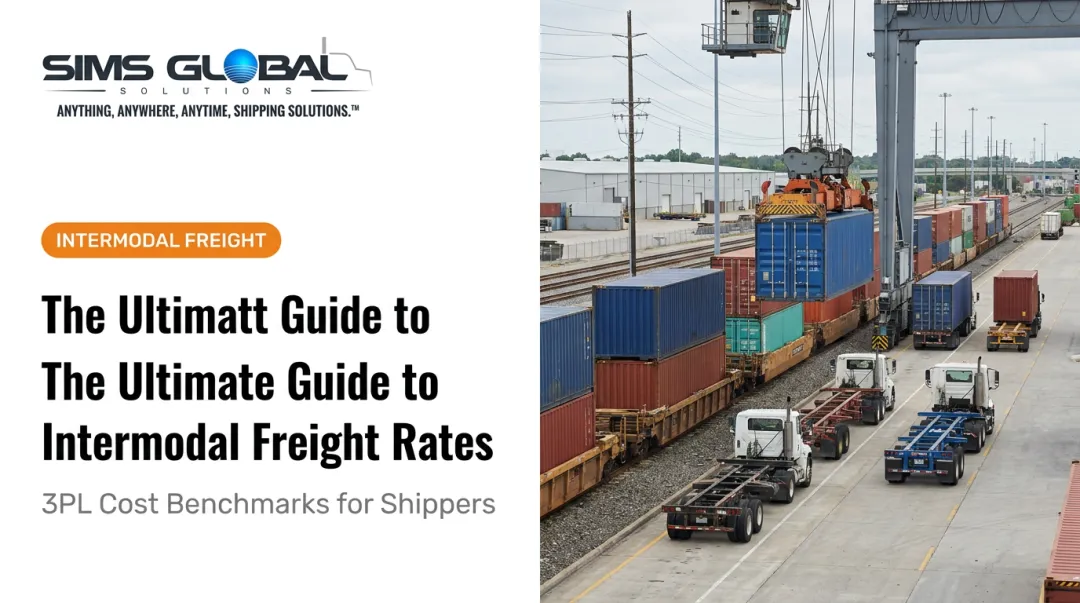
An intermodal freight quote estimates the cost of moving a shipment using two or more transportation modes, typically rail and truck, while the freight stays inside the same container for the entire trip.
The move typically breaks down into four steps:
- A drayage carrier picks up the container from the shipper's dock.
- That carrier hauls the container to a rail ramp for loading.
- The railroad moves the container long-haul to the destination ramp.
- A second drayage carrier delivers the container to the consignee.

Two equipment types show up in quotes:
- COFC (Container on Flat Car): A shipping container loaded onto a rail flatcar, usually a well car. It has no wheels of its own, so it needs a chassis for drayage.
- TOFC (Trailer on Flat Car): A full semi-trailer, wheels included, loaded directly onto a flatcar.
Knowing which equipment type applies to your freight matters before you request a quote, since chassis availability and handling differ between the two.
This bundling also separates an intermodal quote from a standard truckload quote. A truckload rate is one number covering a single carrier and one continuous move. An intermodal quote is a sum of parts: linehaul, two drayage legs, fuel, and whatever accessorials apply. Ask for a single "rate" without asking what's inside it, and fees tend to appear later.
How Intermodal Freight Quotes Are Calculated
Unlike OTR trucking, where a single per-mile rate covers the whole trip, an intermodal quote is assembled from several cost segments layered on top of each other.
The core components:
- Rail linehaul – the cost of moving the container on the train, priced ramp-to-ramp rather than door-to-door
- Origin drayage – trucking the container from the shipper's dock to the nearest rail ramp
- Destination drayage – trucking the container from the arrival ramp to the consignee
- Fuel surcharge – layered on top of linehaul and drayage, tied to a diesel price index
- Accessorials – chassis fees, storage, detention, and other case-by-case charges
Three Pricing Models You'll Encounter
- Contract pricing – A locked rate and guaranteed capacity for a set period, negotiated for recurring lanes and volume.
- Spot pricing – A market-based rate quoted per shipment that moves with current supply and demand.
- Project pricing – A custom rate built for large or unusual volume that doesn't fit a standard contract or spot model.
How Fuel Surcharges Get Added
Most Class I railroads tie their fuel surcharge programs to a diesel price index, similar in spirit to the U.S. Energy Information Administration's weekly on-highway diesel data. Norfolk Southern, for instance, applies its mileage-based surcharge once diesel prices cross a set threshold in its published program. CSX and other carriers run their own schedules on their own update cycles.
Ask which index and effective date apply to your quote. A surcharge based on last month's diesel price can look very different from one based on this week's.
Interline Fees Aren't Always a Separate Line Item
Freight crossing more than one Class I railroad is an interline move. That doesn't automatically mean an added fee — BNSF's own glossary defines an interline rate as one that already includes interchange charges unless the quote says otherwise. What it more reliably means is an extra transit day. Ask your provider directly whether interline charges are baked into the number you're seeing.
Why Ramp-to-Ramp Mileage Matters
The rail linehaul portion of your quote is generally priced on the distance between rail ramps, not full door-to-door mileage. That's why drayage distance from your dock to the nearest ramp is its own line item. Two shippers on the "same lane" can get different quotes if one sits five miles from a ramp and the other sits sixty.

Key Factors That Influence Your Intermodal Freight Quote
Intermodal pricing depends on more than the mileage between origin and destination. Several variables shape what carriers and drayage providers charge before your quote is finalized.
Distance and Length of Haul
Intermodal gets more cost-competitive as the haul gets longer. Guidance from the Intermodal Association of North America puts 700 miles as the point where intermodal generally starts to make economic sense. Shorter hauls, especially under 400 miles, usually favor a straight OTR (over-the-road) move, since drayage on both ends can eat into any rail savings.
Weight, Equipment Type, and Freight Class
Intermodal containers typically carry less payload than a standard dry van. IANA lists 42,500 pounds as a general maximum for domestic intermodal loads, worth checking against your actual freight weight before assuming a container will work.
Hazmat, oversized, and temperature-sensitive freight raise that bar further, since they require specialized equipment and handling. Each requirement adds cost to the base quote, as not every ramp or drayage carrier is equipped for reefer containers or hazmat-rated moves.
Drayage Distance from the Ramp
The closer your dock sits to an intermodal ramp, the lower your drayage cost. Shippers in remote areas often find that drayage erases most of the rail savings, sometimes making OTR the more economical choice regardless of the rail leg's efficiency.
Capacity, Seasonality, and Supply/Demand
Only a handful of Class I railroads operate nationwide, and that limited competition, combined with seasonal freight surges around peak retail season, keeps rates elevated during high-demand windows.
Storage, Detention, and Free Time Allowances
Every ramp grants a fixed number of free days for container dwell before storage charges kick in. Those charges accrue fast once the window closes, so know your carrier's specific allowance before booking.
Intermodal vs. Truckload: Which Costs Less?
For long-haul lanes, intermodal is usually the cheaper option. Rail moves freight more fuel-efficiently per ton-mile than trucks, and that efficiency, combined with railroad economies of scale, tends to translate into lower linehaul costs on lanes over roughly 700 miles.
That's not guaranteed, though. Three scenarios close the gap:
- Truckload capacity tightens, narrowing the price difference
- The lane runs short-haul, where drayage costs erode rail savings
- The freight is time-sensitive and can't absorb the extra day
Here's how the two typically compare:
| Factor | Intermodal | Truckload (OTR) |
|---|---|---|
| Cost on long hauls (700+ mi.) | Often lower, but savings vary by lane and market | Competitive when truck capacity is loose |
| Transit time | Roughly truckload transit plus a day; longer with interline moves | Fastest option for time-critical freight |
| Flexibility | Fixed ramp-to-ramp routing, limited mid-transit changes | More origin/destination pairs, can reroute mid-move |
The smartest move is to stop assuming and start comparing. Request quotes for both modes on your actual lane, then weigh total landed cost against transit time.
A rate that looks 15% cheaper on paper isn't a win if it also means missing a delivery window that triggers a chargeback. Sims Global Solutions can quote both modes side by side for an apples-to-apples comparison.
How to Get an Accurate Intermodal Freight Quote
Before requesting a quote, have these details ready:
- Origin and destination ZIP codes
- Total weight and commodity or freight class
- Equipment needs (COFC or TOFC, chassis type, reefer if applicable)
- Desired ship date and any delivery deadline
Complete information upfront gets you a faster, more accurate number and cuts down on the back-and-forth that delays booking.
Compare providers before you book. Not every carrier services every lane, and rail ramp access varies by region. Comparing rate, transit time, and reliability across a few providers gives you a realistic picture instead of a single data point.
This is where a multi-modal 3PL earns its keep. Rather than chasing intermodal, truckload, and LTL quotes separately, a broker that handles all three side by side lets you compare real cost and transit tradeoffs for each shipment.
Sims Global Solutions built its SimsTrak Transportation Management System around that idea. Agents can pull intermodal, truckload, LTL, and drayage quotes through the same platform, backed by access to a nationwide carrier network. A shipper deciding between rail and road for a 900-mile lane can see both options side by side instead of contacting separate vendors.
Whichever provider you use, ask about accessorials before you book, not after. Get clarity upfront on:
- Drayage fees for the last-mile move between rail ramp and dock
- Storage charges if containers sit at the ramp past the free period
- Detention fees for late equipment returns
Common Fees to Watch for in an Intermodal Quote
Even a well-built intermodal quote can hide costs if you don't ask the right questions upfront. The line items shippers overlook most often:
- Drayage fees – trucking charges at both ends of the rail move, separate from linehaul
- Chassis fees – rental cost for the chassis a container rides on during drayage
- Storage or per diem charges – fees for keeping a container at the ramp beyond free time
- Detention fees – charges for holding equipment past the allotted loading or unloading window
- Interline fees – charges that may apply when freight crosses multiple Class I railroads, though these are often already built into the quoted rate

Storage and detention charges are tied directly to free time, which varies by railroad. Union Pacific's published storage chart, for example, grants 24 hours of free time for domestic containers after the shipper is notified the unit is available, with storage charges accruing once that window closes.
Other carriers set their own terms. Don't assume one railroad's policy applies across the board.
Ask for an itemized quote before booking, not a single bundled number. For recurring or high-volume lanes, negotiate free time allowances and clarify accessorial policies as part of the rate discussion.
Frequently Asked Questions
What is intermodal pricing?
Intermodal pricing combines rail linehaul cost, origin and destination drayage, and fuel surcharges into one quoted rate. Providers price it under contract, spot, or project models depending on volume and timing.
Is intermodal cheaper than trucking?
Intermodal is often cheaper than OTR trucking on long hauls of 700+ miles, though the savings margin swings widely by lane and market conditions. Shorter or time-sensitive shipments often favor truckload instead.
How long does it take to get an intermodal freight quote?
When shipment details are complete, quotes can often come back within hours, especially through a broker with direct carrier access. Missing details like weight or commodity class will slow the process down.
What information do I need to request an intermodal freight quote?
At minimum, you'll need origin and destination, weight, commodity type or freight class, and equipment needs. Providing your desired ship date speeds things up further.
What's the difference between contract and spot intermodal rates?
Contract rates lock in pricing and capacity over a set period, usually for recurring lanes. Spot rates fluctuate with current market conditions and are quoted per shipment.
How can I reduce my intermodal freight costs?
Minimize drayage distance where possible, negotiate free time allowances upfront, and compare quotes across multiple carriers. Working with a 3PL like Sims Global Solutions makes that comparison faster and more transparent.