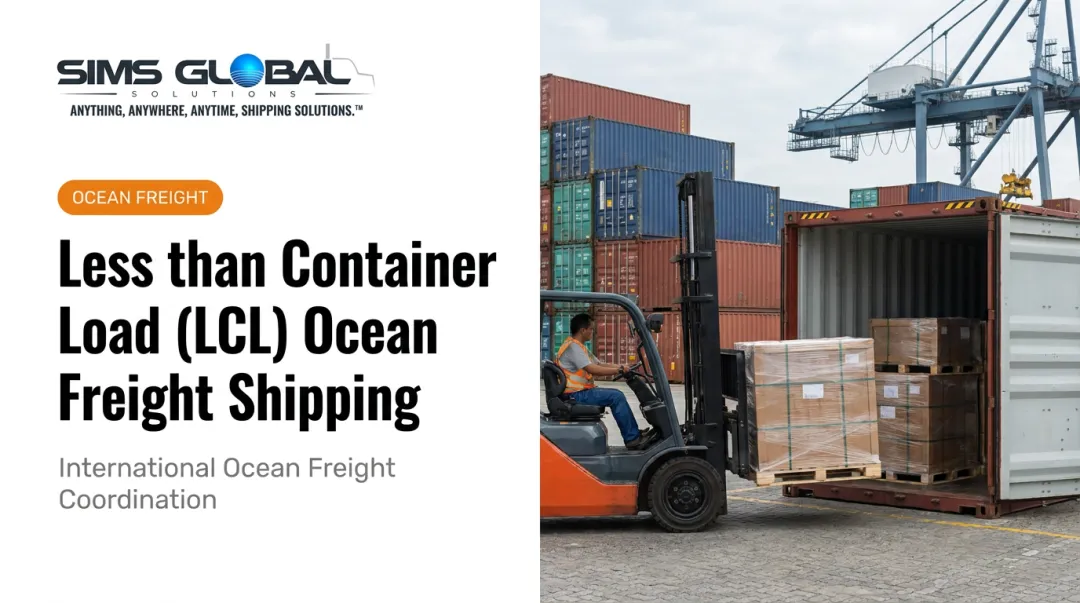

This is where LCL (Less than Container Load) comes in. It lets multiple shippers split the cost of one ocean container, each paying only for the space their cargo occupies.
LCL sits alongside FCL (Full Container Load) for ocean freight and LTL (Less than Truckload) for domestic trucking. This guide covers how LCL works, what it costs, its benefits and drawbacks, and how to choose the right partner for the leg after your cargo hits U.S. shores.
Key Takeaways
- LCL consolidates cargo from multiple shippers, lowering costs for smaller shipments
- Global seaborne trade grew 2.2% in 2024, sustaining strong demand for LCL
- Shipments under roughly 15 CBM generally suit LCL; larger volumes favor FCL
- Consolidation and deconsolidation add handling steps, meaning LCL often takes longer than FCL
- Inland drayage and final delivery often determine how smoothly LCL shipments finish
What Is LCL Logistics?
LCL logistics refers to shipping smaller cargo loads by consolidating them with other shippers' goods inside a single ocean container. Instead of renting an entire container, you pay for the volume you actually use. This mirrors how major carriers like Maersk and DHL describe LCL industry-wide: cargo from multiple shippers sharing space in one consolidated container, rather than each business securing a container of their own.
LCL vs. FCL: The Core Difference
With FCL (Full Container Load), one shipper books an entire container, whether they fill it completely or not. With LCL, that same container gets split among several shippers headed to similar destinations. You get ocean access without paying for unused space.
LCL vs. LTL: Same Idea, Different Mode
LCL is easy to confuse with LTL because the underlying concept is identical: share transportation capacity to avoid paying for a full unit you don't need.
- LCL applies to ocean and intermodal freight (shared containers)
- LTL applies to domestic road freight (shared trailer space)
- Freight forwarders sometimes call sea freight consolidation "groupage," a term reserved for ocean shipments, so confirm which mode is being discussed
You'll also hear LCL cargo referred to as "loose cargo" since it arrives at the origin dock as individual pieces rather than a pre-loaded container.
Why LCL Matters for Growing Businesses
LCL exists because not every shipper has volume to justify a full container. For SMEs testing a new supplier, launching a new SKU, or managing seasonal demand, LCL removes a major barrier to entry into global trade.
This relevance shows up in the data: seaborne trade grew 2.2% in 2024, according to UNCTAD's Review of Maritime Transport 2025, though growth is projected to slow to just 0.5% in 2025. Steady (if moderating) ocean trade means shippers of all sizes, especially smaller ones, need flexible options like LCL to stay competitive.
How Does LCL Shipping Work? (Step-by-Step Process)
LCL involves more coordination than FCL because your cargo shares space with other shippers' goods. Here's the process from booking to final delivery.
Booking and documentation. You work with a freight forwarder to secure space in a shared container, providing a bill of lading, commercial invoice, packing list, and customs declarations. The forwarder inspects your cargo and issues a House Bill of Lading confirming receipt.
Pickup and consolidation. Your cargo is collected and delivered to a Container Freight Station (CFS), an origin facility where it's combined with other shipments heading to the same destination. This is the step that makes shared-container shipping possible.
Loading and ocean transport. Once consolidated, the container is sealed and loaded onto the vessel for the main ocean transit leg, alongside FCL containers on the same ship.
Deconsolidation and final delivery. At the destination port, the container moves to another CFS, where it's opened, customs-cleared, and separated back into individual shipments for trucking or drayage to their final destinations.

The Overlooked Fourth Step
Most conversations about LCL focus on steps one through three. But step four, the inland leg, is often what actually determines whether your shipment arrives on time and intact. Once cargo is deconsolidated, it still needs reliable drayage, potential warehousing, and final-mile trucking. Sims Global Solutions closes that gap with its own drayage fleet and 33 million square feet of warehousing across 96 locations, keeping deconsolidated freight moving without added delays. A slow or disorganized inland partner can erase every day you saved by choosing LCL over FCL in the first place.
Benefits of LCL Shipping
LCL delivers real strategic advantages for businesses managing lean inventories or unpredictable demand, well beyond serving as a workaround for small shipments.
- Cost efficiency: You only pay for the container space your cargo occupies, calculated by weight or measurement (W/M), rather than committing to an entire container's fixed rate
- Flexibility: Ship smaller, more frequent quantities that match actual demand instead of over-ordering to justify a full container
- Frequent departures: LCL schedules let you ship as inventory needs dictate, rather than waiting weeks to accumulate enough cargo for FCL
- Lower barrier to entry: SMEs and businesses testing new markets can access global ocean freight without the large upfront cost of a full container
For a business shipping 8-10 CBM, LCL avoids paying for the roughly 60-70% of container space that would otherwise sit empty on an FCL booking. That difference compounds fast for companies shipping multiple times a year.
The trade-off is that shared space comes with shared timing. Which brings us to the bigger question: when does LCL actually make sense versus FCL?
LCL vs. FCL: Which Should You Choose?
The right choice depends on three factors: how much cargo you have, how fast you need it, and what kind of goods you're shipping.
Key Factors to Consider
| Factor | LCL | FCL |
|---|---|---|
| Shipment volume | Generally under 15 CBM, per Maersk guidance | Better suited for 15+ CBM |
| Transit time | Slower: consolidation and deconsolidation add handling stages | Faster: sealed origin-to-destination, fewer stops |
| Cost structure | Pay by CBM/weight for space used | Fixed rate regardless of fill level |
| Handling risk | Higher: more touchpoints during consolidation | Lower: container stays sealed |
| Best for | Small/fluctuating volumes, testing new markets | Large volumes, time-sensitive or high-value cargo |
Maersk notes that LCL suits shipments below roughly 15 CBM, or about two to three pallets, while larger volumes typically justify booking a full container. That threshold isn't universal. Route, cargo density, and container availability all shift the math, but it's a useful starting benchmark.
Urgency matters too. Because FCL skips the consolidation and deconsolidation steps, it generally moves faster on the same trade lane. If you're shipping high-value electronics, temperature-sensitive goods, or fragile items, FCL's reduced handling can also lower the risk of damage.

Challenges of LCL and Industries That Rely On It
LCL's flexibility comes with real operational trade-offs. Knowing them upfront helps you plan around them.
Common Challenges
- Consolidation delays: Waiting for a container to fill, plus the extra handling at origin and destination CFS facilities, adds time compared to FCL
- Increased handling risk: More touchpoints during consolidation and deconsolidation raise the chance of damage versus a sealed FCL container
- Documentation complexity: Missing or inaccurate customs paperwork can trigger inspections, delays, or fines, a risk that grows when cargo from multiple shippers moves through the same container
Best Practices to Reduce Risk
- Use sturdy, well-labeled packaging designed to withstand multiple handling points
- Double-check documentation accuracy before booking, especially commercial invoices and customs declarations
- Partner with a forwarder experienced in managing consolidated freight end-to-end, such as Sims Global Solutions' international freight team, which coordinates ocean and air LCL shipments alongside domestic transportation
Industries That Lean on LCL
Retail and e-commerce are the clearest examples. Retail and e-commerce accounted for 35.25% of Asia-Pacific LCL spending in 2025, the largest end-user category tracked in that market. Manufacturing is another consistent user, particularly for component shipments that don't require full-container volumes but still need predictable, recurring transit.
Why the Right Logistics Partner Matters Beyond the Ocean Leg
Here's something shippers often overlook: the ocean voyage is only half the equation. What happens after deconsolidation, drayage from the port, warehousing if needed, and final inland delivery, often determines whether your LCL shipment actually meets its deadline.
A container can clear customs smoothly and still sit at a port for days if the inland transportation plan isn't already in place. This is where a logistics partner's domestic capabilities become just as important as the ocean carrier's schedule.
Sims Global Solutions builds this inland leg around a multi-modal network spanning LTL, truckload, intermodal, and drayage. That network is backed by 33 million square feet of warehousing across 96 locations in 48 markets. For cargo arriving at U.S. ports after an LCL ocean leg, that footprint means:
- Drayage capacity to move containers from port to warehouse or final destination without scrambling for capacity
- Warehousing options if cargo needs to stage before distribution
- A domestic carrier network built to handle the trucking leg once your goods are deconsolidated
Physical infrastructure only tells part of the story. Sims Global Solutions also runs SimsTrak, its proprietary Transportation Management System, giving shippers real-time visibility into shipment status.
For businesses using LCL, that visibility matters most right after deconsolidation, when cargo is separated and handed off to trucking. Knowing exactly where your freight is during that transition reduces the uncertainty that consolidated shipping can otherwise create.

Frequently Asked Questions
What does LCL mean in logistics?
LCL stands for Less than Container Load. It's the practice of consolidating multiple shippers' cargo into one shared ocean container, letting each business pay only for the space it uses.
What services does LCL logistics typically include?
LCL services generally cover consolidation at origin, ocean freight booking, customs clearance coordination, and deconsolidation at destination. Freight forwarders or 3PLs handle the documentation and handoffs between each step.
What is the difference between LCL and FCL?
LCL means sharing container space with other shippers, while FCL means booking an entire container for yourself. LCL usually costs less for smaller volumes but takes longer; FCL costs more upfront but moves faster with less handling.
Is LCL the same as LTL?
They share the same underlying concept, consolidating multiple shipments to share transport capacity, but apply to different modes. LCL refers to ocean and intermodal freight; LTL refers to domestic road freight.
How is LCL freight priced?
LCL is typically priced by weight or measurement (W/M), using whichever is greater between cargo weight and volume in CBM. Additional charges apply for pickup, origin and destination CFS handling, and final delivery.
Is LCL shipping slower than FCL?
Generally, yes. Consolidating cargo at origin and separating it again at destination adds handling steps that FCL skips entirely. Some forwarders offer expedited LCL options for time-sensitive shipments, though FCL remains the faster default.