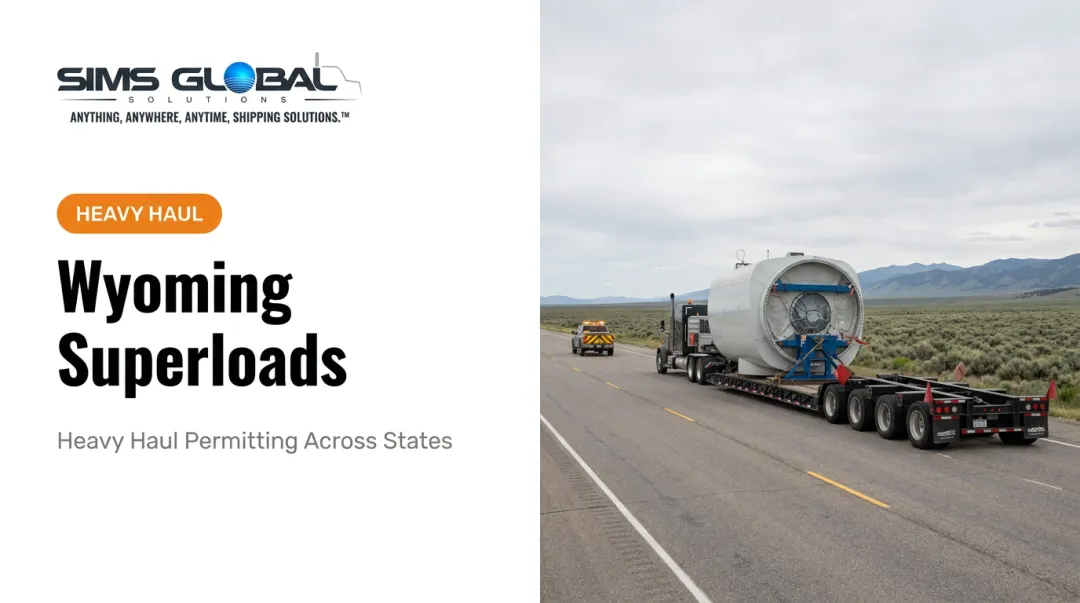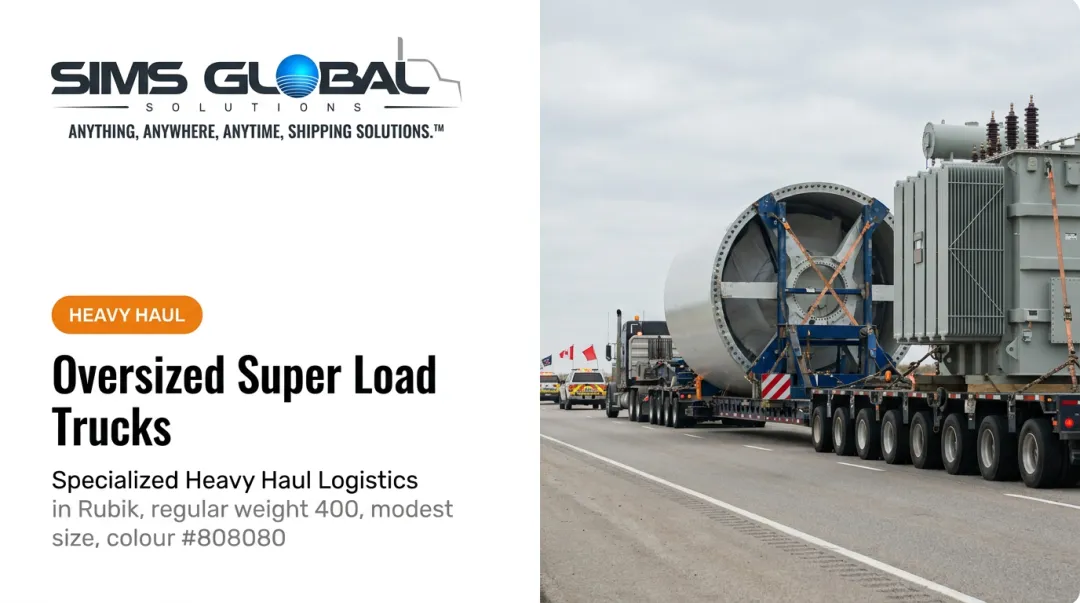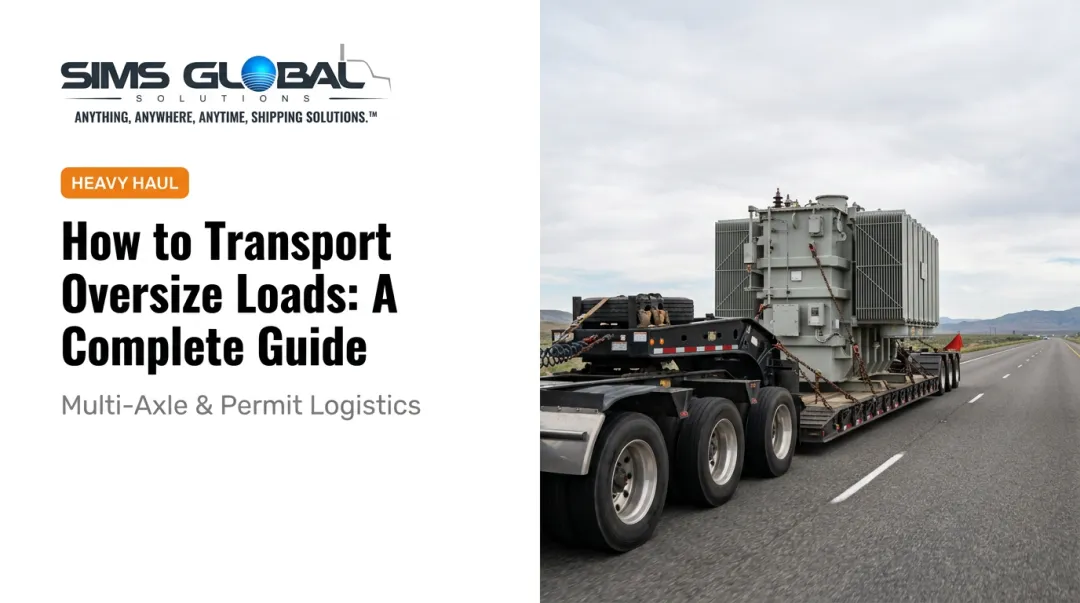

For shippers, project managers, and logistics teams dealing with construction equipment, industrial machinery, wind energy components, or prefabricated structures, the stakes are high and the margin for error is low. A missed permit, an unapproved route, or an overlooked holiday restriction can ground a multi-million dollar move before it starts.
This guide covers everything you need to plan an oversize haul confidently: what qualifies as oversize, how federal and state regulations interact, permit types and costs, route planning, safety requirements, and how to choose the right hauling partner.
Key Takeaways
- Any load exceeding federal width, weight, or state-specific height and length limits requires permits before it moves
- Each state issues its own permits — a 10-state haul means 10 separate applications with different rules and fees
- Route planning must verify bridge ratings, overhead clearances, and travel-hour restrictions before departure
- Escort requirements vary by state and load dimensions — not all states trigger escorts at the same threshold
- Working with an experienced heavy haul partner dramatically reduces permitting delays and compliance risk
What Qualifies as an Oversize Load?
The Basic Definition
An oversize load is any vehicle-and-cargo combination that exceeds one or more legal limits for width, height, length, or gross weight. Critically, the cargo must be nondivisible — meaning it cannot be broken down to meet standard dimensions without compromising its intended use, destroying its value, or requiring more than eight work hours to dismantle.
A shipper can't simply claim a load is nondivisible — the burden of proving dismantling time falls on the applicant.
Federal Baseline Thresholds
Under 23 CFR Part 658, the federal government sets these Interstate baseline limits:
| Dimension | Federal Limit |
|---|---|
| Width | 102 inches (8.5 ft) on the National Network |
| Single axle weight | 20,000 lbs |
| Tandem axle weight | 34,000 lbs |
| Gross vehicle weight | 80,000 lbs |

Federal law does not set a vehicle height limit, nor does it impose a general overall-length limit on standard tractor-semitrailers on the National Network. Height and length limits are state-specific and vary by route configuration. California and North Carolina, for example, both use a 14-foot height limit.
Oversize vs. Overweight
The distinction matters when securing permits:
- Oversize = exceeds dimensional limits (width, height, or length)
- Overweight = exceeds gross or axle weight limits
- A load can be one, both, or technically neither while still requiring flags or markings (such as a load that only exceeds length limits)
Super Loads
Super loads significantly exceed routine permit thresholds and trigger more intensive state review. There's no single federal definition — states set their own criteria. Washington state's super load review begins above 16 ft wide, 16 ft high, 125 ft load length, or 200,000 lbs. California's variance tier applies above 15 ft wide, 17 ft high, or 135 ft long. Texas classifies loads over 254,300 lbs as "superheavy."
For super loads, expect engineering studies, route surveys, and significantly longer permit processing times.
Common Oversize Load Types
Freight that commonly qualifies as oversize includes:
- Construction equipment: bulldozers, excavators, cranes, graders
- Wind turbine components: blades, nacelles, tower sections
- Power transformers and industrial generators
- Prefabricated structures and modular buildings
- Aerospace components and defense equipment
- Large industrial machinery and manufacturing equipment
Oversize Load Regulations: Federal Rules and State Variations
How Federal and State Authority Divide
The Federal Highway Administration sets baseline size and weight standards for the National Network — approximately 200,000 miles of Interstate and designated US highways. But enforcement and permitting authority rests entirely with individual states.
Here's the practical consequence: a load that's legal on an Interstate may be illegal the moment it turns onto a state or local road. Two-lane rural roads often restrict widths to 8 feet or less. States control everything from axle weight formulas to escort rules to permit fees.
How State Rules Differ
A cross-country haul through 10 states requires 10 separate permits — each with its own conditions. The variation is substantial:
| State | Width Limit | Height Limit | Notable Rules |
|---|---|---|---|
| California | 8.5 ft | 14 ft | Variance permit required 30 days before move for super loads |
| North Carolina | 8.5 ft | 14 ft | Escort thresholds begin at 12 ft 1 in |
| Texas | 8.5 ft | State-defined | Loads over 14 ft wide can't move on listed holidays |
| Washington | 8.5 ft | State-defined | Super load review above 16 ft wide or 200,000 lbs |

Travel Restrictions
Most states limit oversize movement — but the specifics vary. Common restrictions include:
- Prohibits movement after sunset in most states — Ohio (effective November 2023) bars travel from sunset to sunrise unless the permit explicitly allows it
- Bans movement on major holidays for loads exceeding dimension thresholds — Texas restricts loads over 14 ft wide, 16 ft high, or 110 ft long on days including Memorial Day and Christmas
- Imposes rush-hour travel blackouts in metro areas, often route-specific rather than statewide (Ohio uses this approach)
- Holds operations during high winds, ice, or reduced visibility as a standard permit condition
Permit conditions override general state summaries — a restriction listed online may not apply to your specific route, or your permit may grant an exception. Read each issued permit before dispatch.
Oversize Load Permits: Types, Process, and Costs
Permit Types
The two permits shippers encounter most often:
- Single-trip permits: Issued for one specific move along a defined route, with set travel dates. Required for most non-routine oversize moves.
- Annual/blanket permits: Available in some states for carriers regularly moving loads of the same dimensions. California offers annual and repetitive permits; Florida offers annual blanket and route-specific blanket options. These provide cost savings for frequent haulers but don't eliminate compliance requirements.
What a Permit Application Requires
State DOTs typically ask for:
- Carrier name, USDOT number, and contact information
- Complete load dimensions and gross weight
- Axle count, axle weights, axle spacings, and tire data
- Vehicle identification
- Origin, destination, and proposed route
- Engineering reports or route survey documentation (for super loads)
Incomplete applications cause delays. Assemble accurate load specs before applying — incomplete data triggers delays and resubmissions.
Processing Times
Processing times vary considerably — and don't follow a universal rule:
- Illinois: Most permits issue immediately
- Colorado: Routine permits take roughly two hours; super loads currently run 2–3 weeks
- California: Variance (super load) applications must be filed 30 days before the planned move
Standard moves need applications submitted at least several business days ahead. Super loads or multi-state moves may require weeks of lead time — build that buffer into your project schedule before a carrier is ever booked.
Permit Fees
Costs compound across states. Examples by state:
- Texas: $60 base fee + $375 highway-maintenance fee for superheavy permits; vehicle safety fee is $100 (no bridges crossed) or $500 (when TxDOT analyzes an engineering report)
- California: $16 single-trip; $90 annual or repetitive
- Florida: Dimensional trip fees range $5–$25; annual blanket fees $20–$250; overweight mileage rates vary by weight
- Ohio: $20 base processing fee, plus surcharges — loads over 120,000 lbs add $125 plus $0.04 per ton over 60 tons per mile
Multi-state moves stack these fees across every jurisdiction. Each state DOT runs its own portal, fee structure, and approved-route database. Coordinating those applications simultaneously — while keeping move dates aligned — is where permit management most often breaks down for shippers doing it in-house.
Route Planning and Safety Requirements for Oversize Loads
Infrastructure Constraints That Shape Every Route
Not every road can accommodate an oversize load. Before the truck moves, a route plan must identify:
- Bridge weight ratings cleared for the load's gross weight and axle configuration
- Overhead clearances at overpasses, utility lines, and traffic signals
- Road surfaces capable of supporting extreme axle weights
- Lane widths and turn radii adequate for wide loads on two-lane or urban roads
- Restricted zones where certain load configurations are prohibited entirely
For loads exceeding 16 ft high or 20 ft wide, Minnesota DOT requires a physical route survey within 14 days — and the surveyor must notify utility owners to raise or relocate overhead power lines before the move begins. Texas takes a different approach: when bridges are implicated in a superheavy permit, a full engineering review is required. Most states have comparable super load provisions; the specifics vary.

Travel Time Restrictions
Travel restrictions directly affect how long a move takes. A haul that covers 800 miles in theory might take four days in practice because:
- Daylight-only movement limits daily mileage
- Holiday blackouts can force multi-day waits
- Metro rush-hour windows may require holding the load outside city limits until off-peak hours
Build these constraints into project timelines before committing to delivery dates.
Safety Equipment and Escort Requirements
Required safety markings (enforced through state and permit conditions):
- "OVERSIZE LOAD" or "WIDE LOAD" banners on the front and/or rear
- Orange or red flags at all load extremities
- Flashing amber warning lights on the vehicle and, typically, escort vehicles
Escort (pilot car) requirements vary by state:
- North Carolina: One escort required beginning at 12 ft 1 in wide on two-lane roads, or rear escort on multilane roads
- Texas: Front escort required on two-lane roads for loads over 14–16 ft wide; both front and rear escorts required over 16 ft wide; law enforcement escorts may also be mandated by TxDMV
Lead (front) escorts warn oncoming traffic and verify clearances. Chase (rear) escorts protect traffic approaching from behind. Don't assume the thresholds are the same from state to state — check each permit.
Load Securement Standards
Load securement must meet federal standards under 49 CFR Part 393: systems rated to withstand 0.8g forward and 0.5g rearward/lateral force. Heavy vehicles or equipment at 10,000 lbs or more require at least four tiedowns, with accessories lowered and secured and articulation restrained.
Cost Factors for Oversize Load Hauling
No standard per-mile rate exists for heavy haul freight. The variables are too numerous, and every move requires a custom quote. Key cost drivers include:
- Base freight rate: Mileage, load dimensions, and required trailer configuration
- Permit fees: Per state, per trip, which compound across multi-state moves as shown above
- Escort costs: Multiply for each required pilot car; law enforcement escorts add further cost
- Specialized equipment: RGN (removable gooseneck) trailers, lowboys, step decks, extendable trailers, and multi-axle configurations each have different rental or ownership costs
- Route survey fees: Required for super loads and over-height shipments
- Engineering fees: Bridge analysis or structural review when implicated
- Seasonality and timing: Holiday blackouts that extend transit time increase costs; time-sensitive moves carry higher rates
- Fuel surcharges: Applied as a percentage of base rate, varying with market conditions

The widest and heaviest loads are exponentially more expensive than loads that barely exceed standard limits. A load requiring two escorts, an engineering study, and a variance permit in California costs far more than a modestly oversized piece moving on a single-trip permit through one state.
How to Choose the Right Oversize Load Hauling Partner
The wrong hauling partner turns an oversize move into a compliance problem, damaged freight, and project cost overruns. Evaluate any potential hauling partner against these criteria:
- Verified oversize experience: Prior moves at comparable dimensions and weight, not just general freight history
- FMCSA authority and SAFER record: Check carrier records directly at SAFER Web — confirm authority, insurance, and operating history
- Specialized equipment access: RGN trailers, lowboys, step decks, extendable trailers, and multi-axle configurations for the right load type
- Multi-state permitting capability: Can they manage permit applications across all states in the route simultaneously, or will you be coordinating that yourself?
- Route survey resources: For super loads, does the partner have established relationships with route survey providers and utility companies?
- Cargo and liability insurance: Verify coverage limits directly — don't accept verbal assurances
- Real-time visibility: Tracking capability during the move, not just check-in calls
Sims Global Solutions operates as both an asset-based carrier and a brokerage network for complex oversize moves. With 35,000+ truckload carriers, owned heavy haul assets (including RGN, lowboy, and multi-axle trailer configurations), and the SimsTrak TMS platform for real-time GPS visibility, Sims handles oversize freight across all 50 states.
Their in-house heavy haul team covers equipment selection, route planning, permitting, and en route coordination through a structured process on every move — giving shippers a single point of accountability from quote to delivery.
For a quote or consultation, contact Sims Global Solutions at 855-326-8671 or via shipsims.com.
Frequently Asked Questions
How much does an oversized load cost?
Oversize haul costs vary significantly based on distance, load dimensions, number of states crossed, required escorts, trailer type, and permit fees that compound across every state on the route. There's no standard per-mile rate for heavy haul. Request a custom quote with your load's exact dimensions, weight, origin, and destination for accurate pricing.
How much is an oversize permit in Texas?
Texas superheavy single-trip permits carry a $60 base fee, a $375 highway-maintenance fee, and a vehicle safety fee of $100 (no bridges) or $500 (TxDOT engineer report required). Standard oversize permits use different fee structures. Contact TxDMV or a permit service for the rate that applies to your specific load and route.
What is considered an oversize load?
Any vehicle-and-cargo combination exceeding the federal 102-inch (8.5 ft) width limit on the National Network, the 80,000 lb gross weight limit, or applicable state height and length limits qualifies as oversize. Height and length thresholds vary by state ; California and North Carolina, for example, both use a 14-foot height limit. The load must also be nondivisible.
Do I need a separate permit for each state my oversize load passes through?
Yes. Each state issues its own permit covering fees, approved routes, travel restrictions, and escort requirements — a haul crossing 10 states means 10 separate applications, typically submitted simultaneously. Coordinating this across multiple state DOTs is one of the most complex parts of any oversize move.
What are the escort vehicle requirements for oversize loads?
Escort thresholds and configurations vary by state. North Carolina triggers a front escort requirement at 12 ft 1 in wide on two-lane roads; Texas generally requires escorts for loads over 14 ft wide, with both front and rear escorts above 16 ft wide. Some states also mandate law enforcement escorts for the largest loads. Always verify requirements against each state permit.
How far in advance should I apply for an oversize load permit?
Lead times range from hours (standard single-trip permits in many states) to 30 days (California variance applications) or 2–3 weeks for super loads in states like Colorado. Multi-state moves require coordinated applications across all states simultaneously. Build permit timelines into your project schedule before locking in a delivery date.