The catch is that these models solve different problems. Pick the wrong one, and you either pay for strategic oversight you don't need or hand over control you can't afford to lose.
The stakes are real. The U.S. third-party logistics market hit an estimated $323.4 billion in gross revenue in 2025, up 5.0% year over year, according to Armstrong & Associates. That's a massive, fast-growing space with a lot of providers competing for your freight budget.
This article breaks down what 3PL and 4PL actually mean, compares them side by side, and gives you clear criteria for choosing the right one.
Key Takeaways
- 3PLs execute hands-on logistics; 4PLs orchestrate the entire supply chain
- 3PLs typically own trucks and warehouses; 4PLs stay asset-light, focusing on vendor coordination
- Most mid-market and growing businesses do best with a capable, tech-enabled 3PL
- 4PLs make sense for large enterprises juggling multiple providers across regions
- The two models often work together, not against each other
3PL vs 4PL: Quick Comparison
Here's the fast version, before we dig into details:
| Factor | 3PL | 4PL |
|---|---|---|
| Primary Focus | Day-to-day execution — storage, transportation, fulfillment | End-to-end supply chain strategy and coordination |
| Asset Ownership | Typically owns or operates warehouses, trucks, equipment | Usually asset-light; provides technology and vendor management |
| Point of Contact | Multiple contacts by service type | Single point of contact across all logistics partners |
| Cost Structure | Transactional pricing tied to specific services/lanes | Management fees layered on top of underlying 3PL costs |
| Best Fit | SMBs, growing e-commerce and manufacturing brands | Large enterprises managing multiple providers or regions |
If you need boots on the ground moving freight, that's a 3PL question. Need someone to manage your entire logistics network across providers and regions instead? That's a 4PL question. Sims Global Solutions runs both models, so you can start with hands-on execution support and scale into full network management as your operation grows.
What Is a 3PL?
A third-party logistics provider manages logistics operations on your behalf using its own infrastructure: warehouses, trucks, and trained staff. It's the operational bridge between your business, your carriers, and your customers.
Core services typically include:
- Warehousing and inventory management
- Order fulfillment, including pick and pack
- Truckload, LTL, and intermodal transportation
- Drayage and port operations
- Reverse logistics and returns handling
These benefits are concrete and immediate. Working with a 3PL means you avoid sinking capital into warehouse leases or a private fleet. You scale up during demand spikes without hiring a logistics department overnight. And you get access to negotiated freight rates that would take years to build in-house.
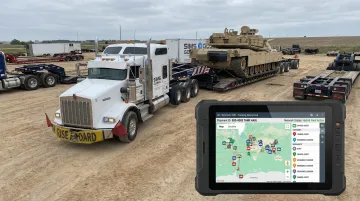
Sims Global Solutions illustrates this model well. The company runs a hybrid operation, owning a heavy haul fleet (RGN, lowboy, and multi-axle trailers) while also brokering through a network of 150,000+ vetted carriers.
That combination gives shippers multi-modal flexibility across LTL, truckload, expedited, and specialized freight. Everything runs through the SimsTrak TMS, so shippers get that flexibility without owning a single truck.
Use Cases of 3PL
3PLs fit best when a company needs to outsource execution but wants to keep strategic control, keeping sales, branding, and customer relationships in-house.
This model dominates in:
- Retail and e-commerce
- Furniture and white-glove delivery
- Material handling equipment
- Manufacturing, especially heavy or oversized freight
Adoption at the top of the market tells the story. 94% of Fortune 500 companies now work with at least one 3PL, up from just 46% in 2001, according to Armstrong & Associates. That adoption curve shows 3PL use has become standard practice for companies of every size.
What Is a 4PL?
A fourth-party logistics provider, sometimes called a Lead Logistics Provider, sits a level above execution. It manages your entire supply chain strategy, often without owning any physical assets, and acts as a single point of contact across multiple providers.
Analysts have formalized this role: Gartner defines the model around design, build, run, measurement, and orchestration of an end-to-end logistics network, coordinated through an integrated technology platform. That's a mouthful, but the practical translation is simple: a 4PL doesn't move your freight. It manages the companies that do.
Core responsibilities include:
- Coordinating multiple 3PL relationships across regions or service types
- Integrating technology for unified data visibility
- End-to-end network planning and performance measurement
The value here is centralized control. Instead of your team juggling five vendor contacts, one 4PL becomes the single throat to choke. That reduces management burden and keeps service standards consistent across a fragmented network.
That centralized control only holds up if the 4PL stays neutral. A true 4PL doesn't push its own transportation or warehousing business; instead, it stays independent, making unbiased calls about which providers actually serve you best.
Use Cases of 4PL
4PLs fit large enterprises with fragmented logistics spread across multiple regions, providers, or international markets that need centralized strategic oversight.
Common industries include:
- Global manufacturers with multi-country supply chains
- Multinational retailers managing regional fulfillment networks
- Companies coordinating several fulfillment partners simultaneously
The category is growing, though forecasts vary widely by source. Market Research Future projects the global 4PL market at $72.10 billion in 2025, growing to $158.61 billion by 2035 at an 8.20% CAGR. Different estimates in the same report put the 2025 figure closer to $73.92 billion.
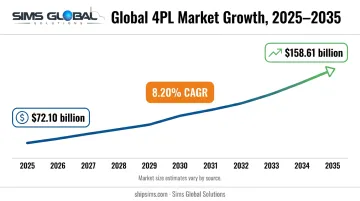
That gap shows 4PL market sizing is still evolving. Still, the growth trend stays consistent across sources.
3PL vs 4PL: Which Model Should You Choose?
The decision usually comes down to four factors:
- Company size and growth stage: startups and mid-market businesses rarely need orchestration-level services
- Number of logistics partners or regions: one region, one warehouse network is a different problem than five countries and a dozen vendors
- Internal bandwidth: do you have a team that can manage supply chain oversight, or do you need someone else to own that entirely?
- Desired control: how much day-to-day decision-making do you want to keep in-house?
Choose a 3PL if you need hands-on warehousing, fulfillment, and transportation support while keeping strategic control internal. Choose a 4PL if you're already managing several vendors across regions and need one strategic partner running the whole show.
Real-World Example: Scaling With the Right Logistics Partner
Picture a mid-market manufacturer shipping heavy equipment and standard freight across the country. Order volume is climbing faster than their in-house team can handle. Freight costs are inconsistent because they're juggling multiple regional carriers with no centralized visibility, and fulfillment delays are starting to hurt customer relationships.
The instinct might be to bring in a 4PL to manage the chaos. But for a company this size, that often adds cost and complexity without fixing the real problem: weak execution on existing freight volume.
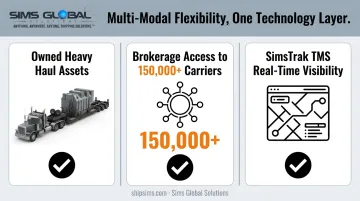
Instead, this is exactly the situation a tech-enabled 3PL like Sims Global Solutions is built for. A capable 3PL brings:
- Owned heavy haul assets for specialized loads
- Brokerage access to 150,000+ carriers for everything else
- SimsTrak TMS for real-time tracking and consolidated visibility
Together, these give a shipper multi-modal flexibility and a single technology layer, without paying for a management tier they don't need yet.
The takeaway: most growing businesses get more value from a capable, well-connected 3PL than from adding a costly 4PL layer on top. If your freight is scaling and your visibility isn't keeping up, talk with the Sims Global Solutions team about building a scalable, multi-modal strategy before considering a 4PL.
Conclusion
The right choice between 3PL and 4PL depends on where your business stands today, not on which model is objectively better. A 3PL suits companies that want hands-on execution support while keeping strategic control. A 4PL suits enterprises juggling multiple providers and regions that need centralized oversight.
The outcomes differ too. 3PL users get cost predictability, faster scaling, and operational simplicity. 4PL users get centralized visibility and reduced complexity across sprawling networks. Many businesses today can meet both needs by partnering with a tech-forward 3PL like Sims Global Solutions, which pairs owned assets and broad carrier access with unified technology in one relationship.
Frequently Asked Questions
What is the difference between 3PL and 4PL?
A 3PL executes physical logistics, including warehousing, transportation, and fulfillment, using its own assets and staff. A 4PL manages and coordinates the entire supply chain, often overseeing multiple 3PLs, without necessarily owning any assets itself.
What is the difference between 3PL, 4PL, and 5PL?
A 3PL executes specific logistics functions, while a 4PL orchestrates multiple 3PLs and overall strategy. A 5PL takes this further, managing entire supply chain networks across multiple clients through advanced technology and large-scale optimization.
Can a 3PL evolve into a 4PL?
Some 3PLs expand into analytics, reporting, and multi-vendor coordination. But a true 4PL operates as an independent, vendor-neutral orchestrator, not simply a 3PL with extra features layered on top.
Is a 4PL more expensive than a 3PL?
Generally, yes. A 4PL adds a management and coordination fee on top of underlying 3PL costs. Working directly with a 3PL is usually more cost-effective, especially when you can negotiate rates directly.
How do I decide between a 3PL and a 4PL for my business?
Base it on company size, number of logistics partners or regions, internal bandwidth for oversight, and how much control you want to retain. Most growing and mid-market businesses start with a 3PL.
Can 3PL and 4PL providers work together?
Yes. The models are often complementary: a 4PL provides high-level governance while individual 3PLs handle day-to-day execution within that structure.