Introduction
You booked standard LTL rates. Then the carrier's dock team measured your pallet and called it oversized. Suddenly you're staring at a reclassification, an accessorial fee, or worse, a refused pickup.
This happens more often than shippers expect. "Oversized" isn't a fixed number: it depends on dimensions, weight, cubic density, and which carrier's tariff you're working under. A 48" x 48" pallet might sail through one carrier's network and trigger extra fees at another.
This guide breaks down what actually counts as an oversized pallet, the common sizes and weight ranges shippers run into, and how to ship these loads without getting hit with surprise charges.
Key Takeaways
- Oversized status depends on footprint, height, weight, and density, not just size.
- The 48" x 40" GMA pallet sets the U.S. baseline; bigger sizes trigger reclassification.
- Overlength fees often start around 8 feet, with charges climbing fast beyond that
- Some oversized freight requires flatbed or heavy haul equipment, not standard dry van LTL.
- Accurate upfront measurements prevent the most common (and costly) shipping surprises
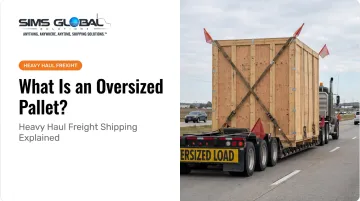
What Is an Oversized Pallet?
Every freight class system in the U.S. is built around one reference point: the GMA pallet, measuring 48" x 40". Carriers size their trailers, dock equipment, and rate tables around this footprint, according to Kamps' standard pallet sizes chart. Anything meaningfully bigger starts to strain the system.
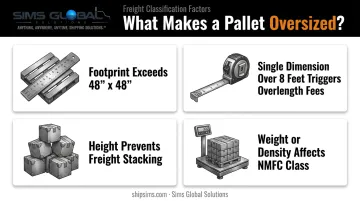
An oversized pallet is generally any palletized shipment that exceeds the length, width, or height thresholds a carrier can handle without special accommodation. In practice, that usually means:
- A footprint larger than roughly 48" x 48"
- A single dimension long enough to trigger a carrier's overlength provisions (often 8 feet or more)
- Height that prevents other freight from stacking above it
- Weight or density that changes how the shipment prices under NMFC rules
It's Footprint AND Density
Here's where a lot of shippers get tripped up. Freight classification doesn't just look at how big something looks on the dock. It factors in density, meaning weight divided by cubic footage. Two pallets can share the exact same footprint, but the lighter, bulkier one may classify differently than the dense, compact one.
So when someone asks "what is considered an oversized pallet," there's no single answer. It depends on both the physical box the freight occupies and how that space translates into class and rate under the carrier's tariff.
Clearing Up the 40x48 Confusion
One of the most common questions we hear is whether a 40" x 48" pallet counts as oversized. It doesn't. That's simply the GMA standard pallet with the length and width written in reverse order. Same footprint, same standard status.
A Real-World Example
Picture a crated CNC machine that's 9 feet long, banded to a standard pallet base. The pallet itself might be a normal size, but the overall handling unit, crate included, exceeds most carriers' overlength thresholds. That single dimension is enough to force an oversized booking, regardless of what the base pallet measures.
Common Oversized Pallet Sizes & Weight Limits
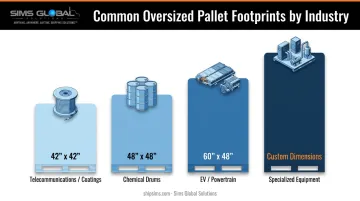
Not every oversized pallet is custom-built. Several non-standard footprints show up regularly across specific industries:
- 42" x 42" — common in telecommunications and coatings; originally designed around military mortar rounds
- 48" x 48" — frequently used for chemical drum transport
- 60" x 48" — used in EV/powertrain and heavier industrial applications
- Fully custom dimensions — built around one specific piece of equipment or product
Weight Capacity Varies by Construction
Pallet weight capacity isn't a simple wood-versus-plastic comparison. It depends on the specific model, support mode, and how the load is distributed. Some reference points from manufacturer data:
| Pallet Footprint | Documented Safe Load |
|---|---|
| 48" x 40" wood | ~4,592 lbs |
| 42" x 42" wood | ~4,445 lbs |
| 48" x 48" wood | ~4,673 lbs |
| 40" x 48" reinforced plastic (edge-racked) | 2,800+ lbs |
These figures come from manufacturer load charts, not carrier acceptance limits. A carrier's per-piece weight limit can be lower than what the pallet itself is rated to hold. That safe-load number is only part of the equation, though—the pallet's own construction adds to the total shipment weight before any freight goes on top.
How Much Does an Oversized Pallet Actually Weigh?
Two things drive total weight: the pallet's own construction and the cargo loaded on it. Reinforced stringers and heavier decking, common on oversized or custom pallets, can add 100 to 200 pounds before you even load freight. Total shipment weight for billing purposes always includes both, so a heavier pallet directly affects what you pay.
Weight Breaks and Pricing Tiers
Carriers price freight in weight tiers, and crossing into a higher bracket can actually lower your rate per hundredweight—even though your total billable weight goes up. This is sometimes called deficit weight pricing. It's why two shipments of similar size can price very differently depending on where they land in the carrier's tier structure.
Custom-built pallets exist for exactly this reason. When a single heavy or irregular piece needs support beyond what a standard pallet offers, manufacturers build a reinforced pallet specifically for that load.
Why Pallets Become Oversized
Most oversized classifications don't stem from the pallet's design. Instead, the issue usually comes from the freight loaded onto it.
Common industries that encounter this issue include:
- Aerospace & defense (crated components, tooling, ground support equipment)
- Material handling (forklifts, racking systems, conveyors)
- Furniture (case goods, upholstered pieces, showroom fixtures)
- Event and concert equipment (staging, lighting rigs, audio gear)
These sectors regularly ship freight that simply doesn't fit a standard footprint, regardless of how it's palletized.
But an item's width and length aren't the only factors.
Stacking Can Push You Over the Line Too
It's not always one giant piece of equipment. Combining multiple boxes on a single pallet, or stacking beyond a carrier's standard height allowance, can move an otherwise ordinary shipment into oversized territory. If nothing else can be stacked above your freight because of its height, carriers often bill that unused space as part of your cubic footprint.
How Oversized Pallets Affect Freight Costs & Shipping Method
This is where oversized classification actually hits your budget.
Freight Class Changes
NMFC classification runs on density, calculated by dividing the handling unit's cubic feet (length × width × height) by its weight. According to NMFTA's freight classification guidance, larger dimensions at the same weight lower your density and often push you into a higher, pricier class. Bigger box, same cargo, higher rate.
Accessorial Fees Add Up Fast
Carriers charge separately for overlength freight, and these fees scale quickly. Estes Express, for example, publishes the following overlength schedule:
| Longest Dimension | Fee |
|---|---|
| 8 ft to under 12 ft | $300 |
| 12 ft to under 16 ft | $600 |
| 16 ft to under 20 ft | $850 |
| 20 ft or more | $1,000 |
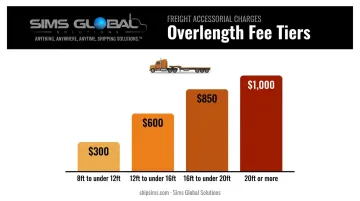
Source: Estes Express accessorial charges schedule.
Beyond overlength, watch for additional handling charges and inside delivery adjustments, all of which stack on top of your base freight rate.
When You Need Flatbed or Heavy Haul Equipment
Some freight simply won't fit inside an enclosed trailer. When width, height, or length exceeds what a dry van can safely handle, you're looking at flatbed, step-deck, or heavy haul equipment instead. Extra-wide or extra-tall loads may also require state permits, since federal law leaves permit issuance to individual states rather than a national standard.
Dimensional Weight vs. Actual Weight
Carriers bill based on whichever produces the higher charge: actual scale weight, or the dimensional/density calculation based on your cubic footprint. Oversized freight almost always trips the dimensional side of that equation, since low density paired with large cube inflates your billable weight.
This is exactly where having flexibility matters. Sims Global Solutions operates both an LTL brokerage network and its own Heavy Haul division, running RGN, lowboy, and multi-axle trailers.
That combination means an oversized shipment can move straight to the right equipment upfront. It won't get reclassified, delayed, or hit with fees after a carrier already has it on the dock.
Best Practices for Shipping Oversized Pallets Safely
Getting an oversized pallet from dock to destination without damage or disputes comes down to preparation.
Before booking:
- Measure the complete handling unit, including pallet, crate, wrap, and any protrusions
- Weigh the pallet and cargo together, not separately
- Document dimensions and weight consistently on your quote and bill of lading
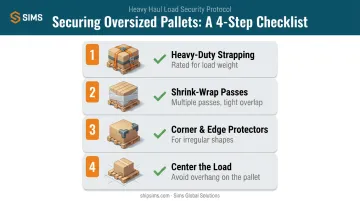
Securing the load:
- Use heavy-duty strapping rated for the load's weight
- Apply multiple shrink-wrap passes with tight overlap, anchored to the pallet base
- Add corner or edge protectors where straps could crush irregular shapes
- Keep the load centered on the pallet to avoid overhang, which exposes freight to abrasion and compression damage
Labeling:
Mark oversized shipments clearly with actual dimensions so dock staff and carriers can plan equipment and floor space before the truck arrives. Skipping this step is one of the most common reasons oversized freight gets delayed or refused at pickup. Partnering with a heavy haul specialist like Sims Global Solutions helps verify these details before dispatch.
How Sims Global Solutions Simplifies Oversized Pallet Shipping
Shipping oversized freight without the right tools usually means bouncing between carriers, re-quoting after the fact, and disputing charges you didn't expect. Sims Global Solutions built its process to avoid that from the start.
- SimsTrak, the company's proprietary TMS and CRM platform, delivers real-time quoting and tracking through direct API integrations with 70+ LTL carriers
- Access to 150,000+ carriers, plus a dedicated Heavy Haul Trucking team for oversized loads like crated machinery and construction equipment
- 24/7 agent support and a dedicated operations team that resolves freight class questions and accessorial charges before they hit your invoice
Because Sims Global Solutions operates its own heavy haul fleet alongside its brokerage network, shippers aren't stuck choosing between "cheap but wrong equipment" and "right equipment but no visibility." Both options sit under one roof.
Frequently Asked Questions
What is considered an oversized pallet?
An oversized pallet is a shipment exceeding standard footprint (beyond 48" x 48"), height, or weight thresholds set by carriers. Classification depends on both physical dimensions and cubic density, not visual size alone.
How big is a 40x48 pallet?
A 40" x 48" pallet is a standard size, identical to the common GMA 48" x 40" pallet with dimensions listed in reverse order. It is not considered oversized under any carrier's tariff.
How much does an oversized pallet weigh?
Pallet weight varies with construction. Reinforced oversized pallets weigh more than standard ones due to added stringers and decking. Total shipment weight always includes both the pallet and the cargo loaded on it.
What is a large box on a pallet called?
Large industrial cartons placed on pallets are commonly called gaylord boxes or bulk boxes. These bulk containers are typically used for storing and transporting loose or granular industrial materials.
Do oversized pallets cost more to ship?
Yes. Oversized freight often shifts into a higher NMFC class and triggers accessorial fees like overlength charges. It may also require specialized flatbed or heavy haul equipment, which adds to the total cost.
What is the maximum pallet size for LTL shipping?
There's no single industry-wide maximum. Thresholds vary by carrier, but shipments significantly exceeding 48" x 48" footprint or standard height typically require special handling, added fees, or alternate equipment.