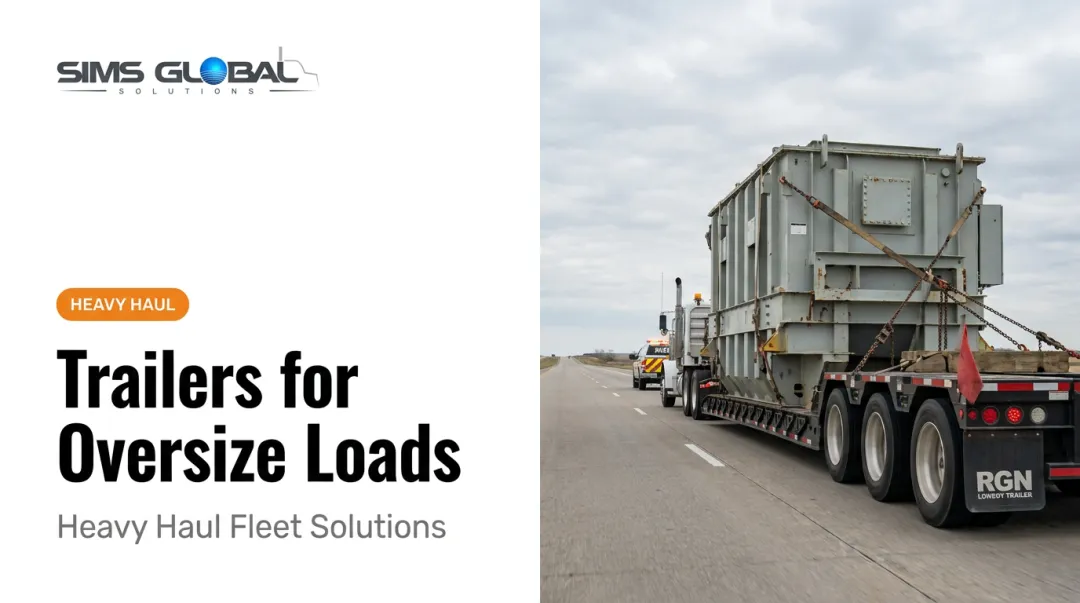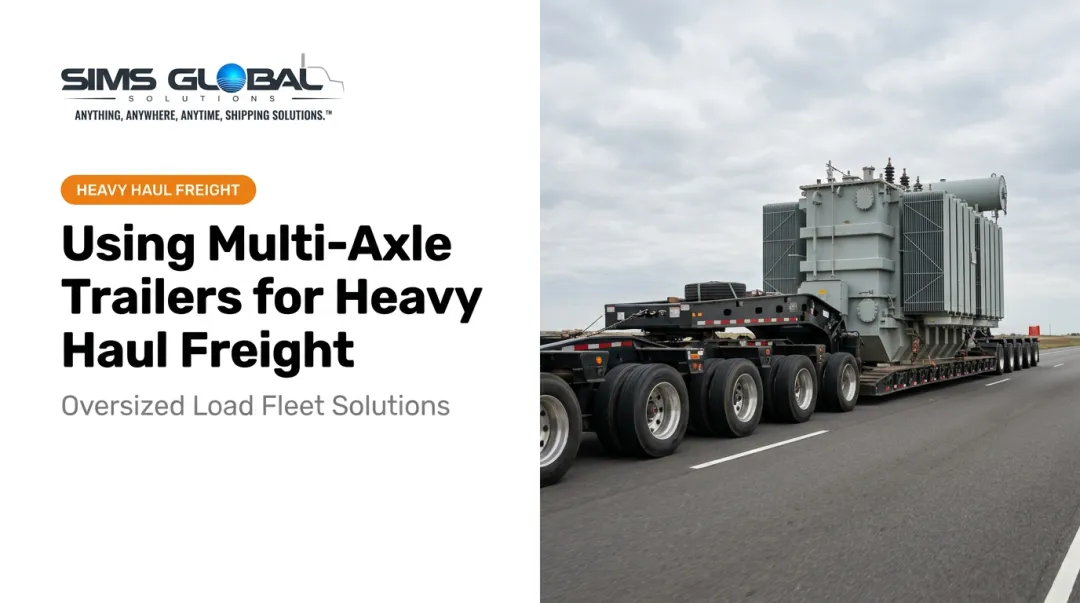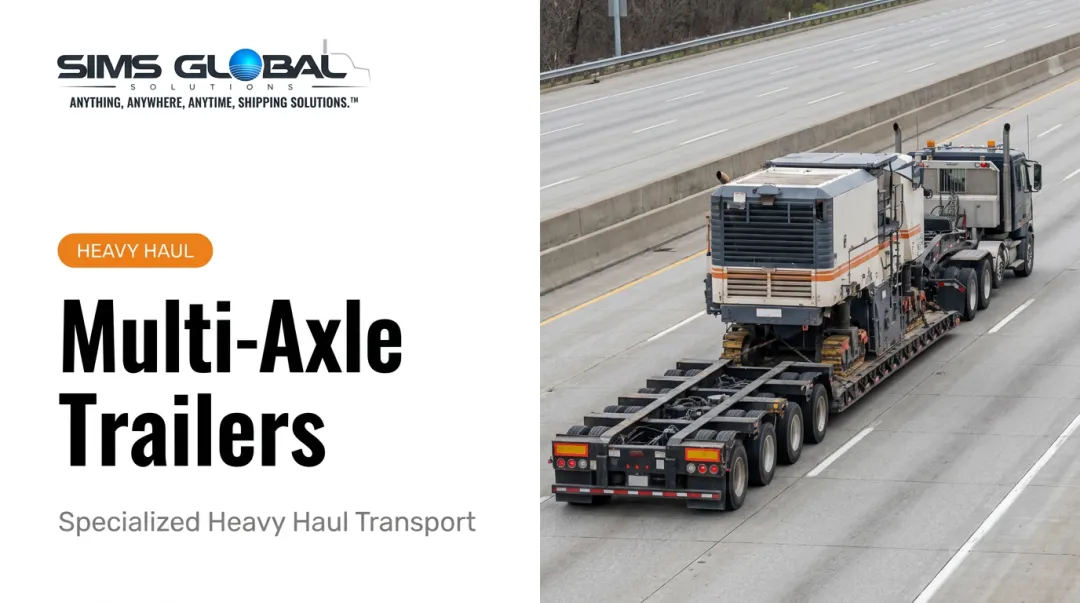
Shippers researching this equipment often hit a wall. What exactly is a 19-axle trailer? How is it configured? Who's even allowed to operate one? This guide breaks down the build, the cargo it serves, the regulations behind it, and how to find a transport partner who actually knows the space.
Key Takeaways
- A 19-axle combination is typically required once gross freight weight exceeds roughly 150,000 lbs
- These setups pair a 4-axle truck with a 15-axle trailer, jeep dolly, and booster system
- The Federal Bridge Formula and state-specific permitting dictate exact axle counts and spacing
- Legal payload varies by axle rating; Faymonville's HighwayMAX-3 reaches about 240,000 lbs
- Moving freight at this scale demands an experienced, asset-based heavy haul partner like Sims Global Solutions
What Is a 19-Axle Heavy Haul Trailer?
A 19-axle heavy haul trailer is a specialized multi-unit combination engineered to spread extremely heavy, concentrated loads across enough axles to satisfy the Federal Bridge Formula and state weight limits. Without that axle count, the load simply can't stay road-legal.
Here's the distinction that trips up a lot of researchers: "19 axles" refers to the entire combination, not the trailer by itself. That total includes the truck tractor, a jeep dolly, the main trailer deck, and a booster (sometimes called a stinger) at the rear.
Weight Capacity: What 19 Axles Can Actually Haul
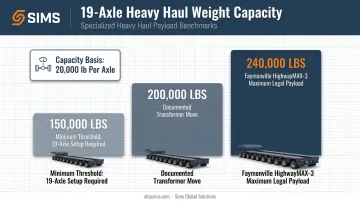
This configuration generally comes into play once cargo weight crosses the 150,000 lb mark. On the high end, real-world examples push well past that:
- Faymonville's HighwayMAX-3 combination carries roughly 240,000 lbs of legal payload
- That capacity is based on a 20,000 lb per axle loading standard
- One documented move used this configuration to haul a 200,000 lb transformer
Deck configurations vary by manufacturer and load type. Some 19-axle systems use extendable loading platforms that stretch to 82 feet to accommodate long, awkward cargo like pressure vessels or turbine sections.
Exact legal payload always depends on the specific equipment, materials, and axle weight ratings involved. Confirm specifications with both the equipment provider and every state along the route.
How Are 19-Axle Trailer Configurations Built?
Breaking this down into its parts makes the "19 axles" figure much less abstract.
The Four Building Blocks
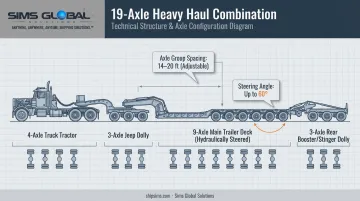
A typical 19-axle combination is built from:
- A 4-axle truck tractor - the power unit pulling the entire combination
- A jeep dolly (often 3 axles) - a sliding fifth-wheel/kingpin unit positioned between the truck and the main trailer
- The main trailer deck - where the actual cargo sits, often with multiple hydraulically steered axle lines
- A rear booster or stinger dolly (often 3 axles) - positioned behind the main deck
The jeep dolly extends the wheelbase and helps distribute weight more evenly across the front portion of the load. That matters for cargo like industrial tanks and generators, where concentrated weight in one spot can blow past axle limits fast.
The booster does similar work at the back. It bears tail weight and, on many modern systems, includes steering capability that makes tight turns and off-ramps far more manageable than they'd be with a fixed rear axle group.
Real-World Example: Faymonville HighwayMAX Dolly & Booster
Faymonville's HighwayMAX Dolly & Booster illustrates how this looks in practice. According to Overdrive's coverage of the launch, the setup combines 9 hydraulically steered pendle axles with a 3-axle jeep dolly and a 3-axle nitro booster, forming a 19-axle combination once the tractor is included.
| Specification | Detail |
|---|---|
| Main trailer axles | 9 hydraulically steered |
| Jeep dolly | 3 axles |
| Booster | 3 axles |
| Payload basis | ~20,000 lbs per axle |
| Axle group spacing | 14-20 ft, adjustable |
| Steering angle | Up to 60 degrees |
Both the jeep and booster are detachable. That means one trailer system can be reconfigured for different loads, sometimes running as a 9-axle, 12-axle, or full 15-axle towed unit, instead of a fleet needing several dedicated trailers for each job.
Depending on load height, length, and terrain, some moves at this scale also call for a second tractor or additional pusher trucks to help manage grades and turns.
Common Cargo & Industries That Require 19-Axle Trailers
Freight this heavy doesn't come from just anywhere. It tends to show up when a single fabricated component can't be broken into smaller pieces without adding cost, risk, or engineering headaches.
Typical cargo includes:
- Industrial tanks and pressure vessels
- Boilers
- Large generators
- Transformers
- Heavy fabricated steel structures
Industries that regularly generate this class of freight include aerospace & defense, material handling, and energy or industrial manufacturing, where oversized, single-piece components are simply part of doing business. Sims Global Solutions regularly moves freight for these sectors, coordinating permitting and equipment for each load.
Every one of these moves demands a meticulous route survey. Bridge weight limits, tunnel clearances, and overhead obstructions vary state by state, and what clears in one jurisdiction might not clear 50 miles down the road. That's before permitting even enters the picture.
Weight Distribution, Axle Ratings & Legal Requirements
This is where a lot of the confusion around 19-axle trailers actually lives, and it's worth separating fact from folklore.
You'll sometimes hear haulers reference a "60/40" weight split as a rule of thumb, loosely meaning more weight toward the rear axle group and less toward the front. In practice, that concept applies more directly to consumer trailer loading than to permitted heavy-haul engineering. For a 19-axle combination, actual weight distribution comes down to route-specific calculations, not a fixed ratio.
What Really Determines Axle Count
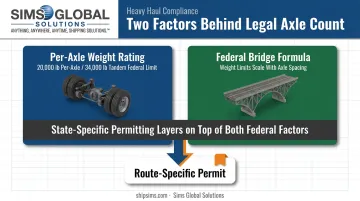
Two things drive how many axles a load actually needs:
- Per-axle weight ratings. The HighwayMAX-3 above runs a 20,000 lb per-axle legal basis, matching federal Interstate limits that cap a tandem group at 34,000 lbs, per FHWA's Bridge Formula guidance.
- The Federal Bridge Formula. It sets the maximum weight allowed across a group of axles based on their spacing — the real mechanism, not a fixed percentage, that determines legal axle spacing for a permitted heavy-haul move.
States layer their own rules on top of these federal baselines, and those rules shift over time. That's why every 19-axle shipment needs route-specific permitting rather than a one-size-fits-all approval.
CDL and Permit Requirements
Operating a commercial 19-axle, 150,000+ lb combination requires a Class A CDL. Under FMCSA's licensing rules, Class A applies once a combination's gross weight rating hits 26,001 lbs or more with a towed unit over 10,000 lbs.
That's a completely different regulatory tier than someone pulling a smaller personal-use trailer, where licensing thresholds and exemptions vary by state and are far less involved.
Beyond the CDL, expect these requirements at scale:
- Multi-state oversize/overweight permits for every jurisdiction on the route
- Pilot cars or escort vehicles, and sometimes police escorts, depending on load dimensions
- Restricted travel windows that avoid rush hour and certain bridge crossings
Working with a carrier or broker who actively tracks these evolving state rules is what keeps a shipment moving instead of stuck at a weigh station waiting on paperwork. Sims Global Solutions, for example, runs this permitting oversight through an in-house carrier procurement team dedicated to exactly this kind of route-by-route compliance work.
Why Work With Sims Global Solutions for 19-Axle Heavy Haul Shipments
Freight at this scale isn't something you want to hand off to just anyone with a load board account. Sims Global Solutions operates its own heavy haul trucking assets, including RGN, lowboy, double drop, and multi-axle trailers.
That owned fleet is backed by a network of more than 150,000 vetted carriers, giving shippers access to specialized equipment many traditional brokerages simply can't reach.
Owning the equipment is only half the equation. Behind every move sits the SimsTrak Transportation Management System, paired with a dedicated Heavy Haul Trucking team handling real-time tracking, permitting coordination, and route planning across all 50 states.
Sims works with sectors where oversized, heavy freight is routine, including:
- Aerospace & defense
- Material handling equipment manufacturers
- Fortune 100 manufacturers
Got a shipment approaching the 150,000 lb mark? Request a quote from a Sims heavy haul team that understands both the equipment and the regulatory maze around it.
Frequently Asked Questions
What is the 60/40 rule for trailer axles?
The 60/40 rule shifts more weight to the rear axle group while keeping steer axles within limits. For 19-axle heavy haul moves, distribution actually follows the Bridge Formula and route permits, not a fixed ratio.
How much does a 19 ft trailer weigh?
A standard 19-foot utility trailer weighs roughly 800-1,000 lbs empty. A 19-axle heavy haul rig is different, built to carry 150,000+ lbs of cargo, not weigh that much itself.
What are standard trailer axle sizes?
Heavy haul axle ratings vary by manufacturer and suspension type, but most multi-axle systems run on a roughly 20,000 lb per-axle legal basis. That figure determines how many axles a load requires.
Do I need a CDL to pull a 20,000 lb trailer for personal use?
Personal-use CDL rules depend on your rig's gross weight rating and vary by state. Commercial 19-axle, 150,000+ lb combinations always require a Class A CDL plus oversize permits, well beyond typical personal towing.
How much weight can a 19-axle trailer haul?
These rigs typically haul freight in the 150,000 to 225,000+ lb range, with some systems rated higher. Faymonville's HighwayMAX-3, for example, carries about 240,000 lbs at 20,000 lbs per axle.
How do I get permits for an oversized 19-axle load?
States issue these permits individually, often requiring route surveys and bridge analysis. Most shippers rely on an experienced heavy haul provider such as Sims Global Solutions rather than handle multi-state permitting alone.