
Introduction
You've got an excavator, a piece of production machinery, or a generator that's too tall for a standard flatbed. Standard equipment tops out around 8-8.5 feet of deck-to-ground clearance before you're staring down oversize permits, escort vehicles, and route restrictions in nearly every state.
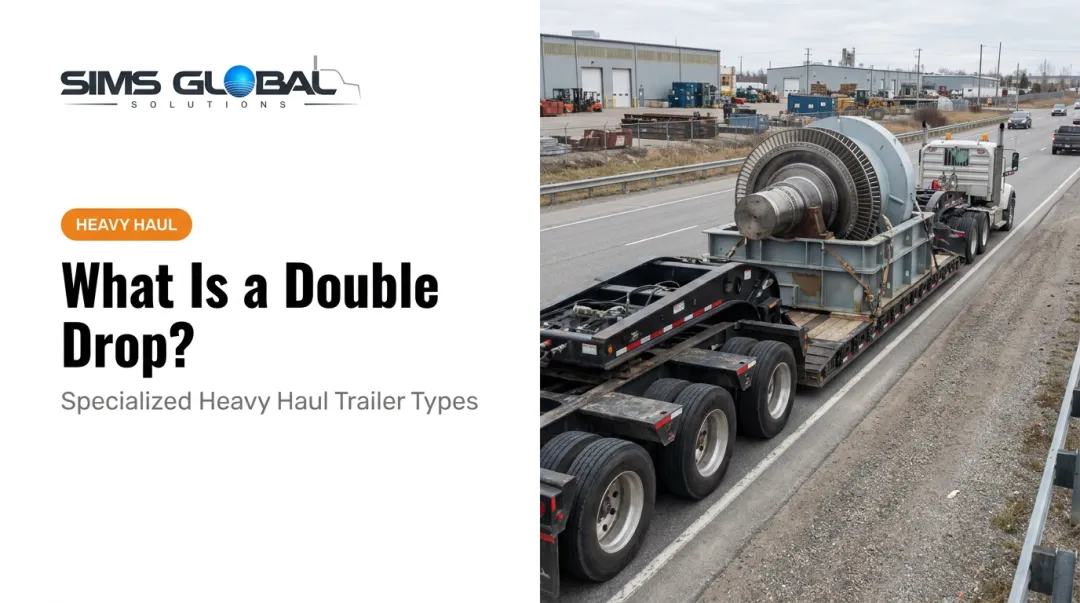
That's where a double drop trailer comes in. It's a specialized deck trailer with a lowered center "well" section built specifically for tall, heavy freight that won't fit on anything else.
This article breaks down how a double drop trailer is built and how it stacks up against step deck, lowboy, and RGN trailers. You'll also get the dimensions and permit requirements to expect, plus how to find a carrier who actually knows what they're doing with this equipment.
Key Takeaways
- Double drop trailers use two deck drops to create a low center well, typically 18-22 inches off the ground.
- Built for construction machinery, industrial equipment, and freight exceeding flatbed or step deck height limits.
- RGN is a double drop subtype with a detachable gooseneck for drive-on loading.
- Matching trailer to freight only works with a carrier who can vet compliance and handle permitting.
What Is a Double Drop Trailer?
A double drop trailer gets its name from its shape. There's a raised deck section near the tractor, a recessed lower deck in the middle, and another raised section near the rear axles. Picture a staircase that steps down, flattens out, then steps back up.
You'll also hear this equipment called a double drop deck trailer, and it's frequently grouped under the broader "lowboy" category in industry conversations. The terms overlap more than shippers expect.
Why the lowered well matters:
- It lets tall equipment sit much closer to the ground than a flatbed or step deck allows.
- That lower ride height keeps total load height under state limits more often, cutting down on permit and escort requirements.
- A lower center of gravity also improves stability in transit, particularly through mountain grades and sharp turns.
The Federal Highway Administration confirms that a lower center of gravity and more uniformly distributed payload make a vehicle more stable, a critical factor when hauling something like a 40,000-pound press.
Those stability gains depend partly on design, but construction materials matter too, and they vary by manufacturer. Most double drops use high-strength steel flanges, though some models incorporate aluminum components for weight savings and corrosion resistance.
Steel tends to favor durability and capacity; aluminum trims weight where every pound matters for legal payload limits. There's no single industry-standard trade-off here — it depends on the specific trailer build.
Anatomy of a Double Drop Trailer: Key Parts Explained
Every double drop trailer breaks down into distinct sections, each doing a different job.
Upper (Front) Deck
This section sits over the rear tractor axles, and while it's not the star of the show, it's useful. Crews often load smaller cargo, tarps, chains, or components that don't need extra vertical clearance here. It also helps balance weight across the rig.
Lower Deck (The "Well")
This is where the tallest, heaviest cargo rides. Manufacturer specifications for conventional double drop models show loaded deck heights in the 18-22 inch range, with some low-profile RGN configurations dropping as low as 15 inches. Main deck (well) lengths typically run 24-29 feet, depending on the model and axle configuration.
That extra depth is the entire point of the trailer. Equipment that would blow past a step deck's height limit fits comfortably here.
Rear Deck
The rear deck bridges the well and the trailer's axles. It supports long equipment that extends past the center well, and it also carries part of the load's weight, which is critical for keeping axle weights legal.

Removable Gooseneck (RGN) Option
Some double drops feature a detachable front gooseneck that lowers to the ground. This lets self-propelled equipment like excavators or bulldozers drive directly onto the deck instead of requiring a crane.
Not every double drop has this feature, and whether you need it depends on:
- How the cargo needs to be loaded (drive-on versus lift-on)
- Whether the job site even has crane access
- The equipment's own mobility
Double Drop Trailer vs. Other Trailer Types
Shippers mix up double drop, step deck, lowboy, and RGN trailers constantly. Understanding the actual differences saves you from booking the wrong equipment, or worse, discovering the mismatch after the truck arrives.
Double Drop vs. Single Drop (Step Deck) Trailers
A step deck, also called a single drop, has just one deck drop between the front and rear sections. A double drop adds a second drop, creating a lower, deeper well. That extra drop is what lets double drops handle taller loads that would exceed a step deck's clearance.
Double Drop vs. Lowboy Trailers
"Lowboy" often functions as an umbrella term covering low-deck trailers generally, including double drops. Not every lowboy uses the identical two-drop design, though. In practice, the industry uses "lowboy" and "double drop" interchangeably more often than not. Don't assume a strict technical distinction when a carrier uses one term or the other.
Double Drop vs. RGN Trailers
Here's the piece that trips people up most: an RGN is technically a type of double drop trailer, not a separate category. It's a double drop equipped with a detachable gooseneck. That detachable neck is what enables drive-on loading for heavy equipment without a crane. Sims Global Solutions operates its own fleet of RGN and double drop trailers, so our team can match your load to the right equipment before it ships.
| Trailer Type | Typical Deck Height | Ideal Cargo | Loading Method |
|---|---|---|---|
| Step Deck | 33-40 inches | Moderately tall freight, pipe, building materials | Crane, forklift, or ramps |
| Standard Double Drop | 18-22 inches | Tall industrial equipment, presses, generators | Crane or ramps |
| RGN | 15-22 inches | Self-propelled heavy equipment (excavators, dozers) | Drive-on, gooseneck detaches |
Use Cases, Dimensions, and Permit Considerations
Best Use Cases for Double Drop Trailers
Double drops make sense for freight that genuinely needs the clearance. Common candidates include:
- Bulldozers and excavators
- Mobile cranes
- Industrial presses
- Large generators
- Scaffolding sections and modular structures
If your freight is small palletized goods that don't need extra clearance, skip the double drop. A flatbed handles it cheaper, and double drops typically cost more to charter than standard equipment.
For oversized equipment like the examples above, permits and route surveys often move in parallel with the trailer booking. Heavy-haul teams, including Sims Global Solutions, usually start that process before the load leaves the yard.
Dimensions, Weight Capacity, and Legal/Permit Basics
Exact specs vary by manufacturer and axle configuration, but here's a representative sample based on published trailer specifications:
| Spec | Typical Range |
|---|---|
| Overall Length | 48-53 feet |
| Width | 8 feet 6 inches (102 in) |
| Deck Height | 15-22 inches |
| Rated Capacity | 60,000-120,000 lbs |
Most states define oversize loads by height, width, or weight thresholds. Federal rules set baseline limits of 80,000 lbs gross weight, 20,000 lbs per single axle, and 34,000 lbs per tandem axle on Interstate highways, according to FHWA's Bridge Formula guidance. There's no federal height limit; states set their own. Iowa, for example, requires a permit above 13 feet 6 inches in height or 8 feet 6 inches in width.
A double drop's lower profile often helps keep total load height under these permit-triggering thresholds. It's not automatic, though. Heavier loads still need additional axles and oversize/heavy-haul permits regardless of trailer type. Always confirm state-specific rules before the truck rolls — route restrictions and permit requirements shift from state to state, and sometimes county to county.
Partner with Sims Global Solutions for Heavy Haul Shipping
Picking the right double drop or RGN trailer solves half the problem. The other half is finding a carrier who can actually execute the move — permits confirmed, routes surveyed, and equipment matched correctly to the freight.
Sims Global Solutions operates as both an asset-based heavy haul carrier and a broker with access to an extensive network of over 150,000 carriers. That combination matters when you need an RGN or double drop trailer fast, not just whatever truck happens to be available.
Our approach includes:
- Owned heavy haul fleet for direct control over specialized moves
- A vetted carrier network to fill capacity gaps quickly when demand spikes
- SimsTrak, our proprietary TMS, giving real-time shipment visibility from pickup to delivery
- In-house permitting expertise that handles state-by-state oversize/overweight requirements before dispatch, not after

We regularly support industries like aerospace, defense, material handling, and manufacturing, sectors where oversized equipment moves are routine rather than occasional. If you've got a load that needs a double drop or RGN trailer, request a heavy haul quote and let our team confirm the right equipment and compliance details upfront.
Frequently Asked Questions
What is a double drop trailer?
A double drop trailer is a specialized deck trailer with a lowered center well positioned between two deck drops. It's designed to haul tall, heavy equipment while keeping total load height within legal limits.
What is the difference between single drop and double drop trailers?
Single drop (step deck) trailers have one deck drop, creating a moderately lowered main deck. Double drops add a second drop, producing a lower, deeper well and greater height clearance for taller freight.
What is the difference between a lowboy trailer and a double drop trailer?
"Lowboy" is often used as an umbrella term for low-deck trailers, including double drops. In practice, the industry uses these terms interchangeably more often than as strict separate categories.
What is the difference between RGN and double drop trailers?
An RGN is a double drop trailer equipped with a detachable front gooseneck for drive-on loading. It's a specific subtype of double drop rather than a distinct trailer category.
What size loads can a double drop trailer haul?
Rated capacities typically range from 60,000 to 120,000 pounds, depending on axle configuration. Height capacity depends on the specific trailer's deck height and each state's height-limit regulations.
Do you need a permit to use a double drop trailer?
Permits depend on your final load's height, width, and weight, not the trailer type itself. A double drop's lower profile often helps loads stay under permit thresholds, but it doesn't guarantee an exemption.