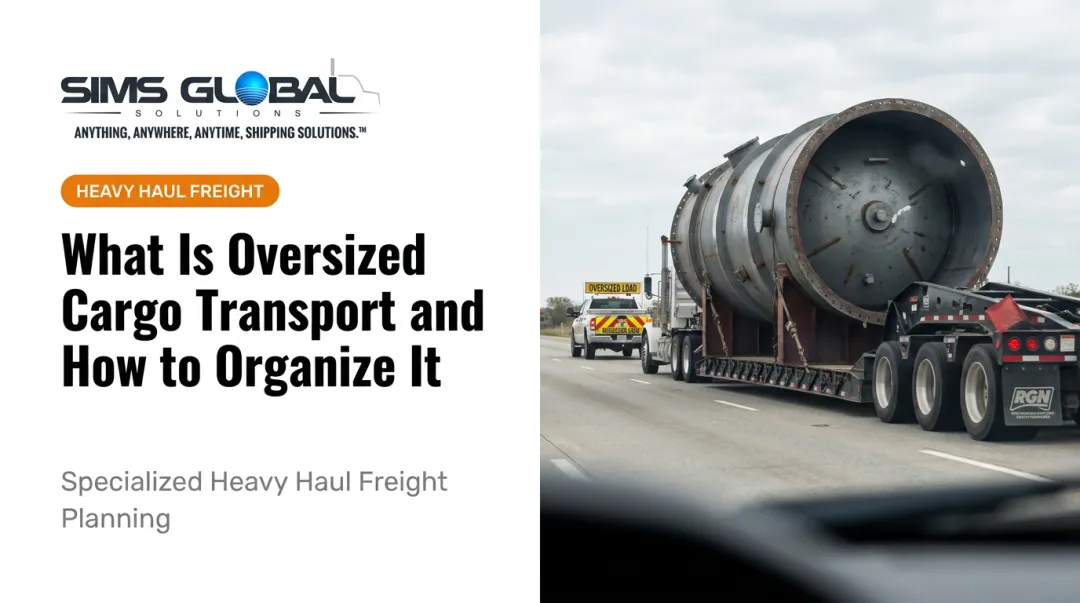

This scenario plays out constantly across construction, energy, and manufacturing sectors. Knowing exactly what qualifies as oversize cargo — before the truck is loaded — determines whether a project stays on schedule or grinds to a halt.
This guide covers federal and state legal thresholds, load classifications, specialized equipment, permit requirements, and what the full shipping process looks like for oversize freight.
Key Takeaways
- Any load exceeding 8 ft 6 in wide or 80,000 lbs gross vehicle weight on the Interstate System triggers oversize or overweight permitting
- Height and length limits vary by state — there are no uniform federal standards
- Classifications range from standard oversize to superloads, each with escalating requirements
- Every state on a route requires its own permit; processing times vary from same-day to several weeks
- Trailer selection — flatbed, lowboy, RGN, or step-deck — must match the load's specific oversize characteristic
What Qualifies as Oversize Cargo? Legal Thresholds Explained
Oversize cargo is any load that exceeds the legal limits set by the Federal Highway Administration (FHWA) for width, height, length, or gross vehicle weight on public roads. Exceeding even one dimension triggers oversize classification and requires a permit before the vehicle can move.
Federal Baseline Thresholds
| Dimension | Federal Rule |
|---|---|
| Width | 102 inches (8 ft 6 in) on the National Network |
| Height | No federal maximum — states set their own limits |
| Length | No general federal overall-length maximum for tractor-semitrailer combinations |
| Gross Vehicle Weight | 80,000 lbs on the Interstate System |
| Single axle | 20,000 lbs |
| Tandem axle | 34,000 lbs |

One critical nuance: there is no universal federal height limit. Each state sets its own cap — most land between 13 ft 6 in and 14 ft — so height compliance depends entirely on your route.
State-Level Variation
State rules frequently differ from federal baselines, and shippers must comply with every jurisdiction on their route:
- Texas: 8 ft 6 in wide, 14 ft high, 80,000 lbs gross on the Interstate
- California: Single-trip permits required above 8 ft 6 in wide, 14 ft high, or 80,000 lbs
- Florida: Width maximum of 102 inches, height capped at 13 ft 6 in — 6 inches lower than Texas
Oversize vs. Overweight: Not the Same Thing
These two designations are distinct and trigger different permitting requirements:
- Oversize (over-dimension): triggered by width, height, length, or overhang
- Overweight: triggered by gross vehicle weight, axle group limits, or Bridge Formula violations
A load can be oversize, overweight, both, or neither. A compact but extremely dense mining component might fit within dimension limits yet still require an overweight permit.
The Bridge Formula Factor
Staying under 80,000 lbs GVW doesn't automatically mean the load is legal. Bridge Formula B tests every consecutive axle group independently: W = 500[(LN/(N-1)) + 12N + 36]. Axles spaced too closely together can violate the formula even when total weight is within limits. Trailer configuration and axle layout matter as much as the number on the scale.
Oversize vs. Superload: Understanding the Classifications
"Oversize" isn't a single category — it exists on a spectrum with escalating requirements at each tier.
The Classification Spectrum
Standard Oversize: Load exceeds one legal limit (width, height, or length) by a modest margin. Typically requires a single-trip permit and may need basic safety equipment like flags and banners.
Wide Load: Generally used when width exceeds 12 ft. Most states require escort vehicles and restrict travel hours once loads reach this width.
Superload: Loads that exceed standard oversize permit thresholds by a substantial margin. No single national definition exists — each state sets its own threshold:
- Pennsylvania defines superload as exceeding 201,000 lbs GVW, 160 ft length, or 16 ft width
- Texas classifies a move as "superheavy" when it exceeds 254,300 lbs GVW or meets specific axle/spacing conditions
What Superload Status Means Operationally
When a shipment qualifies as a superload, the requirements increase sharply across every phase of the move:
- Engineering route studies and structural analysis
- Coordination with utility companies to temporarily raise power lines
- Potential bridge closures or weight-restricted route bypasses
- Mandatory law enforcement escorts
- Advance permit applications 3-4 weeks out (Texas requires this for superheavy permits unless the route is pre-approved)

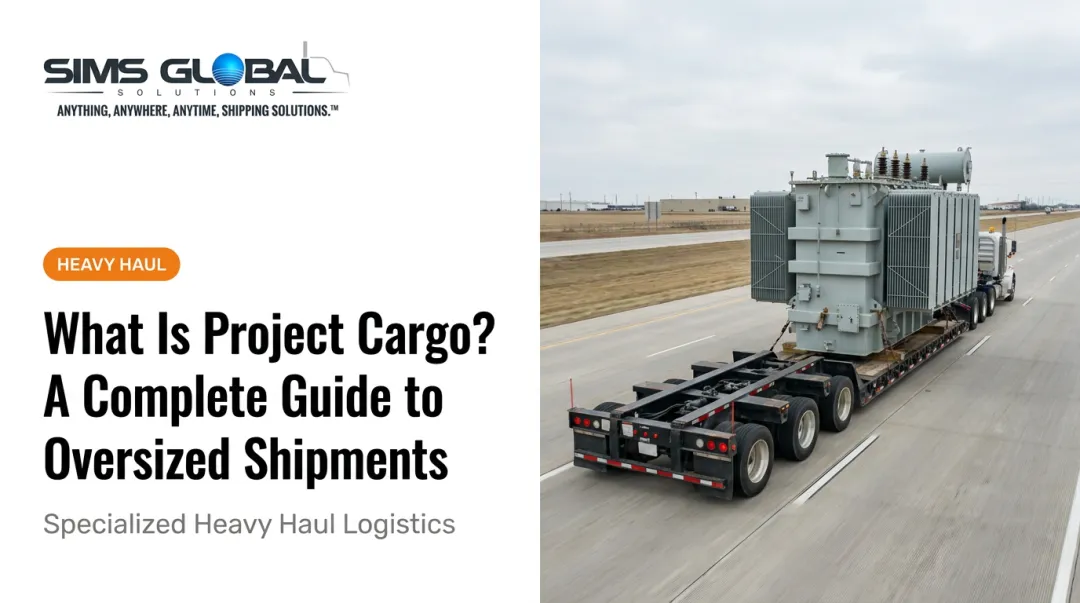
Large power transformers are a common superload example. The DOE reports these units typically weigh 100 to 410 tons. At that scale, moves require coordinated road, rail, and sometimes water transport. Weight alone is enough to trigger superload classification in virtually every state the route crosses.
Out-of-Gauge (OOG) in Intermodal Contexts
In maritime and rail freight, "out of gauge" describes cargo that extends beyond standard ISO container dimensions. OOG is an intermodal classification, not a US highway permit category. That said, once OOG cargo moves by truck, standard oversize permitting rules apply in every state along the route.
Key distinctions worth knowing:
- OOG status is determined at the container/vessel level, not at the highway level
- The same shipment can be both OOG (for ocean booking) and oversize (for the drayage leg)
- Permit requirements are assessed by the trucking leg independently of the ocean or rail classification
Common Examples of Oversize Cargo by Industry
Oversize freight isn't limited to a single sector. Several industries routinely generate loads that exceed standard transport limits:
| Industry | Common Oversize Cargo |
|---|---|
| Construction | Cranes, excavators, bulldozers, steel beams |
| Energy | Power transformers (100-410 tons), wind turbine blades, generators |
| Agriculture | Combines, harvesters, large implements |
| Manufacturing | Industrial presses, boilers, pressure tanks |
| Infrastructure | Prefabricated bridge sections, modular buildings |
Wind turbine blades are rigid and cannot be folded or bent, which severely constrains route options — not every road can accommodate a blade running 60-80 meters in length.
Weight alone can also push cargo into oversize territory. A dense manufacturing component that fits within width and height limits can still trigger overweight permits based on axle loading.
For companies in aerospace and defense, material handling, and manufacturing — sectors where Sims Global Solutions regularly operates — oversize freight is a routine part of operations, and coordinating permits, escorts, and equipment is handled as standard practice.
Specialized Equipment Used to Transport Oversize Freight
Trailer selection is driven by the specific oversize characteristic of the load. Matching the wrong equipment to a cargo profile creates safety risks and compliance problems.
| Trailer Type | Best For | Deck Height | Typical Capacity |
|---|---|---|---|
| Flatbed | Wide loads, side/rear loading | ~60 in | Up to 80,000 lbs |
| Lowboy (Double-Drop) | Tall, heavy equipment | ~18 in loaded | 60,000–110,000 lbs |
| RGN | Drive-on wheeled/tracked equipment | Ground level | 60,000–110,000 lbs |
| Step-Deck | Cargo too tall for flatbed limits | 34–38 in | Up to 48,000 lbs |
| Extendable/Multi-Axle | Long or extreme-weight loads | Varies | Varies by axle config |

Flatbed Trailers
Best for wide loads and cargo that can be loaded from the side or rear. The Fontaine Revolution, for example, has a 45 ft deck at 102 inches wide with an 80,000 lb distributed frame rating. Flatbeds work well for steel beams, pipes, and machinery with manageable height profiles, but standard deck height (around 60 inches) limits their usefulness for tall equipment.
Lowboy (Double-Drop) Trailers
The go-to option for tall, heavy equipment. The Talbert 30-55 SRG achieves an 18-inch loaded deck height with capacity ranging from 60,000 to 110,000 lbs. That lower deck drops the cargo's center of gravity and preserves bridge and overpass clearance — critical for cranes, excavators, and large construction equipment.
RGN (Removable Gooseneck) Trailers
The detachable front allows wheeled or tracked equipment — bulldozers, large vehicles — to be driven directly onto the trailer from ground level. No crane required at loading. RGN trailers can be configured flat, beam, or raised-center depending on the load profile.
Step-Deck Trailers
A middle ground between flatbed and lowboy. Trail King's step-deck models have loaded deck heights of 34 or 38 inches — more vertical clearance than a conventional flatbed without the full height reduction of a double-drop. Useful for cargo slightly too tall for flatbed-legal limits.
Extendable and Multi-Axle Configurations
- Extendable trailers telescope to accommodate cargo exceeding 53 feet — wind blades, precast concrete beams, long structural steel
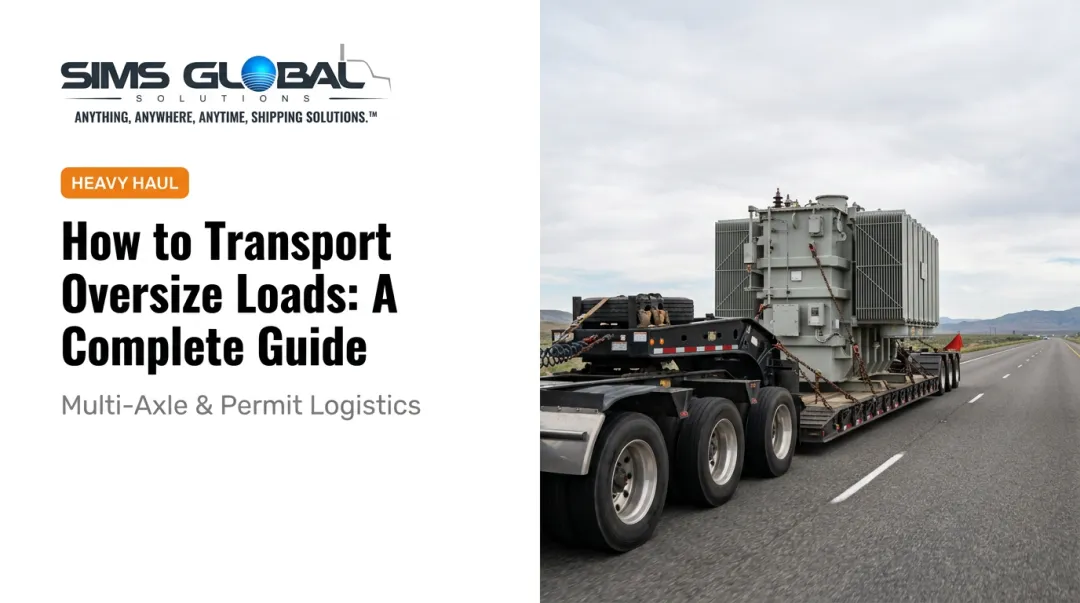
- Multi-axle setups distribute extreme weight across more axle groups to protect road infrastructure and satisfy Bridge Formula requirements per axle group
Permits, Regulations, and Route Planning for Oversize Loads
Permit Requirements
The FHWA issues no federal oversize permit. Every state traversed on a route requires its own permit, submitted with cargo dimensions, weight, planned route, and travel dates. Processing times vary widely:
- Illinois: Most permits issue immediately
- Georgia: Up to 3 days, with complex cases taking up to 3 weeks
- Texas (superheavy): Applications requested 3-4 weeks in advance unless the route is pre-approved
Permit procurement is the first step in planning an oversize move — not a detail to sort out after carrier assignment.
Travel Restrictions
Most states restrict oversize loads to daylight hours. Georgia, for example, permits movement Monday through Sunday from 30 minutes after sunrise to 30 minutes before sunset — but prohibits travel during inclement weather and defined holiday periods. These windows vary by state and must be factored into project timelines well in advance.
Escort Vehicle Requirements
Escort requirements are state-specific, not governed by a single federal rule. Texas generally starts requiring escorts above 14 ft in width:
- Over 14 ft to 16 ft: one escort, positioned in front on two-lane roads or behind on multi-lane
- Larger loads: front and rear escorts; law enforcement may also be required
Escort vehicles serve multiple functions — warning approaching traffic, verifying overhead clearances, managing intersections, and coordinating with law enforcement when needed.
Safety Equipment
Standard equipment requirements are set at the state level. Common provisions include:
- Oversize load banners at the front and rear of the vehicle
- Warning flags at load extremities
- Flashing amber lights on the transport and escort vehicles
State rules vary in the specifics: California mandates prescribed front/rear oversize signs and red warning flags; Texas requires escort-vehicle signage visible from all sides. Verify requirements for each state on the planned route before departure.
Route Survey Process
For complex moves, FHWA route planning guidance calls for a physical turn-by-turn review covering:
- Overhead wires, signals, and signs
- Bridge weight restrictions and roadway width
- Railroad crossings and sharp turns
- Work zones and escape areas
Delaware's superload form requires the route to be physically driven before the move, with the surveyor certifying the findings. Some loads require utility crews to raise power lines or police to close intersections — route planning at this level is an engineering process with documented sign-off, not a pre-move assumption.
Costs and Challenges of Oversize Cargo Shipping
Primary Cost Drivers
Oversize moves cost substantially more than standard dry van or flatbed freight. The main components:
- Permit fees for every state on the route (California, for reference, charges $16 for a single-trip permit — but this is one state's administrative fee, not a national benchmark)
- Specialized equipment rental or carrier rates for flatbeds, lowboys, RGNs, or extendable trailers
- Escort vehicles and pilot car services
- Route modification costs: utility coordination, bridge engineering studies, traffic control
- Engineering review for superload or complex structural analysis
Costs scale with load size, route complexity, and the number of states involved.
Key Challenges Beyond Cost
- Permit lead times: some states take days, others weeks — planning must start early
- Limited travel windows: daylight-only rules and weekend restrictions extend delivery timelines, sometimes significantly
- Carrier availability: finding a carrier with both the right equipment and experience for complex loads is harder than sourcing standard freight capacity
- State-to-state variation: rules on escorts, travel hours, and safety equipment differ enough that a compliant move in one state may be non-compliant in the next
How Sims Global Solutions Helps
Sims Global Solutions manages oversize freight through a structured five-step process:
- Equipment determination
- Route creation
- Route survey and review
- Permitting
- En route logistics coordination
With access to over 35,000 truckload carriers, Sims Global handles permit procurement, carrier vetting, and travel window management — giving shippers a single point of accountability across the full move.

Frequently Asked Questions
What is oversized cargo?
Oversized cargo is any freight that exceeds legal transport limits for width (8 ft 6 in), height (varies by state, commonly 13 ft 6 in to 14 ft), length, or gross vehicle weight (80,000 lbs on the Interstate System). Exceeding even one limit triggers oversize classification and requires special permits, equipment, and handling.
How many slots does oversized cargo take up?
Oversize cargo typically occupies a full dedicated trailer, not shared with other freight. In intermodal or maritime contexts, out-of-gauge cargo may require two or more container slots depending on how far dimensions extend beyond standard ISO container size.
What permits are required for oversize cargo transport?
A separate state permit is required for every state on the route, specifying exact dimensions, weight, travel dates, and planned route. Loads meeting superload thresholds require additional engineering review and, in some states, municipal or local approval.
What equipment is used to haul oversize loads?
The main options are flatbeds (wide loads with manageable height), lowboys (tall and heavy equipment), RGNs (wheeled or tracked equipment that can be driven on), step-decks (moderately tall cargo), and extendable trailers (very long loads exceeding 53 feet).
How much does oversize cargo shipping cost?
Costs depend on load dimensions, weight, route distance, number of states (and permits), escort vehicle requirements, and equipment type. Permit fees, specialized carriers, and escort services all add to base transport rates, so oversize moves regularly cost 2–3× standard freight.
Can oversize cargo travel at night or on weekends?
Most states restrict oversize loads to daylight hours and prohibit travel on certain holidays. Weekend rules vary by state: some allow Saturday movement, others don't. Factor these restrictions into project schedules early to avoid missed delivery windows.