This guide is written for shippers, operations managers, and businesses in construction, manufacturing, aerospace, and material handling that need to move heavy or dimensional freight. Whether you're shipping a bulldozer across three states or a wind turbine blade through rural highways, the process follows a structured sequence. Get it right and your load arrives on time. Get it wrong and you're looking at fines, roadside shutdowns, or worse.
Here's what we'll cover: how to identify an oversize load, navigate the permit landscape, select the right equipment, and execute a safe move from origin to destination.
Key Takeaways
- A load qualifies as oversize if it exceeds 8.5 ft wide, 13.5–14.5 ft tall, 48–53 ft long, or 80,000 lbs gross weight
- Every state along the route requires its own permit — no single national permit exists
- Permit timelines range from a few hours to six weeks depending on load size and route complexity
- Pilot cars, load securement, and safety signage are all legally required once you cross certain size or weight thresholds
- Choosing a carrier on price alone — without checking heavy haul experience — is a costly mistake many shippers make
What Is an Oversize Load?
Legal Thresholds That Trigger Oversize Classification
A shipment becomes an oversize load the moment it exceeds any one of these federal baseline thresholds on the National Network:
- Width: Over 102 inches (8 ft 6 in), per 23 CFR 658.15
- Height: No single federal height limit exists — states set their own thresholds, typically triggering permits at 13.5 to 14.5 feet
- Length: Federal law requires states to allow at least a 48-ft semitrailer; 53 ft is a common state-level reference, but not a universal federal trigger
- Gross vehicle weight: Over 80,000 lbs, subject to the Federal Bridge Formula (23 CFR 658.17)
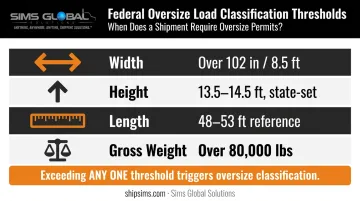
Exceeding any one of these dimensions qualifies the shipment as oversize. Exceeding multiple thresholds simultaneously — say, a load that's both wide and overweight — compounds the complexity of permitting and routing significantly.
Oversize vs. Wide Load vs. Overweight
These terms are related but not interchangeable:
- Wide load — exceeds the width threshold only
- Overweight load — exceeds gross, axle, or bridge-formula weight limits but may fit within standard dimensional limits
- Oversize load — may exceed width, height, length, or weight, often in combination
The nondivisible load classification also shapes permitting eligibility. Under 23 CFR 658.5, a load is nondivisible when separating it would destroy its intended use, compromise its value, or require more than eight work hours to dismantle. Only nondivisible loads qualify for oversize permits on the federal highway system.
Common Cargo That Qualifies as Oversize
- Construction machinery: excavators, bulldozers, graders
- Industrial boilers and pressure vessels
- Oilfield tanks and separators
- Wind turbine blades (DOE notes these can reach hundreds of feet and cannot be bent after manufacture)
- Bridge beams and structural steel
- Pre-fabricated modular buildings
- Mining and quarrying equipment
Permits and Regulations for Oversize Loads
No National Permit Exists
This is the fact that catches most shippers off guard: there is no single federal oversize permit. The federal government does not issue them. According to FHWA's best practices report on oversize and overweight permitting, permits are a state function — and a carrier needs authorization from every state, county, or municipality the load passes through.
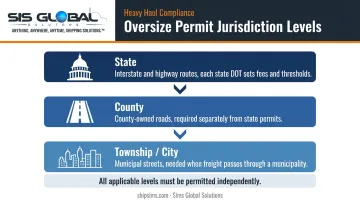
Three Levels of Permit Jurisdiction
| Level | Covers | Notes |
|---|---|---|
| State | Interstate and highway routes | Each state DOT sets its own fees, thresholds, and travel conditions |
| County | County-owned roads | Required separately when the route leaves state-controlled roads |
| Township/City | Municipal streets | Needed when freight must travel through a city or municipality |
Some states offer one-stop arrangements. Georgia and Maryland, for example, have streamlined permit issuance across jurisdictions — but most states require operators to work through each level independently.
What Permit Applications Require
Every application will ask for some combination of:
- Load dimensions and gross vehicle weight
- Origin, destination, and planned route
- Trailer type and axle configuration
- Requested travel dates
Permits are date-specific and nonrefundable. Confirm your move dates before submitting — a schedule change typically means starting over.
How Long Does Permitting Take?
Timelines vary based on load size:
- Routine oversize loads: Automated systems in many states can issue permits in minutes. FHWA data shows Maryland auto-issued roughly 70% of all permits.
- Larger loads (200,000–500,000 lbs): Colorado processed these in under three hours; non-automated loads of 200,000 lbs or more averaged about two days.
- Superheavy loads in Texas: Submit applications 3–4 weeks in advance to allow for route approval and bridge/pavement analysis.
Missing those windows means delays — or operating without authorization and facing the penalties below.
Penalties for Non-Compliance
Operating without a valid permit exposes carriers to fines, shutdowns, and liability for infrastructure damage:
- Texas: Failure to obtain the required permit is a misdemeanor punishable by $100–$250 per Transportation Code Sec. 623.219
- Florida: Oversize violations can result in penalties up to $1,000; overweight violations are assessed at $0.05 per pound over the legal weight limit
- Ohio: Permit holders can be required to compensate for or repair excess roadway damage caused by overweight movement
- All states: Roadside shutdown, forced permit purchase at higher on-site rates, and potential liability for infrastructure damage
The 2015 Salado, Texas incident illustrates the real-world cost: an unpermitted oversize load struck bridge beams, resulting in one fatality, three injuries, and approximately $150,000 in bridge damage.
How to Transport an Oversize Load: Step-by-Step
Experienced carriers follow this sequence on every move. Skipping any step creates downstream risk.
Step 1: Assess Your Load and Plan the Route
Start with accurate measurements — height, width, length, and total gross weight including the trailer. From there, a route survey identifies:
- Low bridge clearances
- Overhead utility lines
- Tight turns or narrow lanes
- Weight-restricted roads and bridges
For particularly large loads, a physical pre-run of the route may be required before the permitted move. FHWA training instructs surveyors to specifically identify railroad crossings, construction zones, and turning constraints. Nebraska, for example, requires route surveys for loads exceeding 16 feet in height.
Step 2: Obtain All Required Permits
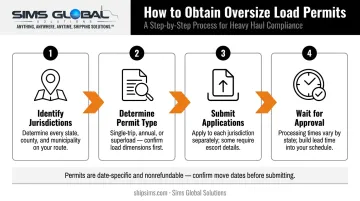
Work through each jurisdiction the load will cross:
- Identify all states, counties, and municipalities on the planned route
- Determine permit type needed at each level
- Submit applications with complete route and load details
- Wait for approval before scheduling the move
Many carriers work with permit services that maintain active accounts across multiple states, which can cut approval timelines considerably for routine oversize moves. Sims Global Solutions coordinates permits across the US, Canada, and Mexico as part of its heavy haul service.
Step 3: Select the Right Equipment and Carrier
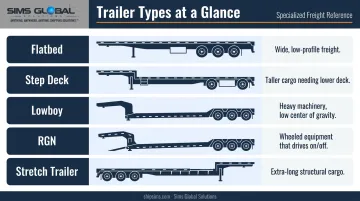
Equipment choice flows directly from your load's profile:
- Flatbed — wide, low-profile cargo
- Step deck — tall cargo needing a lower deck section
- Lowboy — heavy machinery requiring a low center of gravity
- RGN (Removable Gooseneck) — wheeled equipment that needs to drive on and off
- Stretch/extendable trailer — extra-long cargo
The carrier must hold appropriate operating authority, insurance, and demonstrated experience with oversize freight. Sims Global Solutions pairs its own heavy haul fleet with a network of over 35,000 vetted truckload carriers, making it straightforward to match the right equipment and operator to any load profile.
Step 4: Secure the Load and Arrange Required Escorts
Load securement for oversize freight typically involves chains, binders, blocking, and bracing — governed by FMCSA cargo securement rules that expressly cover heavy equipment on flatbed and lowboy trailers.
Pilot car and escort requirements vary by state and load dimensions:
| State | Escort Trigger (Width) | Additional Triggers |
|---|---|---|
| Texas | Front + rear above 16 ft wide | Front height-pole escort above 17 ft high |
| California | Route-dependent (CHP escort on Yellow routes above 16 ft wide) | None specified statewide |
| Kansas | Mandatory above 14 ft wide | Required for all superloads |
| Ohio | Lead escort above 13 ft wide on two-lane roads | Rear escort above 90 ft long |
Required safety markings on the transport vehicle typically include:
- "OVERSIZE LOAD" banner (Kansas requires signs at least 7 ft × 18 in with 10-inch letters)
- Red or fluorescent-orange flags at lateral extremities
- Amber flashing lights visible during darkness
Step 5: Execute Transit and Complete Post-Transport Procedures
During transit, drivers must adhere to permit-specified travel windows. Most states restrict oversize movement to daylight hours. Texas bans movement on loads exceeding 14 ft wide, 16 ft high, or 110 ft long during specified holiday periods. California prohibits pilot-car loads from moving from 4 p.m. the day before a holiday through midnight on the holiday itself.
Active transit management includes:
- Regular load checks at planned intervals
- Continuous communication between driver, pilot cars, and the dispatch team
- Immediate rerouting if conditions change (weather, road closures, bridge restrictions)
After delivery, inspect the load for damage, complete all required documentation, and verify whether permits expire automatically or must be returned to the issuing authority. Closing out these details promptly protects against compliance issues on future moves through the same jurisdictions.
Specialized Equipment for Oversize Transport
Primary Trailer Types
The trailer you choose directly affects your permit requirements, route options, and securement strategy:
- Flatbed — the workhorse for wide, low-profile freight; highest availability across carrier networks
- Step deck — provides a lower deck section for taller cargo that wouldn't clear height limits on a standard flatbed
- Lowboy — keeps the load close to the ground; ideal for heavy machinery like bulldozers or excavators
- RGN (Removable Gooseneck) — the gooseneck detaches so equipment can drive directly onto the deck; preferred for wheeled machinery
- Stretch/extendable trailer — accommodates extra-long cargo like structural beams or wind turbine components by extending the deck length
When SPMTs and Bucket Trucks Enter the Picture
Some loads exceed what any standard trailer can handle. When dimensions or weight make conventional equipment impractical, Self-Propelled Modular Transporters (SPMTs) step in — computer-controlled, multi-axle platforms built for extremely heavy or uniquely shaped freight. AASHTO has documented bridge work using SPMTs to move an 86 ft × 21 ft steel box-girder segment. These are low-availability assets that require advance planning and specialized carrier relationships to secure.
Bucket trucks become necessary when overhead utility lines or traffic signal infrastructure along the route sit below the load's height. Coordinating utility line lifts adds time and requires coordination with local utility providers — something that needs to be identified during the route survey phase, not on the day of the move.
Both SPMTs and bucket trucks tie directly to scheduling. If the equipment isn't confirmed before the move date, delays compound fast. Verify that your carrier can actually secure what you need — and when — before committing to a project timeline.
Key Factors and Common Challenges
What Complicates Oversize Moves Most
- State-by-state variation: Permit thresholds, travel windows, escort requirements, and signage specs differ in every jurisdiction
- Bridge capacity constraints: FHWA's 2024 National Bridge Inventory shows 6.8% of U.S. bridges rated in poor condition — route approval still requires structure-specific load capacity review, not just general condition ratings
- Weather and road conditions: Loads can be grounded or rerouted without warning
- Multi-vendor coordination: Permit agents, pilot car operators, and bucket truck crews must all align to the same schedule
Most Common Shipper Mistakes
These complications create predictable failure points. Knowing where other shippers go wrong is the fastest way to avoid the same mistakes.
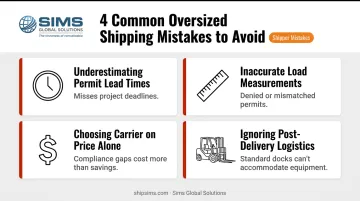
- Underestimating permit lead times — Texas superheavy permits require 3–4 weeks minimum; treating permitting like a same-day task is how projects miss deadlines
- Inaccurate load measurements — submitting incorrect dimensions results in denied or mismatched permits; re-measure before applying
- Choosing on price alone — a carrier without verifiable heavy haul experience creates compliance gaps that cost far more than the initial savings
- Ignoring post-delivery logistics — unloading oversize cargo at the destination requires its own planning; don't assume a standard dock will accommodate the equipment
Oversize permits are only available for nondivisible loads. If your cargo can be broken down into pieces that each fit within standard legal dimensions, it must ship conventionally. Moving divisible loads under oversize permits adds unnecessary cost and exposes the shipper to legal risk. Getting this classification right before you apply for permits saves significant time and money down the road.
Frequently Asked Questions
How do you transport oversize loads?
Start by measuring the load, then secure permits from every jurisdiction along the route. From there, select the appropriate trailer, arrange pilot cars and required safety markings, and execute the move within permit-specified travel windows.
What are common challenges when transporting oversize loads?
The biggest hurdles are navigating different permit rules across every state, identifying route obstacles like low bridges and utility lines, coordinating escorts and daylight-only travel windows, and managing the extended permitting timelines that larger or super loads require.
What are the consequences of hauling an oversize load without a permit?
Operating without a permit can result in significant fines (up to $1,000 in Florida; misdemeanor charges in Texas), forced roadside shutdown, potential load impoundment, and liability for any infrastructure damage caused. Carriers also risk losing operating authority.
Are you allowed to go around an oversize load?
On multi-lane roads, passing may be legal when safe, but FHWA advises escort vehicles not to wave motorists around. If a convoy delays more than five vehicles for five or more minutes, the team should pull over where possible. Always follow escort vehicle directions.
How long does it take to get an oversize load permit?
Routine loads can be permitted in minutes through automated state systems. Loads in the 200,000–500,000-lb range typically process in hours to two days. Texas superheavy loads require 3–4 weeks minimum for route approval and engineering review.
What equipment is used to transport oversize loads?
The most common trailer types are flatbeds, step decks, lowboys, RGNs, and stretch trailers. For extremely heavy or uniquely shaped loads, SPMTs are used. Equipment choice depends on the load's dimensions, weight, and how it needs to be loaded and unloaded at each end of the move.