
Introduction
A crane sits idle at a construction site because a single hydraulic fitting didn't show up. A manufacturing line stalls waiting on one replacement part. These aren't hypothetical scenarios. They happen every week across construction, oil and gas, and manufacturing operations.
Hotshot trucking exists to solve exactly this problem. It's an expedited freight service that uses medium-duty trucks and trailers to move urgent, smaller loads fast, without waiting on a full trailer's worth of cargo.
This guide breaks down what hotshot trucking is, how it works, and where it delivers the most value.
You'll also see where it falls short and how to access it through a logistics partner like Sims Global Solutions when your freight needs move faster than standard shipping allows.
Key Takeaways
- Hotshot trucking uses Class 3-5 trucks with flatbed or gooseneck trailers for urgent partial loads
- It bridges the gap between LTL and full truckload shipping, usually at lower cost
- Weight and length limits rule out oversized or very heavy freight
- Capacity relies mainly on independent owner-operators, making short-notice sourcing tricky
- Partnering with an asset-based broker like Sims Global Solutions simplifies hotshot access
What Is Hotshot Trucking?
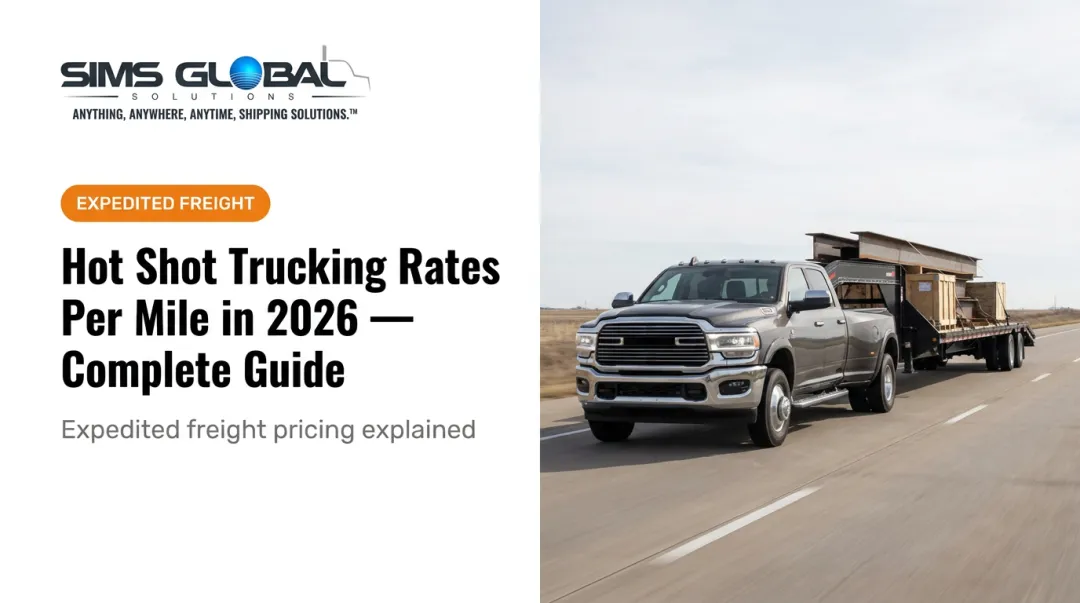
Hotshot trucking is the transport of smaller, time-critical freight using a flatbed or gooseneck trailer towed by a medium-duty pickup, rather than a full semi-tractor. FreightWaves defines it as the direct movement of time-sensitive, less-than-truckload freight using medium-duty trucks, commonly paired with flatbed or gooseneck trailers.
Think of it as the middle ground. LTL and partial truckload shipments often ride with other shippers' freight through multiple stops. Full truckload requires enough cargo to justify a 48-53 foot trailer. Hotshot skips both problems by dedicating a single, smaller rig to a single load.

The term traces back to oilfield work, where drivers rushed urgently needed parts and tools to drilling sites under tight deadlines.
The exact decade this started is murky. Some sources point to the 1970s, but that timeline isn't confirmed by verified historical records. What's clear is that the practice has since spread well beyond the oilfield into construction, agriculture, and manufacturing.
Trucks and Trailers Used
Hotshot rigs typically fall into Class 3, 4, or 5 weight categories. According to the Alternative Fuels Data Center, these break down as:
- Class 3: 10,001-14,000 lb GVWR
- Class 4: 14,001-16,000 lb GVWR
- Class 5: 16,001-19,500 lb GVWR
Many hotshot setups stay under the federal combined weight threshold that would require a CDL, which we'll cover in the limitations section. Three trailer types dominate this niche:
- Gooseneck - hitches over the rear axle for a more stable ride and higher capacity, the go-to choice for heavier or longer loads
- Bumper pull - couples through a rear receiver hitch, more affordable and easier for beginners, but less stable at higher weights
- Dovetail - features a ramped or hydraulic tail section that lowers the loading angle, ideal for wheeled equipment like skid steers or ATVs
Capacity and Size Limits
Trailer lengths commonly run 20 to 44 feet, with 30-40 feet being the sweet spot for most hotshot operations. Weight capacity is often cited around 16,500 lbs, but that number isn't universal.
Manufacturer specs tell a different story. One current gooseneck spec sheet lists GVWR ranging from 25,000 to 30,000 lbs, with load capacity swinging anywhere from roughly 16,250 to over 24,000 lbs depending on axle count and configuration. In other words, capacity is configuration-specific, not fixed.
This is exactly why hotshot works well for partial loads but hits a wall fast with oversized or heavy freight. When a shipment exceeds what a pickup-and-trailer combo can legally or safely handle, a heavy haul division takes over. Sims Global Solutions, for example, operates its own RGN, lowboy, and multi-axle trailers for exactly these situations.
How Hotshot Trucking Works
The process is straightforward compared to standard freight. Here's how a typical hotshot shipment moves:
- A shipper posts an urgent load, either directly to a load board or through a broker.
- A driver or dispatcher matches that load to available hotshot capacity nearby.
- The freight gets loaded onto a dedicated truck and trailer.
- The truck moves straight to its destination.
No detours. No waiting while the driver picks up or drops off freight for other customers along the way.
Industries that lean on hotshot trucking most:
- Construction (equipment parts, materials that can't wait for the next delivery cycle)
- Oilfield services (tools and components needed to avoid costly downtime)
- Agriculture (seasonal equipment repairs, planting and harvest deadlines)
- Manufacturing (production line parts where every idle hour costs money)

Across these industries, the dedicated truck-and-driver model is the real differentiator. Standard LTL shipments move through terminal networks, getting consolidated, transferred, and re-routed alongside other freight. Hotshot skips that entirely.
One truck, one load, one direct route. That structure doesn't guarantee a specific transit-time improvement on paper, but it does remove the unpredictability that comes from multiple handoffs.
For a shipper watching a production deadline, that predictability often matters more than shaving a few hours off a delivery window.
Benefits of Hotshot Trucking for Shippers
Hotshot trucking earns its popularity for a handful of concrete reasons.
Cost efficiency for partial loads. If your freight doesn't fill a 48-53 foot flatbed, paying for a full trailer doesn't make sense. Hotshot lets you pay for capacity that actually matches your shipment size. It also widens the pool of available trucking solutions, and more competition among carriers tends to keep rates in check.
Speed for tight windows. Because the load is dedicated to a single shipper, there's no waiting on other pickups or drop-offs. That's the entire point.
Simpler tracking. With freight that isn't shared across multiple shippers, communication is usually more direct. You're not waiting on updates from a terminal juggling dozens of shipments.
Better access to tight or remote sites. Smaller trucks and trailers can navigate:
- Congested urban delivery zones
- Job sites with limited maneuvering room
- Remote drilling or agricultural locations larger rigs can't reach
A larger driver pool. Since many hotshot combinations stay under the CDL weight threshold, the pool of eligible operators is broader than it is for standard Class 8 trucking. Tapping into an established carrier network, like Sims Global Solutions' 150,000+ vetted carriers, turns that broader pool into more available capacity when you need it.
Limitations of Hotshot Trucking
Hotshot isn't a fit for every shipment, and knowing the boundaries upfront saves headaches later.
Weight and length ceilings. Trailers can't legally or practically haul freight much past 16,500 lbs, or exceed roughly 40 feet in length, though this varies by trailer spec and state regulations. Heavier or longer freight needs a different solution entirely.
Fragmented capacity. Most hotshot trucks are run by independent owner-operators rather than large, centralized fleets. That's great for flexibility, but it can make finding an available truck in a specific lane, especially on short notice, harder than booking standard LTL or FTL.
Suspension limitations. Most hotshot trailers use leaf-spring suspension instead of air-ride. Leaf springs are simpler and more affordable, but they transmit more road shock to cargo. For freight sensitive to vibration or shifting, that shock transfer can affect load integrity.
None of these are dealbreakers. They're just factors that determine whether hotshot is the right tool for a given shipment. When freight exceeds these limits, Sims Global Solutions can shift you into standard LTL, FTL, or heavy haul service without missing a beat.
Is Hotshot Right for Your Freight? How to Add It to Your Supply Chain
Here's a simple way to think about it:
| Freight Type | Best-Fit Mode |
|---|---|
| Time-critical, partial load, under ~16,500 lbs | Hotshot |
| Non-urgent partial freight | LTL |
| Larger or bulkier shipments | FTL or heavy haul |
If your shipment fits hotshot parameters and needs to move fast, it's usually the right call. But sourcing a reliable driver on your own, especially given how fragmented and independent this market is, can eat up hours you don't have.
That's where a logistics partner earns its keep. Sims Global Solutions operates as a multi-modal provider, offering truckload, LTL, expedited, drayage, and warehousing alongside its own trucking assets and a dedicated heavy haul division. That combination matters when a load starts as a hotshot candidate but turns out to be heavier or bulkier than expected.
The company's proprietary SimsTrak TMS platform gives shippers real-time visibility into every load. Its network of over 150,000 vetted carriers adds instant access to capacity, cutting out the manual legwork of chasing down individual owner-operators.

If your shipment is urgent, or it's edging past typical hotshot limits into oversized or heavy haul territory, contact a provider that handles both under one roof.
Frequently Asked Questions
What does hotshot mean?
"Hotshot" originally described fast, urgent freight runs in the oilfield. Today it refers to a trucking method using medium-duty trucks and trailers to move small, time-sensitive loads quickly, distinct from standard full-truckload service.
Is hotshot trucking cheaper than LTL or FTL shipping?
Hotshot can be more cost-effective for partial loads that don't justify booking a full trailer. That said, rates vary by distance, urgency, and freight type, so comparing quotes across modes is always worth doing.
Do you need a CDL to drive hotshot loads?
Many hotshot setups stay under the 26,001 lb combined weight threshold that triggers federal CDL requirements. Rules can still vary by state and cargo type, so it's worth checking local regulations.
How is hotshot trucking different from expedited freight?
Hotshot typically uses smaller pickup-and-trailer combinations for partial loads. Broader expedited freight often uses cargo vans, straight trucks, or full tractor-trailers for exclusive-use, non-stop delivery.
What size and weight loads can a hotshot truck carry?
Trailers usually run 30-40 feet long, with weight capacity commonly cited around 16,500 lbs, though it varies by configuration. Heavier or oversized freight should go through a heavy haul carrier instead.
How do I book a hotshot shipment for my business?
Shippers can work directly with owner-operators through load boards. Alternatively, a broker like Sims Global Solutions offers vetted capacity, real-time tracking, and support across multiple freight modes if hotshot isn't the exact fit.