Introduction
Construction sites, hospitals, data centers, and concert venues all share one problem: they can't afford to lose power. That's pushing demand for backup and industrial generators higher every year, and with it, the need for transport partners who actually know how to move them.
Here's the catch. Many shippers underestimate what it takes to move a generator safely. A standby unit weighing several thousand pounds isn't something you strap into a pickup bed.
Get it wrong, and you're looking at equipment damage, safety violations, or a shipment stuck at a weigh station because nobody pulled the right permit.
This guide breaks down generator types, the real logistics challenges involved, and how to pick a transport partner who can handle the job.
Key Takeaways
- Portable generators ship with basic precautions.
- Standby and industrial units require heavy haul equipment and permits.
- Weight, height, and destination determine escort, survey, and trailer needs.
- Asset-based carriers with owned equipment cut delays versus broker-only sourcing.
- Real-time tracking and permit expertise cut risk on multi-state generator moves.
Types of Generators and When You Need Professional Transport Services
Not every generator needs a heavy haul truck. The gap between a portable unit and an industrial genset is enormous, and that difference dictates everything about how you ship it.
Portable and inverter generators sit at the small end. A Generac GP2500i, for example, weighs about 48 lbs and fits in a car trunk. Larger portable units like the GP18000EFI still come in under 450 lbs. These move fine with basic tie-downs, standard freight, or even personal vehicles once fuel is drained.
Standby and commercial generators are a different story. A commercial unit like the Cummins C300D2R weighs over 10,000 lbs wet. That's well past what any pickup truck or box truck can legally or safely carry.
Industrial generators, the kind powering hospitals and data centers, push into serious heavy haul territory:
- A Cummins C1000N6C tips the scale at roughly 34,375 lbs wet
- A Cat C175-16 configuration can run 42,750 to 50,750 lbs dry, depending on setup
- Length on these units can exceed 300 inches, well beyond standard trailer dimensions

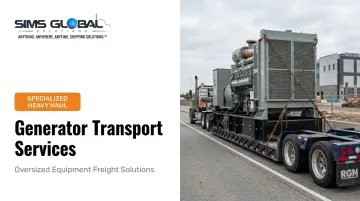
Once you're in this weight class, DIY methods are off the table. You need flatbeds, step-decks, lowboys, or RGN trailers built to carry multi-ton loads while keeping height and axle weight within legal limits. Sims Global Solutions runs its own fleet of these specialized trailers, giving shippers direct access to the right equipment without waiting on outside carriers.
Key Challenges in Transporting Large and Industrial Generators
Moving a generator that weighs as much as a school bus creates problems most shippers never think about until they're stuck with them.
Weight, Dimensions, and Legal Limits
Federal rules cap Interstate operation at 80,000 lbs gross vehicle weight, with single axles limited to 20,000 lbs and tandem axles to 34,000 lbs. That 80,000-lb figure includes the tractor, trailer, and fuel, not just the generator. A large industrial unit can eat up most of that allowance before you've added anything else.
There's also no federal height limit, which sounds like good news until you realize states set their own rules. That means the same load might be perfectly legal crossing one state line and require a special permit crossing the next.
Route Planning
Bridges, low clearances, and weight-restricted roads have to be mapped out before a truck ever leaves the yard. Minnesota, for instance, requires a full route survey for any load exceeding 16 feet high, 20 feet wide, or 175 feet long, including a required 6-inch clearance buffer above and below the load. Skip this step, and you risk a truck getting stuck under an overpass with nowhere to turn around.
Loading, Securement, and Compliance
A few more pieces have to line up:
- Loading equipment: Cranes or hydraulic gantries are often required since units this heavy can't be lifted manually.
- Securement: Standard tie-downs won't cut it. FMCSA rules require at least four tiedowns for equipment over 10,000 lbs, using chains and load binders rated for the cargo weight.
- Permits and insurance: Oversize/overweight permits are state-issued, so requirements shift by route. High-value equipment also needs supplemental cargo insurance beyond standard coverage.
Sims Global Solutions manages this complexity end-to-end, pairing an owned fleet of RGN, lowboy, and multi-axle trailers with in-house permit coordination for oversized generator loads.
Equipment and Process Professional Carriers Use for Generator Transport
Getting a generator from Point A to Point B safely comes down to matching the right equipment to the load, then executing a tight process around it.
Trailer Selection
- Flatbed trailers work for standard commercial generators that fall within normal height limits.
- Step-deck trailers offer a lower deck, roughly 34 to 38 inches loaded, creating more vertical clearance for taller enclosures.
- Lowboy and RGN trailers handle the heaviest industrial units, with deck heights as low as 22 inches and capacities running well past 70,000 lbs on detachable gooseneck models.

Loading and Escort Requirements
Once the right trailer is selected, loading becomes the next challenge. Multi-ton generators, often exceeding 20,000 lbs, require a crane or hydraulic gantry system since manual handling isn't an option. Once loaded, oversized shipments often need escort or pilot vehicles to navigate tight turns, manage traffic, and flag clearance issues before the truck gets there.
Securement and Visibility
Carriers use chains, load binders, and calculated weight distribution to keep cargo compliant with FMCSA securement standards. On the visibility side, real-time GPS tracking paired with an integrated Transportation Management System gives shippers a live view of where their generator is at any point in transit.
Sims Global Solutions runs this exact model through its Heavy Haul Trucking division, using RGN trailers, lowboys, multi-axle configurations, and double drop trailers, backed by escort and permit coordination for loads that cross state lines.
How to Choose the Right Generator Transport Partner
Picking a transport provider for a generator shipment isn't the same as booking standard freight. A few things separate the carriers who can handle this from the ones who can't.
Prioritize asset-based capacity. Pure brokers depend entirely on the open market for trucks, which becomes a problem when capacity tightens or your load has unusual specs.
"The company trucking assets have opened up countless opportunities that a traditional freight brokerage would have a difficult time tapping into."
— Billy, Corporate Sales Manager – Heavy Haul Trucking, Sims Global Solutions
Owning the fleet means SGS can say yes to loads that broker-only competitors have to turn down.
Check these before you sign:
- Licensing and insurance, including supplemental cargo insurance for high-value equipment
- Permit and route-survey experience across multiple states
- Real-time tracking through a TMS platform (SGS uses its proprietary SimsTrak system for shipment visibility and consolidated billing)
- Industry experience across sectors like data centers, healthcare, aerospace and defense, and material handling
SGS has worked with Fortune 100 companies and specialized industries where downtime isn't an option. That reliability matters when your generator is the only thing standing between a facility and a power outage.
Cost Factors in Generator Transport
Generator transport pricing varies too much to quote a flat number, but a few factors consistently drive the total.
- Distance and route complexity: More states crossed means more permits, tolls, and potential escort vehicle fees.
- Weight and dimensions: A flatbed-eligible commercial unit costs far less to move than an industrial genset requiring an RGN trailer and axle-load calculations.
- Additional services: Crane rental, rigging, and expedited timelines all add to the base cost.

Permit fees and escort requirements shift by state, so flat-rate quotes rarely hold up. Sims Global Solutions provides custom pricing based on your generator's exact specs, weight, and route.
Frequently Asked Questions
Is it safe to transport a generator in a car?
Small portable or inverter generators can go in a car trunk if the fuel is drained, the space is ventilated, and the unit stays upright. Standby or industrial generators should never go in a passenger vehicle and require flatbed or heavy haul transport instead.
Can you mail a generator?
Small portable generators can ship through standard parcel or freight carriers if fuel is fully drained and packaging meets guidelines. Most commercial and industrial units exceed mail size and weight limits and need LTL, FTL, or heavy haul trucking.
How much does it cost to transport a large generator?
Cost depends on distance, weight, required permits, and whether escort vehicles are needed. Request a custom quote from Sims Global Solutions for accurate pricing based on your specific load.
What permits are required to move an oversized generator?
Oversize and overweight permits vary by state based on the generator's dimensions and trailer type. Experienced carriers typically handle this process on the shipper's behalf.
What type of trailer is used to haul an industrial generator?
Flatbeds work for smaller commercial units, while lowboy or RGN trailers handle taller, heavier industrial generators. The lower deck height on these trailers keeps the load within legal height limits.
How should I prepare my generator before shipment?
Drain all fuel, secure or remove any loose components, and photograph the unit's condition before pickup. This documentation protects you if any disputes arise during transit.