
That gap is exactly where partial truckload (PTL) shipping lives — and despite being a well-established freight mode, it remains one of the most underused options available to shippers.
This guide covers everything you need to make an informed decision about PTL: what it is, how it compares to LTL and full truckload, its practical benefits, when it makes sense for your freight profile, how the process works, and what drives pricing.
Key Takeaways
- PTL covers shipments of 5,000–38,000 lbs or 6–18 pallets — too big for LTL, too small to fill a full trailer
- Freight stays on one truck from pickup to delivery, reducing handling touchpoints compared to LTL's hub-and-spoke model
- No freight classification required — eliminating reclassification fees and quoting complexity
- Shippers pay only for the trailer space they actually use, not a flat full-trailer rate
- Best for fragile goods, low-density freight, time-sensitive shipments, or consolidating multiple LTL moves to one destination
What Is Partial Truckload (PTL) Shipping?
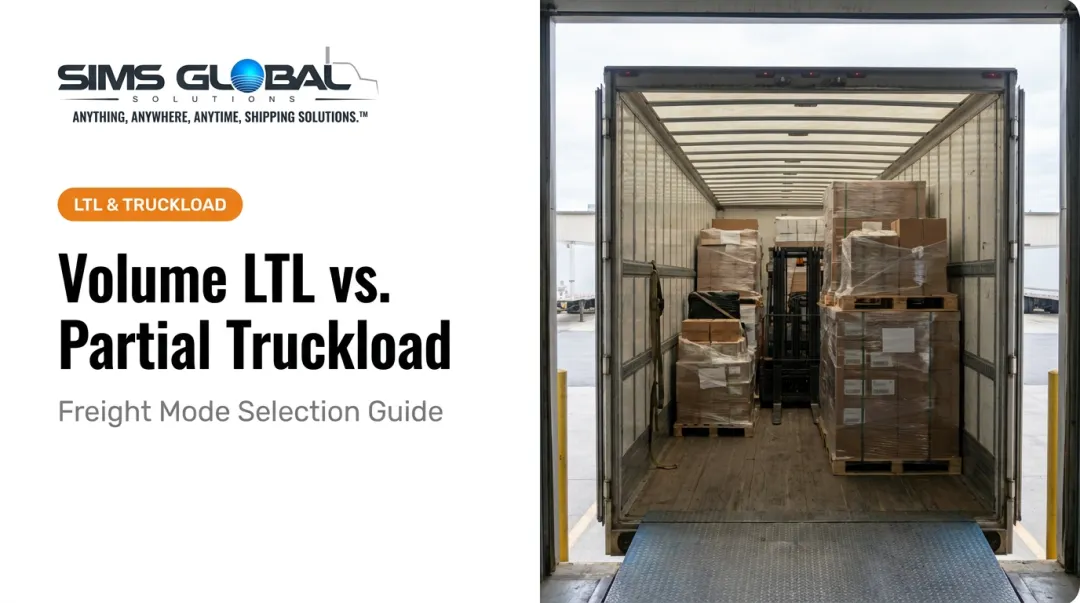
Partial truckload shipping is a freight mode that sits between LTL and full truckload. It's designed for shipments too large or heavy for standard LTL but that don't require — or can't justify — reserving an entire trailer.
Standard Size and Weight Parameters
Most carriers and brokers define PTL using these ranges:
- Weight: 5,000 to 38,000 pounds
- Pallets: 6 to 18
- Linear feet: 12 to 30 feet of trailer space
These are market conventions, not regulatory definitions. Providers set their own thresholds — Echo, for example, uses a narrower range of 8,000 to 27,500 pounds. What matters is where your freight falls relative to your carrier's specific parameters.
What "Staying on One Truck" Actually Means
In LTL, freight moves through a carrier's terminal network. It gets loaded, sorted, transferred to another truck, sorted again, and eventually delivered. Freight can pass through as many as seven terminals before reaching its destination.
PTL works differently. Your freight shares a trailer with only one to three other shippers' loads heading in the same general direction. It does not transfer between trucks during transit. That means fewer handling points, less risk of damage, and a more direct path from origin to destination.
PTL vs. Volume LTL: Not the Same Thing
Volume LTL is often confused with PTL, but the two operate differently. Volume LTL still uses freight class and carrier-published LTL rate structures — it's essentially a discount for larger LTL shipments moving through the same hub-and-spoke network. PTL pricing is based on linear feet, weight, and market conditions, with no freight classification required. PTL also typically involves fewer stops and less handling than volume LTL.
PTL vs. LTL vs. Full Truckload: Key Differences
Choosing the wrong mode is expensive. Shipping a 10-pallet load via LTL means absorbing per-pound class-based rates and multiple terminal transfers. Booking a full trailer for that same load means paying for 20 empty pallet positions.
The table below shows how each mode stacks up across the factors that matter most to shippers deciding between them.
Side-by-Side Comparison
| Factor | LTL | PTL | Full Truckload |
|---|---|---|---|
| Typical weight | Under 10,000 lbs | 5,000–38,000 lbs | 20,000–44,000 lbs |
| Typical pallets | 1–6 | 6–18 | 18–30+ |
| Freight class required | Yes | No | No |
| Terminal transfers | Multiple | None | None |
| Handling level | High | Low | Lowest |
| Transit time | Variable | More predictable | Most predictable |
| Best fit | Small, dense shipments | Mid-sized, fragile, or low-density freight | Full trailer loads |

That comparison makes PTL look appealing across the middle tier — but it's not a universal solution.
Where PTL Falls Short
PTL isn't the right call for every shipment. Avoid it when:
- The move is under 250 miles — volume LTL often wins on shorter lanes
- Freight clearly fits within standard LTL parameters (under 5,000 lbs, fewer than 6 pallets)
- Cargo is loose or unstacked and difficult to consolidate with other shipments
When your freight doesn't fit cleanly into any single category, a 3PL with multi-modal access — like Sims Global Solutions — can match the load to the right mode based on weight, lane, and handling requirements.
Key Benefits of Partial Truckload Shipping
Reduced Handling Means Less Damage
Every terminal transfer is an opportunity for freight damage. In LTL, your cargo may be loaded and unloaded multiple times before delivery. PTL's single-truck journey eliminates most of that exposure.
This matters most for freight that doesn't tolerate rough handling: medical devices, electronics, retail displays, furniture, and trade show equipment. The average LTL damage and loss rate reported in a 2025 Flock Freight survey of 1,000 transportation decision-makers was 1.24% — roughly one claim per 80 shipments. Fewer touches mean fewer opportunities for that to happen.
No Freight Classification Required
LTL pricing runs through the NMFC system — 18 classes from 50 to 500, based on density, stowability, handling, and liability. Getting the class wrong triggers a reclassification fee. ABF Freight's 2023 tariff, for instance, included a $46 reclassification charge per corrected freight bill when corrections changed charges by at least $10.
PTL sidesteps the entire system. Shippers provide dimensions, pallet count, and weight — no class lookup, no reclassification risk, no surprises on the final invoice.
More Predictable Transit Times
The 2025 Flock Freight study found average LTL on-time delivery at 82% — meaning roughly one in six shipments arrives late. PTL's limited stops and absence of terminal transfers produce tighter, more consistent delivery windows. For businesses managing just-in-time inventory or retail replenishment cycles, that predictability has direct supply chain value.
Cost Efficiency for Mid-Sized Shipments
PTL pricing is based on the linear feet or pallet positions your freight occupies. You're not paying a class-based per-pound rate inflated by density calculations, and you're not paying for an empty half-trailer.
PTL makes the strongest cost case when a shipper would otherwise book two or three LTL shipments to the same destination on the same day or week. Consolidating those moves into one PTL shipment typically delivers a better per-unit rate and fewer damage exposures.
Better Suited for Low-Density Freight
LTL classification penalizes low-density freight. High cubic volume relative to weight pushes freight into higher NMFC classes, which means higher rates. Large, lightweight items are particularly affected:
- Patio furniture and outdoor goods
- Foam and bulky protective packaging
- Trade show displays and exhibit materials
- Retail fixtures with high cube-to-weight ratios
PTL's linear-space pricing sidesteps density-driven classification entirely, which typically translates to meaningfully lower rates for these freight categories.

When Does Partial Truckload Make Sense?
The Freight Profile That Fits PTL
PTL works best when shipments fall in the 5,000 to 38,000 pound range, occupy 6 to 18 pallets, or use 12 to 30 linear feet of trailer space. Real-world examples include:
- A furniture manufacturer shipping to a regional distributor
- A medical device company moving equipment to a hospital network
- A retail brand sending branded displays to multiple store locations
- An event production company transporting trade show assets between venues
Freight Types That Consistently Benefit
- Trade show and event equipment — too large for affordable LTL, too small for FTL, and often fragile
- Building materials — flooring, cabinetry, windows
- Machinery and industrial components
- Automotive parts
- Packaged food and beverage moving from distribution centers to retail locations
The Clearest Signal You're Overpaying
If your company regularly sends two or more LTL shipments to the same destination on the same day or within the same week, you're likely paying more than necessary. PTL consolidation can often move that combined volume for less, with fewer handling events in transit.
That pattern is a practical trigger for a mode review. In the industry, this approach is often called "marrying loads" — identifying multiple partial moves heading to the same region and consolidating them into a single optimized shipment. Sims Global Solutions uses this method as a core part of its PTL service to reduce both cost and cargo handling risk.
How Partial Truckload Shipping Works
Getting a Quote and Booking
To get an accurate PTL quote, shippers typically need to provide:
- Origin and destination: Full addresses, including any dock limitations
- Pickup and delivery windows: Preferred dates and any hard deadlines
- Pallet count: Exact number of pallets being shipped
- Pallet dimensions: Length, width, and height for each
- Total shipment weight: The more accurate, the better
- Special handling needs: Liftgate, inside delivery, temperature sensitivity, or HAZMAT

Underestimating dimensions or pallet count is a common mistake — it typically results in additional charges at pickup or capacity conflicts that delay the entire load.
For shippers who want to skip the back-and-forth, Sims Global Solutions handles PTL quoting through SimsTrak — its proprietary TMS platform with live carrier rate access — or through a dedicated logistics agent. Quotes are also available via the online form at shipsims.com, with responses typically within minutes.
Pickup and Transit
Once a shipment is booked, the carrier arrives within the agreed window and loads your freight alongside typically one to three other partial loads headed in the same direction. From there, the truck moves toward the destination with minimal intermediate stops.
This is the core operational difference from LTL:
- No terminal sorts
- No consolidation hubs
- No re-sorting onto a different truck overnight
Delivery and Tracking
PTL deliveries involve fewer stops than LTL, which contributes to tighter delivery windows. Shippers should expect:
- A scheduled delivery appointment or window
- Driver offloading at the destination
- Real-time tracking updates through transit
Working with a technology-enabled broker or 3PL like Sims Global Solutions gives shippers live status updates from pickup through proof of delivery via SimsTrak.
What Affects Partial Truckload Shipping Rates?
PTL rates don't follow a published tariff structure the way LTL does. The main pricing factors:
- Linear feet or pallet positions occupied — the primary cost driver; you pay for the space you use
- Total shipment weight — especially relevant when weight approaches the trailer's limits rather than its space capacity
- Distance and lane — longer hauls cost more, and high-demand lanes carry premium rates
- Market conditions and seasonality — rates fluctuate during peak periods like holiday season or produce season, when truckload capacity tightens
- Accessorial charges — liftgate, residential delivery, and inside delivery are added on top of the base rate
Frequently Asked Questions
What is a partial truckload?
A partial truckload (PTL) is a freight mode for shipments too large for standard LTL but not large enough to justify a full trailer, typically 5,000 to 38,000 pounds or 6 to 18 pallets. Shippers pay only for the trailer space their freight occupies and the freight stays on one truck from pickup to delivery.
How many pallets qualify as a partial truckload?
Most PTL providers define the range as 6 to 18 pallets, though weight (5,000 to 38,000 lbs) and linear footage (12 to 30 feet) are equally important parameters. Exact thresholds vary by carrier and lane, so qualification depends on your specific provider.
How do I quote a partial truckload?
You'll need origin and destination addresses, pickup and delivery dates, pallet count, dimensions (L x W x H), total weight, and any special handling requirements. A freight broker or 3PL with PTL-specific carrier relationships typically delivers faster turnaround and better rates than going direct.
What are the three types of bills of lading?
The three primary types are: a straight bill of lading (non-negotiable, delivered to the named consignee; standard for domestic PTL under 49 CFR Part 1035), an order bill of lading (negotiable, used in trade financing and international transactions), and an ocean/sea waybill (used for maritime shipments).
Is partial truckload faster than LTL shipping?
Generally, yes. PTL freight bypasses LTL terminal networks and stays on one truck, which produces more predictable and often shorter transit times. The difference is most noticeable on long-haul lanes where LTL freight may pass through multiple regional carrier networks before delivery.
What is the difference between partial truckload and volume LTL?
Volume LTL uses a carrier's published LTL rate structure and still requires a freight class; it's essentially a volume discount within the same hub-and-spoke network. PTL pricing is based on linear feet, weight, and market conditions with no freight class required, and typically involves fewer stops and less handling.