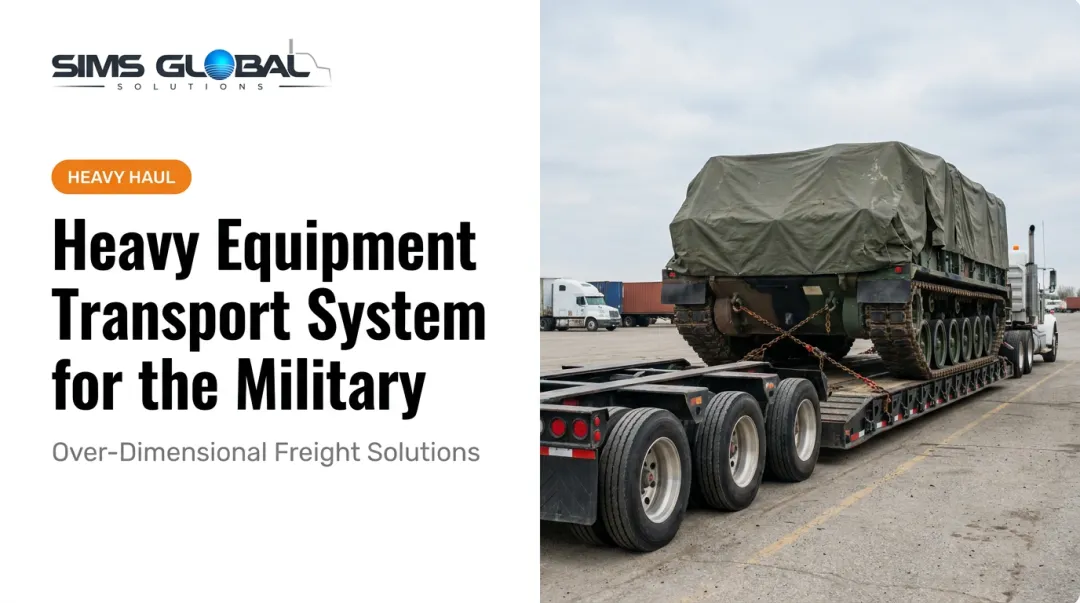

The stakes are real. The wrong carrier means damaged equipment, permit violations, project delays, and costs that spiral fast. For operations managers and logistics teams responsible for these moves, vendor selection carries genuine risk.
This article covers 10 of the top heavy equipment transport companies in the US — what each does well, how they differ, and what to look for when evaluating providers for your specific freight needs.
Key Takeaways
- Heavy equipment transport involves loads exceeding federal Interstate limits of 80,000 lbs. GVW or 8.5 ft. width, requiring specialized trailers and state oversize permits
- Top US providers vary widely by fleet type, industry focus, and geographic reach — brand name alone isn't a reliable selection criterion
- Asset-based carriers offer direct equipment control, while brokers with vetted networks provide flexibility across load types and lanes
- Permitting, escort coordination, and route planning are as critical as the trailer itself — confirm these capabilities before booking
- Some shippers benefit most from a hybrid model: a provider with owned assets and access to a broad carrier network
What Is Heavy Equipment Transport?
Heavy equipment transport covers the movement of freight that exceeds standard US legal limits on Interstate highways: 80,000 lbs. gross vehicle weight and 102 inches (8.5 ft.) in width, as established by FHWA. Height and length rules vary by state — there is no federal maximum height, and states set their own semitrailer length limits above the federally protected 48-ft floor.
Any load exceeding those thresholds requires specialized trailer equipment, state-issued oversize/overweight permits, and often pilot cars or route surveys before a single mile gets driven.
Industries That Depend on Heavy Haul
The sectors with the most consistent demand include:
- Construction — excavators, cranes, graders, and pile drivers
- Energy — wind turbine towers and blades, transformers, large generators
- Petrochemical & refining — pressure vessels, reactors, distillation columns
- Mining — haul trucks, draglines, mineral processing equipment
- Aerospace & defense — military vehicles, aircraft components, launch infrastructure
- Manufacturing — industrial presses, CNC machinery, production line equipment

The DOE has specifically documented the road and bridge transport constraints involved in moving large wind towers and turbine components — constraints that no standard carrier is equipped to navigate.
Top 10 Heavy Equipment Transport Companies in the US
Companies below were selected based on years of operational experience, fleet size and equipment variety, geographic coverage, safety record, and demonstrated capability across relevant cargo types. No particular ranking order applies.
1. Sims Global Solutions
Founded: 2010 | HQ: Lenexa, KS | TIA Member
Sims Global Solutions operates a different model from the pure asset carriers on this list — and for many shippers, that difference is an advantage. Sims combines its own fleet of heavy haul assets (RGNs, lowboys, multi-axle trailers, and double drops), operated through its asset-based carrier Kodiak Freight for direct control over trucks and capacity, with brokerage access to a network of 150,000+ vetted carriers, including 35,000+ truckload carriers.
| Category | Details |
|---|---|
| Carrier Network | 150,000+ carriers; 35,000+ truckload carriers with in-house vetting |
| Equipment Access | RGNs, lowboys, double drops, multi-axle — own fleet plus carrier network |
| Coverage | All 50 states; North America |
| Key Strength | Hybrid asset + brokerage model; SimsTrak TMS with real-time GPS tracking; A+ rated supplemental cargo insurance |
As Billy, Sims Global's Corporate Sales Manager for Heavy Haul, puts it: "The company trucking assets have opened up countless opportunities that a traditional freight brokerage would have a difficult time tapping into." That owned-asset foundation, combined with broad carrier access, positions Sims as a practical option for shippers whose freight requirements vary by project, industry, or season.
2. Landstar Transportation Logistics
Founded: 1968 | HQ: Jacksonville, FL
Landstar operates through a network of independent owner-operators and agents, giving it access to one of the most diverse specialized fleets in the country. According to its SEC filing, Landstar's network includes 8,514 BCO independent-contractor trucks and 17,426 trailers — a network-wide total that spans standard and specialized equipment.
| Category | Details |
|---|---|
| Equipment Types | RGNs, double drops, multi-axle configurations, extendable wind-blade trailers, flatbeds |
| Coverage | Nationwide US + North America; rail intermodal available |
| Key Strength | Owner-operator flexibility; 24/7 service; multimodal options |
Landstar's wind-blade trailer capability is a practical differentiator for energy sector shippers moving components that exceed standard length limits.
3. Daseke Inc. (TFI International)
Acquired by TFI: April 1, 2024 | Coverage: US, Canada, Mexico
Now part of TFI International, Daseke is North America's largest flatbed and specialized transportation company by fleet size. At the time of acquisition, Daseke reported approximately 4,900 tractors and 11,000 flatbed/specialized trailers. Its portfolio of operating subsidiaries — including Lone Star Transportation — allows shippers to access specialist capability matched to specific cargo types.
| Category | Details |
|---|---|
| Equipment Types | Flatbeds, step-decks, lowboys, RGNs, multi-axle trailers |
| Coverage | Nationwide US + Canada and Mexico |
| Key Strength | Scale, subsidiary specialization, advanced telematics |
4. Barnhart Crane & Rigging
Founded: 1969 | Locations: 70+ across the US
Barnhart handles the full project cargo spectrum under one roof — over-the-road heavy haul, barging, rigging, and on-site transport. Its equipment inventory includes 120+ Goldhofer SPMT axle lines available across the eastern US, plus dual-lane transport systems with payloads up to 800,000 lbs.
| Category | Details |
|---|---|
| Equipment Types | SPMTs, dual-lane transporters, dolly transporters, lowboys, modular trailers |
| Coverage | 70+ US locations |
| Key Strength | In-house engineering + project cargo logistics under one provider |
Barnhart's depth in petroleum refining, power generation, and nuclear sectors makes it a strong fit for energy and industrial project cargo.
5. Bennett Motor Express
Founded: 1974 | HQ: McDonough, GA
Bennett's defining feature is its H-Rating system for drivers — a tiered qualification framework that assigns load complexity to drivers based on demonstrated experience. The carrier handles super-heavy moves from 100,000 to 1,000,000 lbs. using equipment configurations up to 55 axles.
| Category | Details |
|---|---|
| Equipment Types | RGNs, stretch double-drops, dual-lane systems, 9–55 axle configurations, spread-axle flatbeds |
| Coverage | Nationwide US |
| Key Strength | Superload capability; structured driver qualification system |
Few US carriers can execute superload transport at Bennett's weight range and axle configuration depth.
6. Mammoet USA
US Operations Since: 1989 | Origin: Rosharon, TX
Mammoet operates at the intersection of engineering and transport. When a load is too complex for conventional heavy haul — for example, multi-million-pound petrochemical modules or large-scale energy installations — Mammoet brings purpose-built solutions. Its SPMTs support up to 44 tons per axle line, and the company has executed moves involving SPMT sets of 62 axle lines for a single module in Texas.
| Category | Details |
|---|---|
| Equipment Types | SPMTs, hydraulic gantry systems, ring cranes, modular trailers |
| Coverage | North America-wide; international project capability |
| Key Strength | Engineering-driven solutions for extreme-weight industrial projects |

7. Keen Transport
Founded: 1968 | HQ: Carlisle, PA | Parent: Wallenius Wilhelmsen Group
Keen specializes in construction, mining, and agricultural equipment and operates a fleet of 400+ specialized trailers handling loads up to 160,000 lbs. across combinations up to 13 axles. Its integration into the Wallenius Wilhelmsen Group adds a rare capability: ocean transport for equipment moving internationally.
| Category | Details |
|---|---|
| Equipment Types | Lowboys, RGNs, step-decks, I-beam decks, multi-axle combinations (up to 13 axles) |
| Coverage | Nationwide US + international ocean transport via parent group |
| Key Strength | Domestic heavy haul with international shipping access |
8. Maxim Crane Works
HQ: Canonsburg, PA | Locations: 50+
Maxim provides heavy lifting, rigging, and transport as an integrated service — useful for shippers who need a single provider to handle the full move, not just the road portion. Its dual-lane transport system has documented capability for loads such as 360,000-lb transformers on long-distance hauls.
| Category | Details |
|---|---|
| Equipment Types | SPMTs, dual-lane trailers, modular platform trailers, perimeter trailers, heavy-duty lowboys |
| Coverage | Nationwide US |
| Key Strength | Crane + rigging + transport as a single-source solution |
9. Mercer Transportation
Founded: 1977 | HQ: Louisville, KY
Mercer operates on a 100% owner-operator model, which gives it flexibility for complex load types. Its OSOW division handles permitted heavy haul alongside industrial and construction equipment — and the company has a documented history of Department of Defense freight.
| Category | Details |
|---|---|
| Equipment Types | Flatbeds, double-drop lowboys, step-decks, RGNs |
| Coverage | Nationwide US |
| Key Strength | Owner-operator model; DoD freight experience |
10. TMC Transportation
Founded: 1972 | HQ: Des Moines, IA | Employee-Owned Since: 2013
TMC's company-owned fleet model (rather than owner-operator) gives shippers greater consistency in equipment condition and driver training. Its Special Ops division covers OSOW needs across the 48 contiguous states, with provider-sourced stretch multi-axle capacity for oversized construction and agricultural machinery.
| Category | Details |
|---|---|
| Equipment Types | 48- and 53-ft flatbeds, step-decks, RGNs, stretch multi-axle trailers |
| Coverage | 48 contiguous US states + Canada |
| Key Strength | Consistent fleet quality; strong Midwest industrial network |
How These Companies Were Evaluated
Five criteria drove the selection of companies on this list: years of operational experience, fleet size and equipment variety, geographic reach, safety and compliance record, and demonstrated capability across relevant heavy haul cargo types.
What Shippers Often Get Wrong
The most common mistake is selecting based on brand recognition alone, without checking whether a carrier's strengths match your specific load type, route, or timeline. A nationally recognized name with a strong flatbed network may lack the modular trailers or permitting expertise your project needs.
Practical vetting questions to ask any provider:
- Do you handle permitting in-house, or subcontract it?
- Can you provide real-time shipment visibility during transport?
- What is your experience with loads of this type and weight in this corridor?
- Who handles loading coordination, escort vehicles, and route surveys?
- What happens if equipment or permitting issues cause a delay?

When a Logistics Partner Outperforms a Single Carrier
Shippers with variable freight requirements — different load types across multiple projects, or freight that spans multiple modes — often get better results working with a logistics provider that maintains both owned assets and a broad carrier network. Each shipment can be matched to the right equipment and operator, rather than defaulting to whatever a single carrier has available.
Sims Global Solutions operates this way: an owned heavy haul fleet paired with access to 150,000+ vetted carriers, so the right trailer and driver combination is selected per load — not per availability.
Conclusion
Choosing the right heavy equipment transport partner comes down to more than fleet size. Safety standards, equipment capability, permitting depth, and communication quality all matter — and the right answer varies depending on your cargo, your route, and your industry.
Start with a clear picture of your requirements: weight, dimensions, origin, destination, timeline, and any industry-specific regulations. Then get itemized quotes from at least three providers before committing.
For businesses that need a reliable, tech-forward partner with SimsTrak TMS visibility to coordinate heavy haul shipments across the US, Sims Global Solutions offers owned fleet assets, access to an extensive vetted carrier network, dedicated operations support, and real-time tracking from origin to delivery. Contact Sims Global Solutions at 855-326-8671 or ContactSims@ShipSims.com to discuss your next heavy equipment transport project.
Frequently Asked Questions
What qualifies as a heavy equipment transport load?
Any freight exceeding federal Interstate limits qualifies — that means over 80,000 lbs. gross vehicle weight or wider than 8.5 ft. on the National Network. Common examples include excavators, crawler cranes, large transformers, pressure vessels, and industrial machinery. State-specific rules may trigger permit requirements at lower thresholds.
Do heavy equipment transport companies handle permits?
Most reputable carriers and brokers manage state-by-state oversize/overweight permits as part of their service. Permit costs, processing times, and route requirements vary significantly by state and load dimensions — always confirm whether permitting is handled in-house or subcontracted.
What types of trailers are used for heavy equipment transport?
The most common trailer types are lowboys and RGNs (removable gooseneck) for tall or heavy machinery, step-decks for freight too tall for a standard flatbed, multi-axle combinations for extreme weights, and SPMTs for massive industrial components requiring multi-directional movement.

How much does heavy equipment transport cost?
Pricing depends on load dimensions, total weight, distance, permit costs, escort vehicle requirements, route complexity, and fuel surcharges. No universal rate applies — request itemized quotes directly from multiple carriers or brokers to compare total costs accurately.
How far in advance should I book heavy equipment transport?
Standard heavy haul moves typically need at least one to two weeks of lead time. Complex multi-state superloads — those requiring route surveys, multiple permit approvals, or escort coordination — can extend to four to six weeks or more, as permitting timelines vary by state and load classification.
What is the difference between a heavy haul carrier and a freight broker for heavy equipment?
Asset-based carriers own their equipment and employ their drivers, providing direct operational control. Freight brokers connect shippers to a network of vetted carriers, offering broader equipment access and flexibility. Hybrid providers like Sims Global Solutions combine both — owned assets plus a large carrier network — giving shippers the reliability of a direct operator alongside the scale of a brokerage.