Introduction
Your shipment doesn't fit the mold. It's too big for a handful of pallets, but nowhere close to filling a 53-foot trailer. If you've ever stared at a freight quote wondering why your 8-pallet load is getting priced like it's twice the size, you're not alone.
Standard LTL pricing runs on freight class and density. Once your shipment crosses a certain size, that math starts working against you. That's where volume quotes come in: a pricing approach built specifically for freight that falls between LTL and truckload.
This guide breaks down what a volume quote actually is, how it stacks up against standard LTL and full truckload, and how to request one that won't leave you guessing at pickup.
Key Takeaways
- Volume quotes price freight by space used, not freight class, typically for 6-11 pallets
- Carrier qualifying thresholds vary, so shop the same shipment across multiple carriers
- Quotes may expire in as few as two business days—confirm validity before scheduling pickup
- Brokers with direct carrier API access speed up comparison shopping
What Is an LTL Volume Quote?
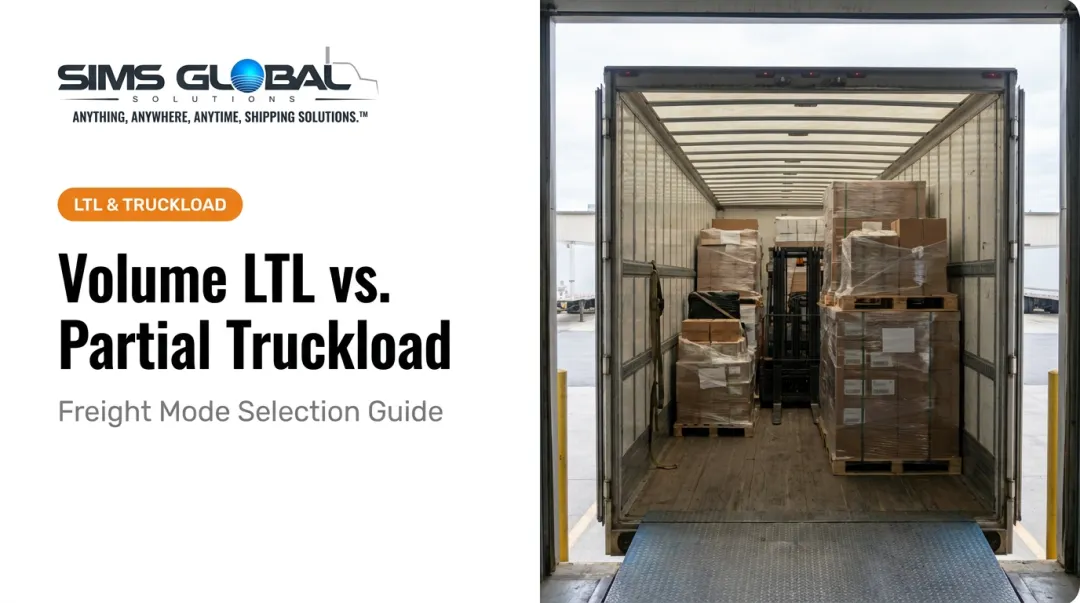
A volume quote is pricing for a shipment that's larger than standard LTL but doesn't need an entire truckload. Instead of rating your freight by class, density, and NMFC code, carriers price it based on how much trailer space it consumes.
Think of it as freight sold by the foot rather than by the pound-and-class combination that governs typical LTL rates.
Qualifying Criteria Vary Widely By Carrier
There's no single industry-wide cutoff for what counts as "volume" freight. Each carrier draws its own line:
- Estes sets its volume LTL threshold at 5,000 pounds or 8 linear feet of trailer space
- Saia routes shipments above 10 pallet spaces or 16 feet to its spot quote process
- R+L Carriers reserves its volume/truckload form for shipments of 20,000 pounds or 20+ feet
Most shippers can use 6+ pallets, 5,000+ pounds, or 12-32 linear feet as a rough starting point, but always confirm the specific carrier's rule before assuming your freight qualifies.
Why "Volume" Quotes Are Also Called Spot Quotes
Carriers price volume freight this way because they're filling gaps. A truck running a lane with unused capacity or heading back empty on a backhaul represents lost revenue. Volume pricing lets that carrier monetize the extra space instead of running it empty.
Carriers often call this a spot quote because the rate is tied to one lane and one truck at that moment, not a published tariff. It's a live capacity match, recalculated whenever open space changes.
Volume Quote vs. Standard LTL vs. Full Truckload
Choosing the right pricing model comes down to how much of the trailer your freight actually needs.
| Shipping Method | Pricing Basis | Best Fit |
|---|---|---|
| Standard LTL | Freight class + density | Smaller, lighter loads, generally under 6-8 pallets |
| Volume/Spot LTL | Actual trailer space used | Mid-size loads, roughly 6-11 pallets or 8,000+ lbs |
| Full Truckload | Flat rate for the whole trailer | Loads at 12+ pallets or filling most of the trailer |
Standard LTL works well until your freight starts eating into cubic capacity charges. Full truckload makes sense once you're using most of the trailer anyway, since paying for empty space defeats the purpose. Volume quotes fill the space in between, where neither option fits cleanly.
Decision Thresholds by Pallet Count and Weight
For stackable pallets, a general decision guide looks like this:
- 1-8 pallets — Standard LTL, unless total weight exceeds roughly 8,000 lbs
- 9-10 pallets — Request a volume or partial truckload quote alongside your LTL rate
- 11+ pallets — Get quotes across all three methods (LTL, volume, and full truckload)

Non-stackable or oddly shaped pallets change the math because they consume more floor space per unit, shifting these thresholds lower. A load of 7 non-stackable pallets can eat as much trailer space as 10 stackable ones.
Request quotes across multiple methods whenever you're near these thresholds. The cheapest option shifts based on lane, carrier capacity, and time of year, so one quote alone won't tell you the full picture.
Key Benefits of LTL Volume Quotes
Volume pricing isn't just a workaround for awkward-sized freight. It brings real advantages when the shipment fits.
Cost control. You pay for space used rather than getting hit with density-based class pricing or cubic capacity minimums. Redwood Logistics notes that volume pricing typically costs less than rating the same large shipment as standard LTL, since it's based on the actual footprint your freight occupies in that lane.
Fewer touches, less damage risk. Volume shipments often move dock-to-dock with minimal terminal handling. Less handling means fewer chances for something to get dropped, crushed, or misrouted between transfers.
Better fit for low-density freight. If you're shipping lightweight, bulky items, such as cushions, insulation, or packaging materials, space-based pricing works in your favor. Weight-based LTL rates punish low-density freight; volume pricing doesn't.

Here's the trade-off worth knowing:
- Volume quotes take longer to process than instant LTL rates
- Carriers manually assess whether your shipment fits an available route
- RXO points out that this capacity depends on backhauls and network gaps, meaning availability can shift day to day
This is where a broker with direct carrier connections earns its keep. Sims Global Solutions maintains API integrations with more than 70 national and regional LTL carriers, which means volume rates from multiple carriers can surface almost simultaneously instead of shippers waiting on manual quotes one at a time.
How to Get an Accurate Volume Quote
Volume quotes live and die on data accuracy. Vague dimensions or estimated weights lead to reclassified rates and surprise charges later.
Carriers typically need:
- Precise dimensions: length, width, and height for each handling unit
- Total weight and per-pallet weight when possible
- Commodity description, including any hazardous material flags
- Estimated ship date and origin/destination
Beyond gathering these details, treat every volume quote as a one-off. Unlike a published LTL tariff, a volume quote ties to a specific carrier, lane, and moment in time.
Document the quote number prominently on the Bill of Lading before pickup. This is what ties your shipment to the negotiated rate rather than a default LTL charge.
Watch the Expiration Clock
Volume quotes don't stay valid indefinitely. Depending on the carrier, expiration windows range anywhere from a couple of days to about a month. Some carriers hold pricing longer if your shipment details don't change; others reprice based on capacity shifts almost immediately.
Fuel costs, weather disruptions, and lane capacity all factor into how long a quote holds. Confirm validity before you schedule pickup, especially if there's any gap between quoting and shipping.
Common Challenges and Limitations to Watch For
Volume quotes solve a real pricing problem, but they come with friction points shippers should plan for.
Inconsistent definitions make comparison shopping hard. One carrier quotes by floor space, another by pallet count, and a third by cubic capacity. Comparing quotes apples-to-apples takes more legwork than comparing standard LTL rates.
Accessorials aren't automatic. Many carriers limit or exclude services like liftgate delivery or inside delivery on volume shipments unless specifically requested at quote time. Standard negotiated accessorial terms often don't carry over to spot pricing.
Before booking, confirm:
- Whether liftgate service is included or needs separate approval
- Inside delivery availability at the destination
- Any residential delivery restrictions
- Storage or delayed pickup terms
Capacity can disappear. Because volume freight fills gaps in existing routes, carriers can decline a load or reprice it if it no longer fits their lane economics. This is the nature of spot pricing, and shippers who need guaranteed capacity on a fixed schedule should factor in some flexibility, or consider full truckload instead.
How Sims Global Solutions Simplifies Volume Quoting
Sourcing volume rates manually means calling or emailing multiple carriers and waiting hours, sometimes longer, for each response. That delay doesn't work well for freight that's often time-sensitive by nature.
Sims Global Solutions shortens that timeline through direct API integrations with more than 70 of the nation's top LTL carriers. Shippers compare volume rates across carrier networks in one pass instead of chasing individual quotes.
That speed matters most when a load needs to move fast to catch available capacity.
Sims also operates its own trucking assets alongside its proprietary SimsTrak TMS platform. That combination gives shippers access to options a pure brokerage, without owned equipment, typically can't offer. It matters most for last-minute volume freight, when standard capacity has already dried up.

Beyond the technology, Sims' operations team works through the details that trip up shippers most often:
- Matching shipments to carrier-specific volume thresholds instead of guessing
- Confirming which accessorials are included on a given quote
- Making sure the quote number lands on the Bill of Lading before pickup so the negotiated rate sticks
For shippers moving freight that regularly falls into that 6-11 pallet gray zone, having a team that already knows where each carrier's line is drawn saves real time. It also prevents billing surprises down the line.
Frequently Asked Questions
What is a volume quote?
A volume quote is pricing for freight larger than a standard LTL shipment but smaller than a full truckload. Carriers base the rate on the trailer space your shipment uses rather than freight class or density.
How is a volume quote different from a standard LTL quote?
Standard LTL pricing is based on freight class and density, which works well for smaller, lighter shipments. Volume quotes price by the actual space a larger, partial load consumes in the trailer.
How many pallets or how much weight qualifies for a volume quote?
General industry ranges start around 6+ pallets, 5,000+ pounds, or 12+ linear feet. These thresholds vary by carrier, so always confirm with the specific carrier quoting your freight.
Do volume quotes expire?
Yes. Volume quotes expire due to shifting fuel prices, capacity changes, and weather disruptions. Validity windows range from just a couple of days to as long as a month, depending on the carrier.
Do all carriers offer volume quote pricing?
Availability varies by carrier and depends on their network and lane capacity at the time. A carrier can decline a volume load entirely if it doesn't fit their route economics.
Can a volume quote replace a full truckload shipment?
No. Volume quotes cover a specific middle-ground range of freight size. Shipments that fill most or all of a trailer are better served, and typically priced better, through full truckload.