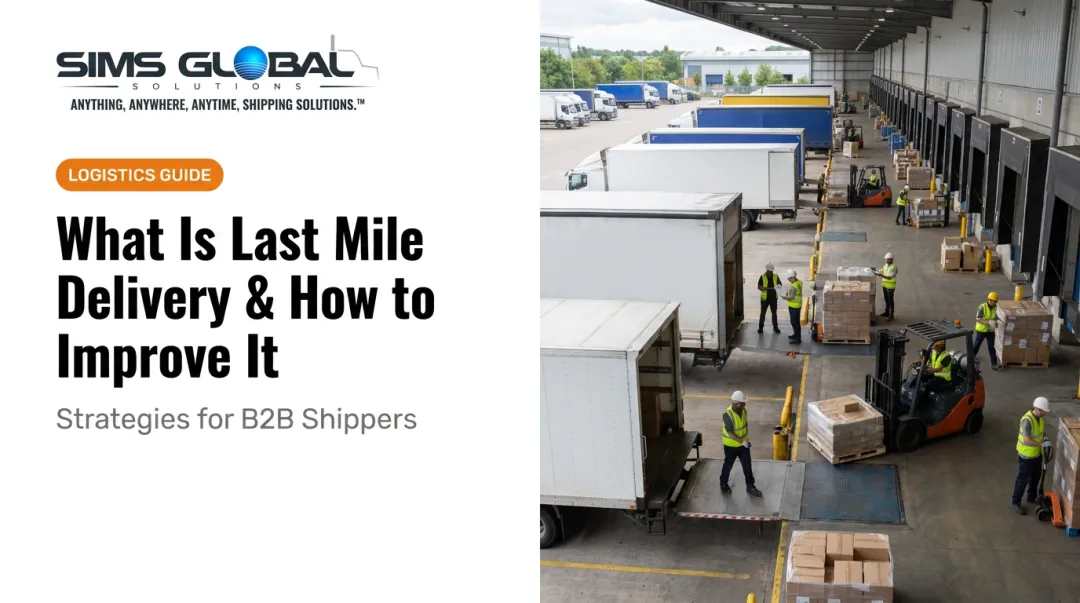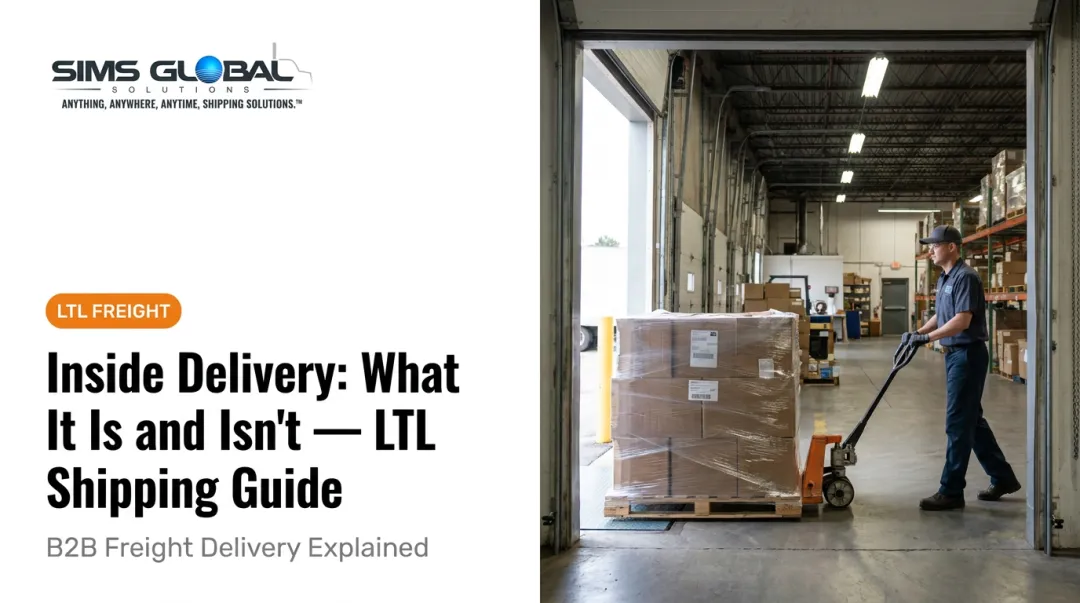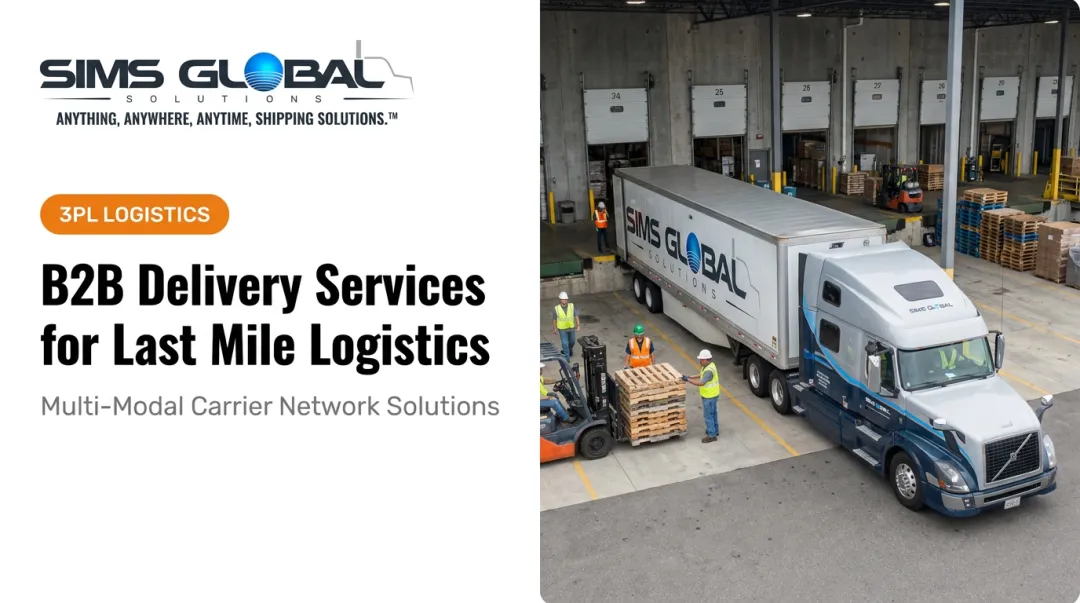

That expectation gap shows up most sharply in final mile delivery, the last stretch of the journey where goods leave a hub and land on a customer's dock, warehouse floor, or loading zone. It's also the leg most businesses underestimate. Final mile delivery is frequently the most expensive and operationally complex part of the entire supply chain, yet many shippers treat it as an afterthought until something goes wrong.
This guide breaks down what final mile delivery actually involves, why it's such a persistent challenge, and how the right logistics partner can turn it from a cost center into a competitive edge.
Key Takeaways
- Final mile delivery moves goods from a warehouse to the end customer, the last leg of shipping
- Also called "last mile delivery," it can account for up to 40% of shipping costs for bulky freight
- Route inefficiencies, failed deliveries, and demands for real-time tracking are the biggest pain points
- Optimized routing, proof-of-delivery confirmation, and strategic warehouse placement all reduce final mile costs
- A multi-modal logistics partner with nationwide warehousing simplifies the final mile handoff
What Is Final Mile Delivery?
Final mile delivery is the last stage of the supply chain: the movement of goods from a distribution hub, warehouse, or transportation terminal directly to the end customer. It's the shortest leg in terms of distance but often the longest in terms of complexity.
Why? Because this is the one moment in the entire shipping process where the customer actually sees what's happening. A flawless cross-country haul means nothing if the delivery shows up late, damaged, or at the wrong loading dock.
The Final Mile Delivery Process, Step by Step
While every shipper's workflow looks slightly different, most final mile operations follow a similar pattern:
- Log the order — The shipment enters a centralized system, triggering the routing and scheduling process.
- Transfer to a local hub — Goods move from a regional distribution center or warehouse to a local transportation terminal closer to the delivery zone.
- Assign the route — Optimized routing assigns orders to drivers based on delivery windows and stop density.
- Scan and load at the warehouse — Staff scan and load shipments onto the correct vehicle, verifying accuracy before departure.
- Deliver and capture proof — The driver completes the delivery and captures confirmation, whether that's a signature, photo, or timestamp.

On paper, that's five straightforward steps. In practice, each one introduces variables that add friction: traffic delays, a driver unfamiliar with the route, a missed dock appointment, or a truck that's already at capacity before the last stop. That's the gap between how final mile delivery sounds and how it actually runs.
Why Final Mile Delivery Matters
Here's the number that should get every shipper's attention: the final leg of a shipment's journey can account for up to 28% of total transportation costs. For heavy or bulky freight like furniture, appliances, and industrial equipment, that share climbs to 30% to 40% of total transportation cost, according to a FreightWaves report on final mile delivery challenges.
That's a disproportionate cost burden for the shortest leg of the trip. Several factors drive that number up:
- Fragmented delivery stops across residential and commercial addresses
- Urban traffic congestion that slows every route
- Service-heavy freight requiring inside delivery or installation
But cost isn't the only reason this stage deserves attention. Final mile delivery is also the most customer-facing touchpoint in the entire logistics chain. A shipment can travel flawlessly for a thousand miles and still leave a bad impression if the last 10 miles go wrong.
The upside: businesses that get this stage right turn a historic cost center into a genuine competitive advantage. Reliable, transparent final mile delivery drives repeat business, reduces support tickets, and builds the kind of trust that keeps B2B customers coming back instead of shopping around.
Final Mile Delivery vs. Last Mile Delivery: What's the Difference?
Short answer: there isn't one. "Final mile" and "last mile" describe the same stage of the shipping journey and are used interchangeably across the industry. Neither term refers to a specific transportation mode. Both simply describe the final leg and the service experience wrapped around it.
You'll sometimes notice a slight pattern in usage, with "last mile" showing up more in consumer tech and software conversations, and "final mile" appearing more often in freight and 3PL circles. But that's more habit than hard rule, and the operational goal never changes.
Where the terminology does matter is in what the delivery actually involves:
- Standard parcel-style final mile: simple drop-off at a door or dock, common for smaller shipments
- Threshold delivery: carrier brings the shipment to the doorway or garage without unpacking, a middle step between dock drop-off and full white-glove service
- White-glove or inside delivery: for heavier, bulkier, or freight-class shipments like furniture, appliances, or industrial equipment, where the item needs to go inside a building, get unpacked, or even get installed
Whatever term your provider uses, the job is the same: get the goods to the customer efficiently, intact, and on schedule.
Common Challenges Businesses Face in Final Mile Delivery
Final mile delivery collects nearly every operational headache in logistics into one stage. Here's where things typically break down.
These challenges show up most often:
- High operational costs: Fuel, labor, and vehicle maintenance eat into margins fast, especially with fragmented stops instead of efficient long-haul lanes. Margins for heavy and bulky freight have declined further as diesel, insurance, and labor costs climb.
- Route inefficiencies and urban congestion: Missed time windows, wasted fuel, and fewer stops per day often trace back to poor routing decisions or traffic that plans didn't account for.
- Failed or missed deliveries: Incorrect addresses, unavailable recipients, or restricted access trigger costly re-delivery attempts, stacking extra labor and fuel costs onto an already expensive leg.
- Lack of real-time visibility: In a survey of 234 retail and manufacturing shippers, 57.4% said real-time visibility was a prerequisite just to be considered as a carrier, and nearly 30% cited its absence as a major operational disruption.
- Rising delivery speed expectations: The 29th Annual Third-Party Logistics Study found 48% of shippers and 53% of 3PLs now expect delivery within two days or less, a pace smaller fleets and manual scheduling processes weren't built for.

How to Optimize Final Mile Delivery
None of these challenges are unsolvable. Businesses that invest in the right combination of technology and network strategy consistently see measurable improvement.
- AI-powered route planning: Software that factors in traffic, vehicle capacity, driver experience, and delivery windows increases stops-per-day and lowers cost-per-delivery
- Real-time tracking and two-way communication: SMS and email updates with live ETAs cut down on failed deliveries and reduce inbound support calls
- Electronic proof of delivery: Photos, signatures, and geo-stamps reduce billing disputes and give both parties a clear record
- Strategic warehouse placement: Positioning inventory in facilities or micro-fulfillment centers closer to end customers physically shrinks the final mile
- Ongoing KPI analysis: Tracking on-time rate, cost-per-delivery, and customer satisfaction scores helps identify bottlenecks before they become chronic
- Multi-modal partnerships: Working with a single provider for long-haul, LTL, and final mile removes handoffs that cause delays and damage
McKinsey's research on logistics handovers backs this up at scale. Blind handoffs between mid-mile and last-mile logistics create an estimated 13% to 19% of total logistics costs in the sectors studied. Closing that visibility gap with better technology can cut much of that waste.
How Sims Global Solutions Supports a Seamless Final Mile
Optimizing the final mile gets a lot easier when your inventory doesn't have far to travel and your provider handles everything from long-haul to the last drop-off point.
Warehousing that shortens the distance. Sims Global Solutions maintains 33 million square feet of warehousing across 96 locations in 48 markets nationwide. That footprint lets businesses position inventory closer to where their customers actually are, cutting the physical distance final mile drivers need to cover.
Full visibility through the handoff. SGS's proprietary SimsTrak TMS gives shippers real-time tracking across the entire shipment lifecycle, including the final-mile handoff where things most often go sideways. It's backed by direct API integrations with 70+ of the nation's top LTL carriers, so freight data moves as fast as the truck does.

One provider, no extra handoffs. SGS combines an owned heavy-haul fleet with brokerage access to 150,000+ vetted carriers, spanning TL, LTL, Expedited, Intermodal, Drayage, Warehousing, and Fulfillment.
A shipment can move from origin through final delivery without a customer juggling multiple vendors. That includes parcel-style drop-offs and white-glove inside delivery for furniture and industrial equipment.
For businesses ready to stop treating the final mile as an afterthought, contact Sims Global Solutions to build a shipping solution tailored to your freight, your markets, and your customers' expectations.
Frequently Asked Questions
What is a final mile delivery?
Final mile delivery is the last leg of the shipping journey, where goods move from a distribution hub or warehouse to the end customer's doorstep. It's used interchangeably with "last mile delivery" throughout the industry.
Who delivers last mile packages?
Parcel carriers, regional couriers, retailers' own delivery fleets, and third-party logistics providers or freight brokers all handle last mile deliveries by coordinating local delivery networks. The right provider depends on shipment size and service requirements.
Is final mile delivery the same as last mile delivery?
Yes, the terms are interchangeable. "Last mile" shows up more often in consumer tech and software contexts, while "final mile" is more common among 3PLs and freight brokers, but both describe the same delivery stage.
Why is final mile delivery so expensive?
Fragmented delivery stops, urban traffic congestion, labor costs, and fuel consumption all drive up final mile expenses. For heavy or bulky freight, this leg can represent up to 40% of total transportation cost.
How can businesses reduce final mile delivery costs?
Route optimization, strategic warehouse placement closer to end customers, and partnering with an experienced multi-modal logistics provider are the most effective ways to lower final mile costs.
What industries rely most on final mile delivery?
E-commerce, retail, furniture and appliance, industrial equipment, and grocery sectors depend heavily on efficient final mile delivery to meet customer expectations and protect their bottom line.