This scenario plays out more often than most shippers expect. Standard 20-foot and 40-foot containers can't handle out-of-gauge (OOG) freight — cargo too wide, too tall, or too long for a fully enclosed box. Choosing the wrong equipment means delays, rebooking fees, and sometimes a scramble for breakbulk space at a much higher price.
This guide breaks down what a flat rack container is, how it works, when it makes sense, and how to get oversized cargo safely to and from the port.
Key Takeaways
- Flat racks are open-sided containers built for cargo too big for standard boxes
- Collapsible models fold flat for compact storage and return shipping
- Fixed models handle heavier, more awkward loads requiring extra structural support
- Rates run higher than standard containers due to crane handling and lashing requirements
- Reaching the port often requires specialized flatbed or heavy haul trucking first
What Is a Flat Rack Container?
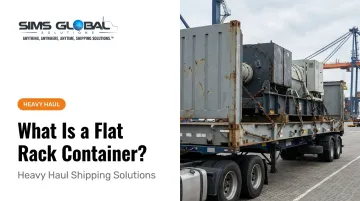
A flat rack container has a reinforced steel base and sturdy end walls, but no side walls and no roof. That open design is the entire point: it lets shippers load cargo that would never fit through a standard container's door opening.
Instead of squeezing freight into a boxed unit, crews lower or slide cargo directly onto the deck with a crane or forklift. According to the IMO/ILO/UNECE Code of Practice for Cargo Transport Units, a flat rack is officially a platform-based container with no side superstructure and either fixed or collapsible end walls. This distinguishes it from a bare platform, which has no walls at all.
Types of Flat Rack Containers
Two configurations dominate the market:
- Collapsible flat racks: End walls fold down flat, making empty stacking and storage far more space-efficient. These are the most common type in circulation.
- Fixed (non-collapsible) flat racks: End walls stay upright permanently. Built for extremely heavy or awkward loads, but they take up more yard space when empty.
Standard Flat Rack Dimensions
Dimensions vary slightly by carrier fleet, but these are the approximate internal measurements shippers can expect:
| Container | Internal Length | Internal Width | Internal Height |
|---|---|---|---|
| 20-ft standard | 18'5" | 7'8" | 7'3" |
| 40-ft standard | 39'5" | 7'8" | 6'5" |
| 40-ft high cube | 39'5" | 7'8" | 7'5" |
Hapag-Lloyd confirms its 40-foot high-cube flat rack units carry a 9-foot-6-inch external height, giving taller cargo the extra clearance a standard 8'6" unit can't offer. Because there's no roof or side walls, cranes and forklifts can load from above or the side. That flexibility cuts down the damage risk that comes with wrestling oversized freight through a narrow door opening.
How Does a Flat Rack Container Work?
Loading starts with a crane or forklift setting the cargo directly onto the flat rack's deck. From there, the process follows a consistent sequence:
- Position the cargo using a crane (top-lift) or forklift, aligning it over the rack's main structural girders.
- Bed and block the load with dunnage or anti-slip material so metal doesn't sit directly on metal.
- Lash the cargo with chains or straps anchored to securement points built into the floor and end walls.
- Verify the load plan to confirm the center of gravity stays balanced and weight spreads evenly.

This isn't a quick strap-and-go job. A short load resting on a small footprint can cut the rack's allowable payload in half, depending on the carrier's engineering standards.
Once secured, the loaded flat rack moves onto the vessel through lift-on/lift-off (Lo/Lo) service, the same crane-based system used for standard boxed containers. Flat racks can stack much like regular containers, though exact stacking limits depend on the individual unit's certification plate rather than one industry-wide number.
One trade-off worth planning for: because flat racks have no roof or side walls, crews usually wrap cargo in tarps for partial weather protection. That's a real difference from a fully enclosed dry container, which shields freight from rain, dust, and theft for the entire voyage.
When Should You Use a Flat Rack Container?
Flat racks exist for one primary purpose: moving out-of-gauge (OOG) cargo, freight that's too wide, too tall, too long, or some combination of the three, to fit inside a standard container.
Maersk defines OOG cargo as freight that exceeds a flat rack or open-top container's normal envelope but still moves through the container shipping system, as opposed to breakbulk cargo, which exceeds even specialized container limits.
Cargo types best suited for flat racks include:
- Heavy machinery: excavators, bulldozers, cranes, and other construction equipment
- Industrial components: steel beams, large-diameter pipes, transformers, and generators
- Vehicles and boats that exceed standard container dimensions
- Military and defense equipment, including bulky or oversized units
Flat racks aren't limited to cargo that can't physically fit anywhere else. Bundled pipe or long metal stock, for instance, will technically fit inside a standard container, but loading it onto an open flat rack from the top is faster and reduces handling damage.
Sailing schedules offer another advantage:
- More options: Flat racks travel on the same vessels as standard containers, unlocking far more sailing choices
- Fewer restrictions: Breakbulk and roll-on/roll-off (Ro/Ro) shipments run on limited, specialized schedules
- Faster transit: That flexibility can shave weeks off transit time
One more reality check: flat rack availability shifts by region and season, and specialized units aren't always sitting at every port ready to go.
Booking early with a logistics partner who understands current equipment positioning, rather than discovering a shortage after cargo is ready to move, makes the difference between hitting a sailing window and missing it. Sims Global Solutions tracks flat rack availability and equipment positioning across ports, helping shippers lock in space before it disappears.
Flat Rack vs. Flatbed vs. Standard Shipping Container
These three terms get mixed up constantly, and the confusion is understandable since flat racks and flatbeds share a similar open-deck concept.
Flat rack vs. flatbed: A flat rack is an ocean shipping container, built to ISO specifications and lifted by cranes onto vessels. A flatbed is a domestic road trailer, pulled by a truck on highways. Both have an open, wall-less deck for oversized loads, but one moves by sea and the other by road.
Flat rack vs. standard container: Standard containers fully enclose cargo, protecting it from weather and theft at a lower cost, and they're far more widely available. Flat racks trade that protection for loading flexibility, letting oversized cargo go where a boxed container simply can't.
| Equipment | Where It Operates | Best For |
|---|---|---|
| Flat rack | Ocean vessels, ports | OOG cargo needing crane or top loading |
| Flatbed | Highways, domestic roads | Trucking oversized cargo to and from ports |
| Standard container | Ocean vessels, rail, roads | General cargo needing full enclosure |

In practice, these pieces of equipment work together rather than compete. A shipper typically uses a flatbed trailer to move cargo overland to the port, where it's transferred onto a flat rack container for the ocean voyage. That handoff is often where delays and damage happen if it isn't planned properly. Sims Global Solutions coordinates this transition by pairing flatbed trucking with ocean carrier bookings, so cargo moves from road to vessel without unnecessary dwell time.
Cost and Pros/Cons of Flat Rack Container Shipping
Flat rack rates don't follow a fixed price sheet. They shift based on cargo weight, dimensions, origin and destination, and port handling fees. Flat rack shipping costs more than standard container shipping because it requires specialized cranes, trained operators, and extra lashing work that a standard box never needs.
That extra cost often buys meaningful flexibility for oversized or unconventional cargo.
Advantages of flat rack shipping:
- Handles out-of-gauge (OOG) cargo that won't fit in a boxed container
- Allows top and side loading, which speeds up handling and reduces damage risk
- Skips the need to disassemble large equipment before shipping
- Opens up more sailing schedule options than breakbulk or Ro/Ro service
Those benefits come with trade-offs worth knowing before you book.
Disadvantages to weigh:
- Higher cost from specialized crane and operator requirements
- Less availability than standard containers, especially during peak season
- Limited inland mobility, since flat racks typically stay at ports rather than get trucked long distances
- Greater exposure to weather and theft risk due to the open design
Before booking, Sims Global Solutions recommends asking a straightforward question: does this cargo actually require a flat rack, or would it fit, and ship more affordably, inside a standard container? Bundled pipe, disassembled equipment, or slightly oversized freight sometimes fits into a standard box with the right packing plan.
Getting Your Cargo To and From the Port: Why the Domestic Leg Matters
A flat rack container never arrives at the port by itself. Before cargo ever touches a crane, it has to travel overland, often on flatbed, step-deck, or heavy haul equipment built for oversized dimensions. The same holds true in reverse once cargo reaches its destination port.
This domestic leg is where a lot of oversized shipments run into trouble. A truck without the right axle configuration, permits, or route survey can turn a straightforward pickup into a multi-day delay.
This is where Sims Global Solutions focuses its attention. As a hybrid logistics provider, Sims operates its own heavy haul fleet, including RGN, lowboy, and multi-axle trailers. That fleet is backed by a network of more than 150,000 vetted carriers, giving shippers access to the right equipment whether cargo is moving five miles or 500.

What that looks like in practice:
- Heavy haul trucking: Company-owned assets built for oversized, overweight freight
- Carrier network depth: Backup capacity through an in-house vetted carrier procurement process when equipment is scarce
- Drayage services: Connecting shipper facilities directly to port terminals
- SimsTrak visibility: Real-time tracking so shippers know exactly where cargo stands before it hits the crane
Working with a logistics partner who handles this domestic leg with the same precision as the ocean carrier reduces the risk of missed sailing windows and keeps oversized freight moving instead of sitting on a dock.
Frequently Asked Questions
What is a flat rack shipping container?
A flat rack is an open-sided, roofless shipping container with reinforced end walls, built to carry oversized or out-of-gauge cargo that won't fit inside a standard container. It allows crane or forklift loading from the top or side.
How much does a flat rack container cost?
Costs vary based on cargo size, weight, shipping route, and port handling fees. Expect rates higher than standard container shipping, since flat racks require specialized cranes and additional lashing work.
What is the difference between a flatbed and a flat rack container?
A flatbed is a domestic road trailer used for highway trucking, while a flat rack is an ocean shipping container lifted onto vessels by crane. Both share an open-deck design for oversized loads, but they operate in different transport modes.
What size is a flat rack container?
Flat racks come in standard 20-foot and 40-foot lengths, with 40-foot high-cube versions offering extra vertical clearance for taller cargo. Internal dimensions vary slightly by carrier fleet.
What types of cargo cannot be shipped in a flat rack container?
Cargo needing full weather protection, small or loose items, and goods vulnerable to theft are poor fits for flat racks since they have no walls or roof. These items are better suited to a standard enclosed container.
Are flat rack containers weatherproof?
No. Flat racks lack a roof and side walls, so cargo is typically tarped for partial protection during transit. A tarp is no substitute for the enclosed protection a standard container provides.