
The equipment itself is only half the equation, though. Conestoga capacity is limited and specialized, which means finding a Conestoga trailer trucking company with real access to this equipment matters just as much as understanding how it works.
This guide covers what a Conestoga trailer is, the three main types, who uses them, and how to pick a trucking partner that can actually deliver capacity when you need it.
Key Takeaways
- Conestoga trailers pair flatbed versatility with a retractable tarp system for weather protection.
- Three trailer types exist: flatbed, step-deck, and double drop, built for different freight heights and weights.
- Limited nationwide availability makes carrier network size and vetting critical to on-time bookings.
- Sims Global Solutions' carrier network and SimsTrak technology deliver vetted Conestoga access, guesswork-free.
What Is a Conestoga Trailer?
The name traces back further than most people expect. Pennsylvania Germans near the Conestoga River in Lancaster County began building Conestoga freight wagons around 1750, using them to haul goods long before railroads existed according to the Smithsonian's National Museum of American History.
These weren't the covered wagons of westward-bound settlers. They were dedicated freight haulers, built to move cargo efficiently across rough terrain.
That freight-first purpose is exactly why the name stuck to modern trucking equipment centuries later.
How the Modern Trailer Works
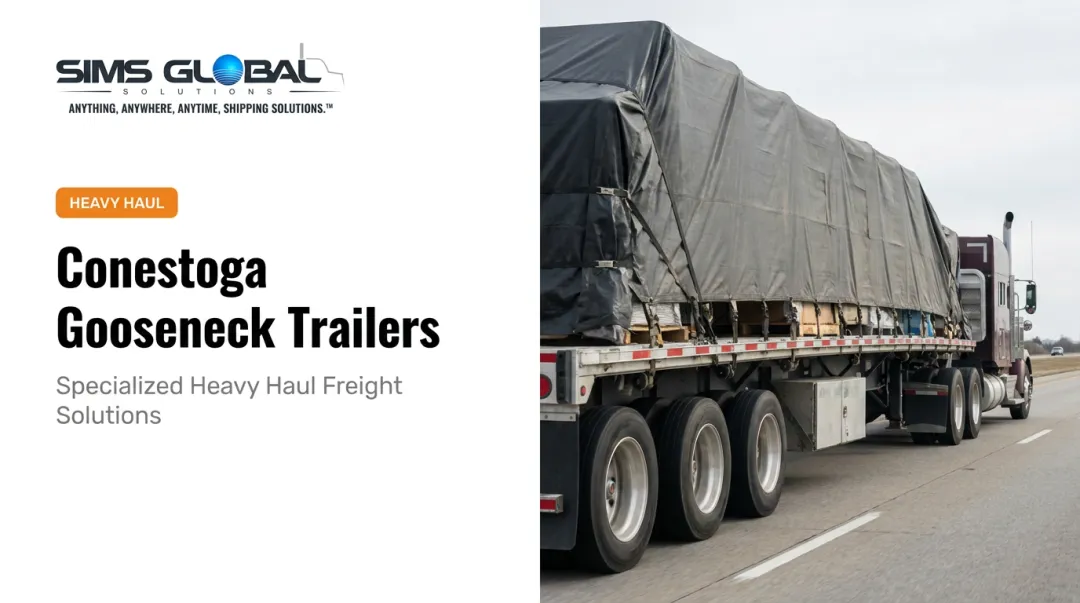
A Conestoga trailer starts with a flatbed base. On top of that base sits a retractable tarp-on-frame system that slides along tracks, similar to a rolling curtain. Operators can retract the cover for side, rear, or top loading, then extend it to seal cargo against rain, snow, wind, and road debris.
Aero Industries, one of the original manufacturers of this rolling tarp design, introduced its version in 1984, and the mechanics haven't changed much since. Steel wheels ride in an internal track while uplift bows keep the tarp from sagging onto the freight below.
Conestoga vs. Flatbed vs. Dry Van
The easiest way to understand where a Conestoga fits is to compare it against the two trailer types it borrows from:
| Equipment | Loading Access | Protection | Typical Capacity |
|---|---|---|---|
| Standard flatbed | Fully open, load from any side | None built in | Varies by carrier |
| Conestoga | Side, rear, and top access | Retractable tarp shields cargo | 44,000 lbs (flatbed configuration) |
| Dry van | Rear-loaded only | Fully enclosed box | 45,000 lbs |
That hybrid design comes with a small trade-off. The tarp-and-frame system adds weight to the trailer itself, which Inbound Logistics notes can slightly reduce payload capacity compared to a standard flatbed hauling the same lane. It's a minor sacrifice for most shippers, but worth factoring in for carriers running close to legal weight limits.
Types of Conestoga Trailers
Not all Conestogas are built the same. Three primary configurations exist, and each one solves a different freight problem.
Flatbed Conestoga
This is the workhorse version and the one most shippers picture when they hear "Conestoga." It's built on a standard flatbed deck, available in 48-foot and 53-foot lengths, and carries the highest weight capacity of the three types at roughly 44,000 pounds.
It's the right fit for:
- Palletized freight that needs weather protection
- Oversized loads requiring side or top loading
- General freight where a dry van's rigid enclosure isn't practical
Step-Deck Conestoga
When cargo is too tall for a standard flatbed, a step-deck Conestoga adds a second, lower tier. This two-level design pushes usable cargo height higher, with published lower-deck clearance ranging from 110 inches on 48-foot trailers up to 116 inches on 53-foot models.
Common freight includes:
- Taller machinery and robotics exceeding flatbed height limits
- Industrial equipment needing extra vertical clearance
- Palletized goods stacked higher than standard flatbed capacity allows
Weight capacity drops slightly here too, typically around 41,000 pounds.
Double Drop Conestoga
For the tallest and most oversized equipment, a double drop features a lowered center "well" between the axles. That well can accommodate cargo up to 139 inches in height, the most clearance of any Conestoga configuration.
Typical freight includes:
- Oversized industrial equipment that exceeds step-deck height limits
- Tall machinery requiring maximum vertical clearance
The trade-off is capacity. Because of the structural changes needed to create that lowered section, double drops typically max out around 35,000 pounds, the lowest of the three types.
Quick tip: Dimensions and weight limits vary by manufacturer and carrier. Always confirm exact specs with your trucking company before booking, especially for freight close to height or weight thresholds.

Benefits of Conestoga Trailer Trucking (and Who Uses It)
Shippers gravitate toward Conestoga trucking for three main reasons.
Versatility. One trailer handles palletized goods, machinery, vehicles, and irregularly shaped freight. That means fewer equipment swaps and simpler planning across mixed loads.
Weather protection. The retractable tarp shields sensitive cargo from rain, snow, wind, and road debris, without sacrificing the loading flexibility of an open deck.
Faster loading and unloading. Side and top access cuts down on labor compared to manually tarping a standard flatbed. That manual process carries real safety risks beyond lost time. A Washington State safety investigation documented a fatal fall involving a driver tarping a flatbed load, underscoring why integrated tarp systems reduce risk alongside time.
That said, Conestogas aren't the answer for every shipment. Weight capacity runs slightly lower than a comparable flatbed, and cost tends to be higher since fewer carriers run this equipment.
Industries That Rely on Conestoga Trailer Trucking
Certain sectors lean on Conestoga trucking more than others, usually because their freight is sensitive, oversized, or both:
- Material handling – CNC machinery, forklifts, and industrial equipment that need top-loading access
- Technology and electronics – Delicate components that require weather protection without full enclosure
- Aerospace and defense – Specialized components with strict handling requirements
- Events and concert production – Staging and AV equipment moved between venues on tight schedules
- Furniture and retail – Bulky goods needing side access for efficient loading
Sims Global Solutions works across each of these verticals, matching the right trailer configuration to your freight rather than defaulting to whatever equipment happens to be available.
How to Choose the Right Conestoga Trailer Trucking Company
Because Conestoga trailers are a lower-availability asset nationwide, the carrier you choose matters more than it would for standard freight. Here's what to evaluate:
- Network reach. Ask whether the provider is asset-based, relies on a broker/agent network, or both. Asset-based capacity reduces dependency on the spot market, while a large carrier network broadens access when demand spikes.
- Vetting rigor. A trustworthy partner checks safety ratings, insurance filings, and performance history before assigning a carrier to your freight. This isn't optional. It's what keeps damage and delay risk low.
- Technology and visibility. Real-time GPS tracking and an integrated transportation management system (TMS) mean you know exactly where your shipment is at any point, not just when someone remembers to call.
- Cargo insurance. Conestoga freight often carries higher value, think machinery, electronics, or event equipment. Confirm adequate coverage before you book.
- Industry experience. Ask directly whether the provider has handled freight similar to yours, whether that's aerospace components or material handling equipment.
Providers pairing an owned fleet with a large carrier network, like Sims Global Solutions' 150,000+ carriers and dedicated vetting team, tend to meet every item on this list. Skipping any of these steps usually shows up later as a delayed pickup or a claim you didn't expect to file.

Why Shippers Choose Sims Global Solutions for Conestoga Trucking
Sims Global Solutions approaches Conestoga trucking the same way it approaches heavy haul and over-dimensional freight generally: with a network built to close capacity gaps other providers can't.
That network includes 150,000+ carriers, with 35,000+ dedicated to truckload service, giving shippers a wider pool to draw from when Conestoga equipment is tight in a given lane. Supporting that network:
- An in-house Carrier Procurement Team vets every carrier before matching them to a shipment
- A+ rated supplemental cargo insurance covers freight where the stakes are higher than a standard pallet load
Visibility matters too. The proprietary SimsTrak TMS paired with real-time GPS tracking keeps shippers informed from pickup through delivery, without the back-and-forth phone calls that used to be standard in specialized freight.
Billy, Corporate Sales Manager for Heavy Haul Trucking at Sims Global Solutions, put it this way: the company's own trucking assets have "opened up countless opportunities that a traditional freight brokerage would have a difficult time tapping into."
That combination, owned capacity plus a deep carrier network, is precisely what specialized equipment like Conestoga trailers demands.
Frequently Asked Questions
What does Conestoga mean in trucking?
The term originates from 18th-century Conestoga freight wagons built in Pennsylvania. Today, it refers to a flatbed trailer fitted with a retractable tarp-on-frame system that allows side, rear, and top loading while protecting cargo.
What is the difference between a flatbed and a Conestoga trailer?
A standard flatbed is fully open with no built-in cover. A Conestoga adds a retractable tarp system for weather protection, though this typically comes with a slightly reduced weight capacity compared to a standard flatbed.
How much does a Conestoga trailer cost?
Conestoga shipping generally costs more than standard flatbed shipping, driven by limited equipment availability and the added value of the tarp system. Exact pricing depends on your lane and freight specs, so request a direct quote for accuracy.
Are Conestoga trailers worth it?
They're worth it when freight needs both weather protection and side or top-loading flexibility. If your cargo tolerates standard tarping on a flatbed, a Conestoga may not be the most cost-effective choice.
How do I choose a reliable Conestoga trailer trucking company?
Look at carrier network size, vetting practices, tracking technology, and cargo insurance coverage. Sims Global Solutions, for example, draws on 150,000+ vetted carriers with real-time GPS tracking and A+ rated cargo insurance, so capacity gaps are rare.
What industries commonly use Conestoga trailer trucking?
Aerospace and defense, material handling, technology, retail, furniture, and event/concert equipment industries all rely on Conestoga trucking for sensitive or oversized freight that needs flexible loading access.