Lowboy trailer dimensions determine what you can legally and safely haul. Deck height sets your maximum cargo height. Well length dictates how much equipment fits without dangerous overhang. Width and weight capacity decide whether you need a permit before the truck ever leaves the yard.
Many shippers treat these numbers as fixed. They're not. Deck height, length, and weight thresholds shift based on the trailer manufacturer, axle configuration, and the state you're driving through. This guide breaks down the standard ranges, explains what actually moves those numbers, and flags the misinterpretations that cause the most expensive mistakes.
Key Takeaways
- Deck height runs 18–24 inches, keeping cargo heights legal up to 11'6"–12 feet in most states
- Well/deck length spans 24–29 feet on standard models; RGN stretch versions reach 50+ feet for oversized equipment
- Legal width without a permit tops out at 8.5 feet (102 inches)
- Weight capacity ranges from 40,000 lbs on two axles to 80,000+ lbs on multi-axle setups
- Published specs are planning benchmarks, not guarantees. Confirm exact figures with your carrier before booking
What Lowboy Trailer Dimensions Represent
A lowboy is a double-drop trailer. The deck drops twice: once behind the gooseneck and again before the rear axle group, creating a low center well that sits closer to the road than a standard flatbed or step deck.
That low well exists for one reason: height clearance. Tall equipment, like excavators, industrial presses, or turbines, needs a deck low enough to keep total vehicle height under bridge and overpass limits.
Each dimension on a lowboy spec sheet functions as a constraint, not just a measurement:
- Deck height governs the maximum legal cargo height you can load
- Well length governs how much cargo fits without dangerous overhang
- Width and weight determine whether you cross into permit territory
Here's the part that trips people up: these figures are design specs used for load planning. They are not universal numbers that apply identically across every manufacturer, trailer, or state. A Talbert 35CC and an XL fixed-neck double drop can both be marketed as "lowboys" with different deck heights, well lengths, and rated capacities.
Types of Lowboy Trailers and How Their Dimensions Differ
Not all lowboys load, haul, or clear bridges the same way. Three configurations dominate the market, and each comes with a distinct dimension profile.
Fixed Neck Lowboy The gooseneck is welded in place. This keeps tare weight lower than removable-gooseneck models, but it means equipment has to be loaded with ramps or a crane rather than driven on.
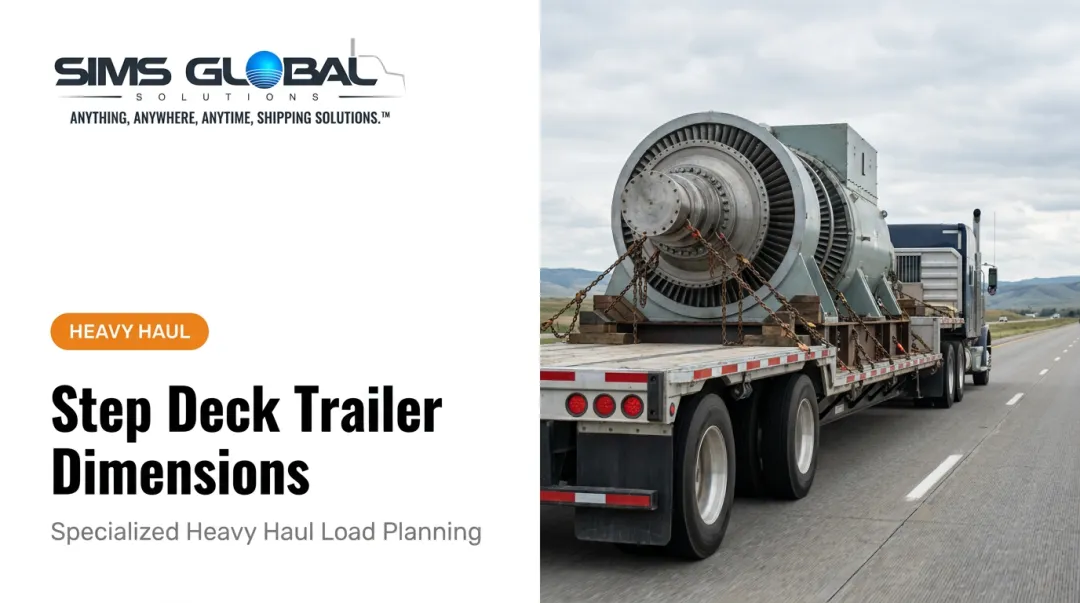
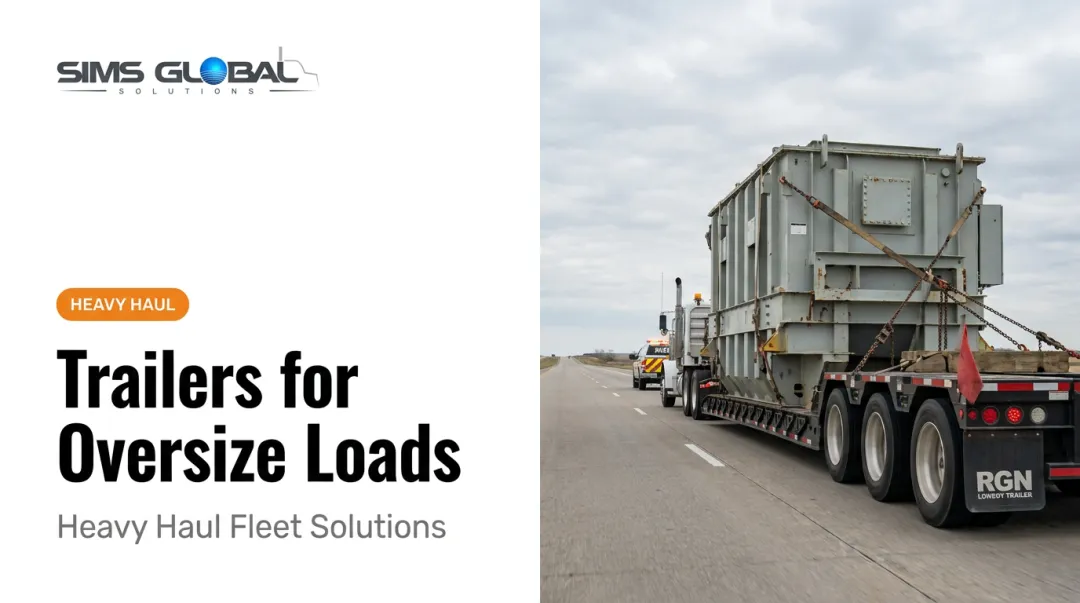
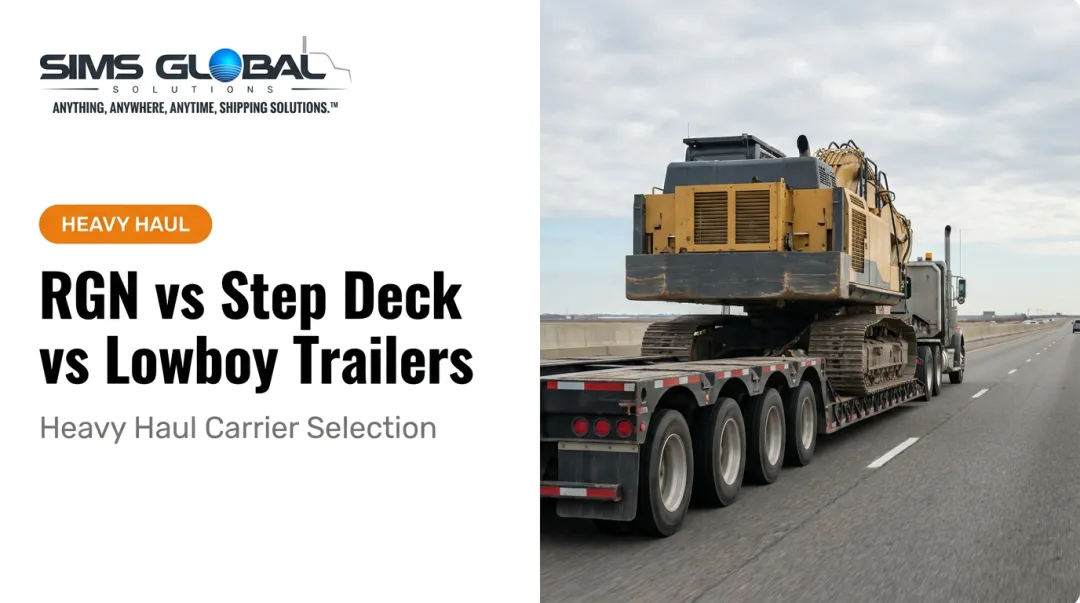
Removable Gooseneck (RGN) Lowboy The front section detaches, dropping the deck to ground level for drive-on loading. RGNs also offer longer, sometimes stretch-capable wells, making them the go-to choice for oversized construction equipment that can't be craned into place. Sims Global Solutions operates company-owned RGNs for this exact reason, moving drive-on loads that would otherwise require crane rigging.
Double Drop Lowboy While every lowboy technically uses a double-drop design, this configuration pushes the well to its lowest point, sometimes as low as 18 inches on models from XL and Talbert. It's built for the tallest cargo but tends to run heavier and cost more to operate given the added structural framing needed to support that low well.

Standard Lowboy Trailer Dimension Ranges
The figures below reflect commonly cited industry ranges pulled from current trailer manufacturer specs. Your actual legal limits still depend on state DOT rules, permit status, and the specific trailer booked for the job.
Deck Height & Legal Load Height Limits
Loaded deck height on most lowboys runs 18 to 24 inches. Verified examples include an 18-inch deck on XL and Talbert double drops, 20 inches on Talbert's 55SA, and 22 inches on Talbert's 35CC.
That deck height directly sets your cargo ceiling. The FHWA reports no federal vehicle height limit, noting that most states cap overall height at 13'6" to 14 feet. Subtract the trailer's deck height from that overall limit, and you get your legal cargo height:
- 18-inch deck + 14-foot state limit = roughly 12'6" of cargo height, an example XL Specialized confirms directly for its 110 Low-Profile HDG low-bridge lowboy
- Most fleets plan around an 11'6"–12 foot cargo ceiling as a conservative working number
Some states push higher. Colorado, Nebraska, and Alaska allow 14'6" to 15 feet of overall height. Others, like California and Texas, hold the line at 14 feet. Always check the route before assuming extra clearance.
Length, Width & Weight Capacity
Well/deck length on standard lowboys runs 24 to 29 feet. RGN stretch configurations push much further. Some XL and Trail King extendable models reach 50 to 59 feet of usable deck, though the overall trailer length marketed (like "52-foot") often differs from the actual well length.
Width is capped at 8.5 feet (102 inches) without a permit. This is the FHWA's national standard for commercial vehicles on designated highways, with Hawaii as the lone exception at 108 inches.
Removable outriggers on some trailers add up to two feet per side of physical support, but that hardware doesn't create a legal width exemption. You still need a permit once loaded width exceeds 102 inches.
Weight capacity scales with axle count:
| Configuration | Typical Capacity |
|---|---|
| 2-axle lowboy | ~40,000 lbs |
| Multi-axle RGN | 80,000+ lbs |
| Specialized multi-axle RGN (superloads) | 150,000+ lbs |
Sims Global Solutions runs its own RGN and multi-axle lowboy fleet across this exact range, matching equipment to load weight before your freight ever reaches the dock.
For context, federal Interstate limits sit at 20,000 lbs per single axle, 34,000 lbs per tandem axle, and 80,000 lbs gross, subject to the Bridge Formula. A trailer's structural rating and your legally permitted operating weight are two different numbers. Don't confuse a manufacturer's payload rating with what you're actually cleared to haul on the road.

Factors That Influence Lowboy Trailer Dimensions in Real-World Operation
Published specs describe the trailer at rest. Real-world operation introduces variables that shift what's actually usable. Three factors matter most: state regulations, axle configuration, and cargo loading method.
State-by-state regulatory variance. Legal height, width, and weight thresholds before a permit kicks in are not uniform. A load that's legal in Nebraska at 14'6" might need a permit the moment it crosses into a state capped at 14 feet.
Axle configuration and suspension type. Air-ride suspension allows fine adjustment of deck height, sometimes via a manual raising and lowering valve, while mechanical suspension offers a fixed clearance. Both affect achievable deck height and how weight distributes across axles.
Cargo type and loading method. A crane-loaded fixed-neck trailer and a drive-on RGN aren't interchangeable for every job:
- Fixed-neck trailers work when a crane is available on-site
- RGNs solve the problem when equipment needs to drive on under its own power
- Your practical dimension profile depends on which loading method fits your site conditions
Matching Lowboy Dimensions to Your Load: Selection & Compliance Considerations
Getting dimension matching right starts before you ever call a carrier.
- Measure your cargo: height, length, width, and weight, in that order
- Compare against trailer specs: deck height, well length, and rated capacity for the trailers under consideration
- Check state permit thresholds: for every state on the route, not just the origin and destination
- Confirm with the carrier: verify the exact deck height and capacity of the specific unit being dispatched, not just the model's marketing spec
This is where working with an established heavy haul partner pays off. Sims Global Solutions' Heavy Haul Trucking division operates its own fleet of lowboy, RGN, and multi-axle trailers, giving the team direct visibility into real deck heights and capacities rather than relying on secondhand specs.
When a load exceeds what the owned fleet can handle, Sims Global's Carrier Procurement Team taps into a network of 150,000+ vetted carriers to source the right trailer configuration. Each carrier is screened for equipment condition, safety record, and compliance history before being matched to a shipment.
The company's SimsTrak TMS platform keeps dimension verification, carrier coordination, and shipment tracking organized in one place as loads move through planning and execution.
Beyond choosing the right trailer and carrier, weight distribution matters just as much as raw capacity. A well-planned lowboy load keeps weight balanced across the axle group, front-loaded appropriately, with adjustable axle spacing used to stay within both the trailer's rated dimensions and the route's bridge formula limits.

Common Mistakes When Interpreting Lowboy Trailer Dimensions
Even experienced shippers misread lowboy specs. These are the errors that show up most often:
- Assuming nominal dimensions apply everywhere. A published 18-inch deck height doesn't guarantee that clearance in every state, so verify local permit rules before booking.
- Confusing trailer length with cargo height. A "52-foot" or "40-foot" designation refers to overall length, not height or well length. These are two separate specs that get mixed up often.
- Overlooking real-world deck sag. Suspension settling, tire wear, and load can add an inch or more to actual deck height, which can throw off bridge and overpass clearance calculations on tight-margin routes.
- Treating benchmarks as guarantees. Dimension ranges here are planning starting points; confirm exact specs with your carrier before shipment to avoid fines, delays, or a failed clearance.
Frequently Asked Questions
What is the standard height of a lowboy trailer?
The deck typically sits 18 to 24 inches off the ground when loaded, allowing cargo heights up to roughly 11'6" to 12 feet depending on state height limits.
What is the height of a 52-foot trailer?
"52-foot" refers to overall trailer length, not height. Height depends on trailer type. A flatbed, step deck, and lowboy will each have very different deck heights regardless of length.
What is the height of a 40-foot trailer?
Same principle applies. A 40-foot designation describes deck length. Actual deck height varies by type, generally 40 to 60 inches for standard flatbeds versus 18 to 24 inches for lowboys.
What is the difference between a lowboy and an RGN trailer in terms of dimensions?
Both typically share similar deck heights and widths. The real difference is access: RGNs offer longer, often stretch-capable wells with ground-level drive-on loading, while a standard lowboy relies on a fixed neck.
How much weight can a lowboy trailer legally carry?
Typical capacity runs 40,000 lbs on two axles up to 80,000+ lbs on multi-axle setups. Specialized RGN configurations can exceed that for superloads, reaching 150,000+ lbs.
Do I need a permit for oversized loads on a lowboy trailer?
Generally, yes, once cargo exceeds standard legal height, width, or weight thresholds. Exact requirements vary by state and route, so check every jurisdiction the load will pass through.