Introduction
One missed weight limit can mean forced off-loading on the side of the highway, permit delays, or fines running into thousands of dollars. The U.S. sets a national floor for Interstate highways, but each state writes its own rules for everything beyond that. With 50 different state rule sets layered on top of one federal baseline, compliance isn't straightforward — it's a maze.
This guide covers what shippers and carriers actually need to know: the federal weight limit framework, how axle limits work, where states diverge from the federal standard, how overweight permits function, and what happens when a truck gets caught running heavy.
Key Takeaways
- The federal GVW limit on Interstate highways is 80,000 lbs., with a 20,000 lb. single-axle and 34,000 lb. tandem-axle limit
- A truck can violate axle limits even if its total gross weight is under 80,000 lbs. — each axle group has its own ceiling
- The Federal Bridge Formula can push the legal GVW below 80,000 lbs. based on axle spacing and configuration
- Overweight permits are issued by each state individually — a multi-state haul needs a permit from every state crossed
- Spring frost laws can cut allowable weights by up to 35% in states with seasonal thaw restrictions
Understanding Federal Truckload Weight Limits
Federal weight limits on Interstate highways aren't suggestions — they're statutory floors that every state must meet. The Surface Transportation Assistance Act of 1982 made the 80,000 lb. gross vehicle weight limit uniform across the Interstate System. States govern their own rules on non-interstate roads, which is where significant variation enters the picture.
The Three Core Federal Limits
Every Interstate shipment must comply with all three simultaneously:
| Limit Type | Federal Maximum |
|---|---|
| Single axle | 20,000 lbs. |
| Tandem axle | 34,000 lbs. |
| Gross vehicle weight (GVW) | 80,000 lbs. |
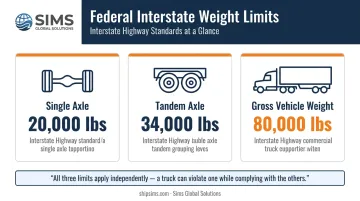
A truck can be legal on gross weight but still in violation if a single axle or tandem group exceeds its limit — all three apply independently.
The Federal Bridge Formula
The Federal Bridge Formula adds a geometry constraint beyond the weight limits. It uses three variables: W (maximum weight on an axle group), L (distance in feet between the outermost axles of the group), and N (number of axles in the group). A vehicle with closely spaced axles and insufficient count may hit its legal ceiling well below 80,000 lbs. — the formula protects bridge infrastructure by controlling how weight distributes relative to spacing.
Grandfather Provisions and Divisible vs. Non-Divisible Loads
Some states were grandfathered into allowing higher axle or GVW limits on specific Interstate routes under pre-1975 rules. This explains why certain states appear to exceed the federal standard in reference tables — those higher limits apply to specific configurations or routes, not to all trucks uniformly.
Only non-divisible loads can be permitted to exceed federal weight limits. Under 23 CFR § 658.5, a load qualifies as non-divisible if dismantling it would compromise its integrity, destroy its value, or require more than 8 work hours to disassemble. Divisible loads — anything that can be broken down — must comply with standard limits, full stop.
Truckload Weight Limits by State: Quick Reference
Most states match the federal 80,000 lb. GVW baseline on Interstates. The compliance risk in multi-state hauls comes from differences in tandem axle allowances, non-interstate road limits, permit thresholds, and seasonal restrictions — not usually from the Interstate GVW itself.
The table below reflects the standard Interstate baseline per FHWA's Commercial Vehicle Size and Weight Program (updated September 2024). All 50 states share these Interstate standards; overweight permits are available in every state.
| State | Interstate GVW | Single Axle | Tandem Axle | OW Permits |
|---|---|---|---|---|
| Alabama | 80,000 lbs. | 20,000 lbs. | 34,000 lbs. | Yes |
| Alaska | 80,000 lbs. | 20,000 lbs. | 34,000 lbs. | Yes |
| Arizona | 80,000 lbs. | 20,000 lbs. | 34,000 lbs. | Yes |
| Arkansas | 80,000 lbs. | 20,000 lbs. | 34,000 lbs. | Yes |
| California | 80,000 lbs. | 20,000 lbs. | 34,000 lbs. | Yes |
| Colorado | 80,000 lbs. | 20,000 lbs. | 34,000 lbs. | Yes |
| Connecticut | 80,000 lbs. | 22,400 lbs.* | 36,000 lbs.* | Yes |
| Delaware | 80,000 lbs. | 20,000 lbs. | 34,000 lbs. | Yes |
| Florida | 80,000 lbs. | 20,000 lbs. | 34,000 lbs. | Yes |
| Georgia | 80,000 lbs. | 20,000 lbs. | 34,000 lbs. | Yes |
| Hawaii | 80,000 lbs. | 20,000 lbs. | 34,000 lbs. | Yes |
| Idaho | 80,000 lbs. | 20,000 lbs. | 34,000 lbs. | Yes |
| Illinois | 80,000 lbs. | 20,000 lbs. | 34,000 lbs. | Yes |
| Indiana | 80,000 lbs. | 20,000 lbs. | 34,000 lbs. | Yes |
| Iowa | 80,000 lbs. | 20,000 lbs. | 34,000 lbs. | Yes |
| Kansas | 80,000 lbs. | 20,000 lbs. | 34,000 lbs. | Yes |
| Kentucky | 80,000 lbs. | 20,000 lbs. | 34,000 lbs. | Yes |
| Louisiana | 80,000 lbs. | 20,000 lbs. | 34,000 lbs. | Yes |
| Maine | 80,000 lbs. | 20,000 lbs. | 34,000 lbs. | Yes |
| Maryland | 80,000 lbs. | 20,000 lbs. | 34,000 lbs. | Yes |
| Massachusetts | 80,000 lbs. | 20,000 lbs. | 34,000 lbs. | Yes |
| Michigan | 80,000 lbs. | 18,000–20,000 lbs.** | 34,000 lbs. | Yes |
| Minnesota | 80,000 lbs. | 20,000 lbs. | 34,000 lbs. | Yes |
| Mississippi | 80,000 lbs. | 20,000 lbs. | 34,000 lbs. | Yes |
| Missouri | 80,000 lbs. | 20,000 lbs. | 34,000 lbs. | Yes |
| Montana | 80,000 lbs. | 20,000 lbs. | 34,000 lbs. | Yes |
| Nebraska | 80,000 lbs. | 20,000 lbs. | 34,000 lbs. | Yes |
| Nevada | 80,000 lbs. | 20,000 lbs. | 34,000 lbs. | Yes |
| New Hampshire | 80,000 lbs. | 20,000 lbs. | 34,000 lbs. | Yes |
| New Jersey | 80,000 lbs. | 20,000 lbs. | 34,000 lbs. | Yes |
| New Mexico | 80,000 lbs. | 20,000 lbs. | 34,000 lbs. | Yes |
| New York | 80,000 lbs. | 20,000 lbs. | 34,000 lbs. | Yes |
| North Carolina | 80,000 lbs. | 20,000 lbs. | 34,000 lbs. | Yes |
| North Dakota | 80,000 lbs. | 20,000 lbs. | 34,000 lbs. | Yes |
| Ohio | 80,000 lbs. | 20,000 lbs. | 34,000 lbs. | Yes |
| Oklahoma | 80,000 lbs. | 20,000 lbs. | 34,000 lbs. | Yes |
| Oregon | 80,000 lbs. | 20,000 lbs. | 34,000 lbs. | Yes |
| Pennsylvania | 80,000 lbs. | 20,000 lbs. | 34,000 lbs. | Yes |
| Rhode Island | 80,000 lbs. | 22,400 lbs.* | 34,000 lbs. | Yes |
| South Carolina | 80,000 lbs. | 20,000 lbs. | 34,000 lbs. | Yes |
| South Dakota | 80,000 lbs. | 20,000 lbs. | 34,000 lbs. | Yes |
| Tennessee | 80,000 lbs. | 20,000 lbs. | 34,000 lbs. | Yes |
| Texas | 80,000 lbs. | 20,000 lbs. | 34,000 lbs. | Yes |
| Utah | 80,000 lbs. | 20,000 lbs. | 34,000 lbs. | Yes |
| Vermont | 80,000 lbs. | 20,000 lbs. | 34,000 lbs. | Yes |
| Virginia | 80,000 lbs. | 20,000 lbs. | 34,000 lbs. | Yes |
| Washington | 80,000 lbs. | 20,000 lbs. | 34,000 lbs. | Yes |
| West Virginia | 80,000 lbs. | 20,000 lbs. | 34,000 lbs. | Yes |
| Wisconsin | 80,000 lbs. | 20,000 lbs. | 34,000 lbs. | Yes |
| Wyoming | 80,000 lbs. | 20,000 lbs. | 34,000 lbs. | Yes |
*Grandfathered limits under pre-1975 grandfather rights — verify current statute before dispatch. **Michigan's single-axle limit depends on axle spacing: 18,000 lbs. where spacing exceeds 3.5 ft but is under 9 ft; 20,000 lbs. where axles are at least 9 ft apart.
Notable State Outliers
These states diverge most from the federal baseline:
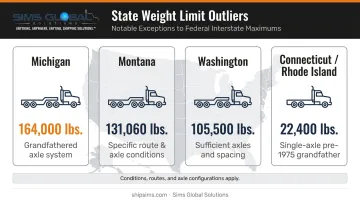
- Montana: Permitted multi-axle configurations can reach 131,060 lbs., but only under specific route, axle count, and spacing conditions. This is not a generic five-axle Interstate allowance.
- Michigan: The grandfathered axle-distribution system spreads load across additional axles, allowing combinations up to 164,000 lbs. Federal limits apply wherever the grandfathered system does not.
- Washington: WSDOT's legal weight table reaches 105,500 lbs. with sufficient axles and spacing. Route and bridge restrictions still apply on a case-by-case basis.
- Connecticut and Rhode Island: Both states retain higher single-axle limits under pre-1975 grandfather provisions — 22,400 lbs. versus the federal 20,000 lb. standard.
South Carolina's Interstate GVW is 80,000 lbs. on a five-axle vehicle. The 73,280 lb. figure that appears in some industry references applies to specific bridge formula scenarios — not as a general Interstate maximum.
Seasonal Frost Laws
Northern states impose spring weight restrictions that temporarily reduce allowable axle and gross weights during the thaw cycle. These restrictions typically run from late winter through late spring, though exact dates vary by state and frost zone.
State-specific reductions to know:
- Michigan: Cuts of 25% on rigid pavement and 35% on flexible pavement on seasonally restricted routes
- Minnesota: Single-axle limits drop to 5 tons on unpaved roads and 10 tons on paved roads during commissioner-set periods, with dates varying by frost zone
- Wisconsin: Operates zone-based restrictions with varying timelines by region
Always check each state's DOT website for current restriction dates before planning any northern route during this window.
Axle Weight Limits: Why They Matter as Much as Gross Weight
Total gross weight is only one piece of the compliance picture. A truck under 80,000 lbs. GVW can still generate a violation if weight is concentrated improperly across axle groups.
Axle Configurations and Weight Ceilings
- Single axle: One axle assembly. Federal limit is 20,000 lbs.
- Tandem axle: Two axles within 40 inches of each other. Federal limit is 34,000 lbs. for the group.
- Tri-axle (tridem): Three consecutive axles. No universal federal limit exists — limits vary by state configuration and the Federal Bridge Formula.
The Bridge Formula matters here too. If axles are closely spaced, the formula may produce a maximum for that axle group that's lower than the standard limit — axle spacing can be just as consequential as the weight itself.
Payload and Tractor Weight
The tractor itself accounts for a significant portion of gross weight before a single pound of cargo is loaded. Deducting tractor weight from the 80,000 lb. GVW ceiling determines usable freight capacity.
Exact figures vary by tractor model, trailer construction, refrigeration equipment, fuel load, and accessories — so carriers should confirm tare weights for their specific equipment before booking a load at the legal maximum.

Load Distribution at the Dock
Proper axle weight distribution is a shared responsibility between shippers and carriers — and it starts at the dock. Load distribution errors can make an otherwise legal shipment non-compliant before it reaches the scale.
Cargo positioned too far forward or too far back shifts weight onto individual axle groups, potentially pushing a single axle over its limit even when total GVW is fine.
For shippers moving heavy freight, communicating load characteristics to the carrier before dispatch gives the operations team time to configure equipment and plan loading sequence correctly. Key details to share include:
- Cargo weight and weight distribution
- Center of gravity (especially for tall or dense loads)
- Overall dimensions and any overhang
Overweight Permits, Fines, and Compliance Strategies
How the Permit System Works
The federal government does not issue overweight permits. As FHWA clearly states, permitting is a state option — meaning a multi-state haul requires a separate permit from every state the truck will cross. Each state has its own fee schedule, processing timeline, application requirements, and route restrictions.
For very heavy loads, states may also require:
- Designated travel routes with bridge reviews
- Escort vehicles (pilot cars) at the front and/or rear
- Travel time restrictions (daylight only, weekday only)
- Police escorts through certain jurisdictions
Applying late is one of the most common sources of shipment delays on permitted moves. Some states process permits in hours; others take days. For complex multi-state hauls, building permit lead time into dispatch planning — not the day before — is essential.
Sims Global Solutions' heavy haul team addresses this through a structured five-step planning process: equipment selection, route creation, route survey, state-by-state permit acquisition, and en route coordination. Dedicated specialists handle permit coordination across the U.S., Canada, and Mexico for over-dimensional and overweight loads.
Consequences of Running Overweight
The penalties for overweight violations vary by state and by the amount of excess weight. Texas statutory fines offer a clear example of how escalation works:
| Excess Weight | Texas Fine Range |
|---|---|
| Under 2,500 lbs. over | $100–$500 |
| 2,500–5,000 lbs. over | $500–$1,000 |
| 5,001–10,000 lbs. over | $1,000–$2,500 |
| 10,001–20,000 lbs. over | $2,500–$5,000 |
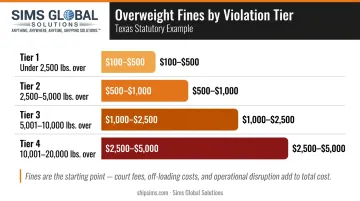
California similarly scales fines by overage amount. Beyond fines, consequences can include:
- Mandatory off-loading of cargo at the violation site
- Permit revocation for repeat violations (North Carolina explicitly documents this)
- Misdemeanor classification in some states for egregious violations
Fines represent the starting point, not the total cost. Court assessments and penalty fees add to the base amounts, and the operational disruption of a roadside enforcement stop — lost time, cargo handling costs, potential load damage — can dwarf the fine itself.
Compliance Strategies for Multi-State Hauls
- Verify limits for every road type on the route — Interstate and non-interstate limits differ; confirm both before dispatch
- Apply for permits early — build processing time into dispatch planning well ahead of the ship date
- Optimize routing around weight-friendly corridors — some states allow higher weights on specific highways or with additional axles
- Distribute cargo weight deliberately — configure loading at the dock to keep each axle group within its limit
- Account for seasonal restrictions — check spring frost law dates for every northern state on the route
- Evaluate intermodal alternatives — for extremely heavy non-divisible loads that cannot be permitted over-road, intermodal rail can be a viable path; Sims Global Solutions provides intermodal rail coordination as part of its multi-modal freight services
Conclusion
Truckload weight compliance is not a single number — it is a combination of federal rules, state-specific limits, axle group ceilings, the Bridge Formula, and seasonal restrictions that must all align before a truck leaves the dock. A load that is legal in one state may be non-compliant at the first weigh station across the border.
For shippers that regularly move heavy or oversized freight across state lines, working with an experienced logistics partner removes the guesswork from that planning. Sims Global Solutions brings a nationwide carrier network, an asset-based heavy haul fleet, and a dedicated team of specialists who handle multi-state permit coordination, route planning, and compliance oversight as standard practice.
For complex shipments, contact our heavy haul team directly at 913-303-3804 or email ContactSims@ShipSims.com to discuss your specific route and freight requirements.
Frequently Asked Questions
How much does a truckload weigh?
A loaded semi-truck can weigh up to the federal maximum of 80,000 lbs. GVW. The tractor alone accounts for a substantial portion of that , with usable freight capacity varying by trailer type, tractor specs, and state-specific limits on the route.
What does 12,000 lb. GVWR mean?
GVWR (Gross Vehicle Weight Rating) is the maximum operating weight a manufacturer specifies for a vehicle — it is a rating, not the actual scale weight. At 12,000 lbs., a vehicle exceeds the FMCSA's 10,001 lb. CMV threshold, meaning federal commercial motor vehicle regulations apply.
Can a truck be overweight on one axle even if the total gross weight is under 80,000 lbs.?
Yes. Each axle group has its own weight ceiling independent of total GVW. A truck can be legally non-compliant on a single axle or tandem group while still being under the 80,000 lb. gross limit. The Federal Bridge Formula may also impose lower allowable weights depending on axle spacing and configuration.
Do weight limits differ for interstate highways versus state roads?
Yes. The federal 80,000 lb. GVW limit applies on the Interstate Highway System. States set their own limits on non-interstate highways ; some allow higher weights on state or county roads, while others impose stricter limits. Shippers must verify limits for every road type on their specific route.
What are seasonal weight restrictions and which states have them?
Northern states enforce spring frost laws that temporarily cut allowable axle and gross weights to protect roads during the thaw cycle. Michigan, Minnesota, Wisconsin, North Dakota, and Maine all run seasonal restriction programs with varying reduction percentages and date windows. Check each state DOT website before planning northern routes between late winter and late spring.
What happens if a truck is caught operating overweight?
Penalties include fines scaled to excess weight (from $100 into the thousands), mandatory off-loading, and permit revocation for repeat offenders; some states treat serious violations as misdemeanors. Beyond the fine, the operational cost of an enforcement stop — lost time, cargo handling, and potential load damage — often runs higher than the penalty itself.