US business logistics costs hit $2.6 trillion in 2024 — roughly 8.7% of GDP — and freight typically represents the largest single piece of that spend for most companies. With costs at that scale, even modest improvements in how you source and manage transportation have real financial consequences.
This article breaks down what a freight broker actually does, where the value shows up in day-to-day operations, and when partnering with one makes the most sense for your business.
Key Takeaways
- Freight brokers use market-wide rate intelligence to negotiate pricing individual shippers can't access on their own
- Pre-vetted carrier networks reduce cargo risk and eliminate the overhead of vetting carriers yourself
- Brokers absorb sourcing, booking, tracking, and exception management — freeing up internal teams
- Multi-modal brokers like Sims Global Solutions consolidate TL, LTL, expedited, intermodal, drayage, and warehousing under one partner
- Over time, accumulated carrier performance data drives better routing decisions and lower rates
What Is a Freight Broker?
A freight broker is a federally licensed intermediary that connects businesses needing to ship goods with carriers that have the capacity to move them. Brokers don't own trucks — they arrange transportation on behalf of shippers, acting as the connective layer between supply and capacity.
Under 49 CFR 371.2, a broker is defined as a person who, for compensation, arranges or offers to arrange the transportation of property by an authorized motor carrier. FMCSA requires brokers to hold operating authority (an MC number) and post $75,000 in financial security through a BMC-84 surety bond or BMC-85 trust fund.
Brokers operate across a wide range of freight modes:
| Mode | Typical Application |
|---|---|
| Truckload (TL) | Full loads — dry van, flatbed, refrigerated, tank |
| LTL | Consolidated freight that doesn't fill a trailer |
| Intermodal | Rail-plus-truck combinations for longer hauls |
| Expedited | Time-critical ground or air freight |
| Heavy Haul | Oversized or specialized flatbed moves |
| Drayage | Container movements to and from ports or rail yards |

The "middleman adding cost" assumption doesn't hold up in practice. Brokers bring market intelligence, vetted carrier access, and logistics expertise that most shippers would struggle to replicate in-house — especially without a dedicated procurement team and real-time rate visibility across hundreds of carriers.
Key Benefits of Using a Freight Broker
The advantages below focus on measurable operational outcomes — cost, efficiency, risk, and scalability — not theoretical benefits. They apply across company sizes, though the value tends to be most visible at higher shipping volumes or when freight complexity outpaces internal capacity.
Cost Savings Through Market Intelligence and Rate Negotiation
Freight rates move constantly. The Cass Freight Index shows just how volatile this market is: freight expenditures rose 23% in 2022, fell 19% in 2023, then dropped another 11% in 2024. As of July 2025, inferred rates were up 7.9% year-over-year even as shipment volume declined.
An internal logistics team managing a handful of carrier relationships doesn't have visibility into those swings across the broader market. A freight broker does — every day, across every lane they cover.
The rate advantage works through two mechanisms:
- Market intelligence: Brokers monitor spot and contract rates continuously, across modes and lanes. They know when a lane is soft and when it's tightening — and they adjust sourcing accordingly.
- Volume leverage: Brokers aggregate shipping volume across their entire client base. That collective buying power produces rates that no single shipper — even a frequent one — can typically negotiate independently.
According to the 2022 Third-Party Logistics Study, 64% of shippers reported that using a third-party logistics provider reduced their overall logistics costs. The savings aren't one-time wins — they compound as brokers benchmark rates on an ongoing basis, preventing businesses from overpaying as conditions shift.
KPIs affected: freight cost per shipment, cost per mile, total logistics spend as a percentage of revenue, budget variance
When this matters most: shipping across multiple lanes or modes, seasonal volume spikes, and entering new regions without established carrier relationships.
Access to a Vast, Pre-Vetted Carrier Network
FMCSA counted 787,189 active motor carriers with USDOT numbers in 2023 — of which 716,558 had no formal safety rating assigned. Finding reliable capacity from that pool on your own takes time, and the consequences of choosing wrong are real.
ATRI's 2025 research estimates annualized US cargo theft costs at as high as $6.6 billion — more than $18 million per day. Working with carriers that haven't been properly vetted for authority, insurance, and identity exposes shippers to both direct cargo risk and liability gaps.
Reputable freight brokers vet carriers before adding them to their networks, checking:
- Operating authority and USDOT status
- Insurance coverage and limits
- Safety ratings and inspection records
- Identity verification and fraud screening
- Equipment condition and compliance history
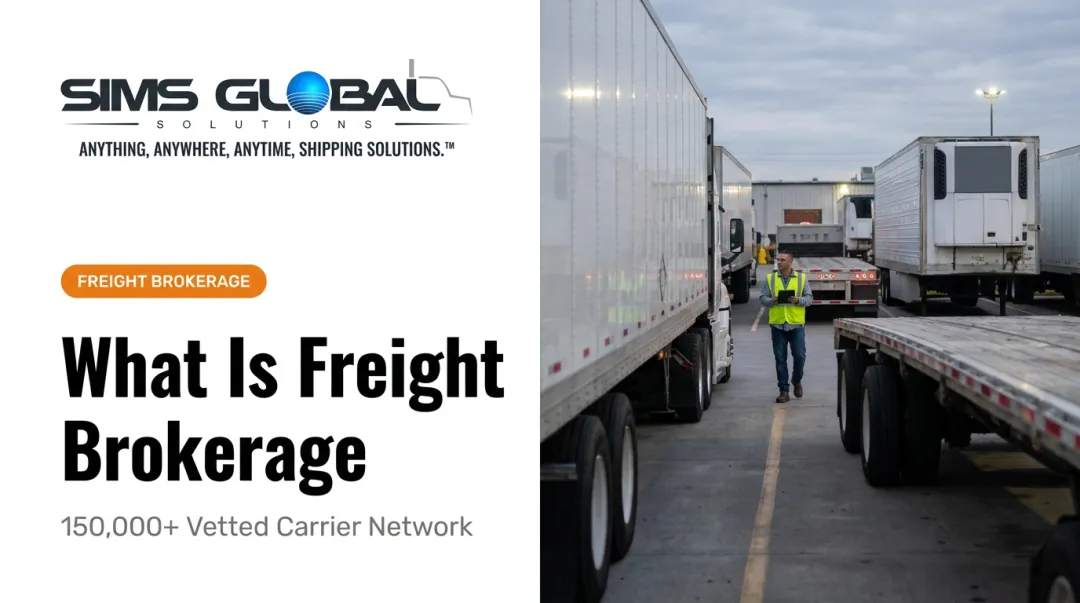
Sims Global Solutions maintains a network of over 150,000 vetted carriers, including more than 35,000 truckload carriers, managed by an in-house Carrier Procurement Team that runs a documented 30-point vetting process. Rather than relying on one-time checks, the team continuously monitors carrier status and uses the latest background-checking technology to catch fraudulent actors before they're assigned a load.

For shippers, the practical benefit is straightforward: access to broad, reliable capacity without the overhead of building and managing those carrier relationships internally.
KPIs affected: on-time delivery rate, cargo claim rate, capacity availability, carrier compliance rate
When this matters most: tight capacity markets, unusual freight types (heavy haul, hazmat, oversized), shipping to regions where your existing carrier relationships are thin, or when speed of carrier sourcing is critical.
Operational Efficiency and Real-Time Shipment Visibility
Freight management generates a surprising volume of administrative work: sourcing quotes, booking loads, coordinating pickups, chasing tracking updates, managing exceptions, handling claims. Each of these tasks pulls time from operations staff who have other priorities.
A freight broker handles that coordination directly. The 2022 Third-Party Logistics Study found that 73% of shippers reported improved customer service after engaging a 3PL or broker — and 89% described those relationships as generally successful.
Beyond offloading tasks, brokers provide tracking visibility that most internal teams can't replicate. Technology platforms with real-time GPS tracking, automated alerts, and exception management let shippers monitor shipments without manually following up on each one.
That visibility has real operational effects:
- Fewer customer service inquiries about shipment status
- Earlier awareness of delivery exceptions — enough time to respond proactively
- Better inventory planning when inbound freight arrival is predictable
- Reduced internal time spent on status chasing and carrier coordination
SimsTrak, Sims Global Solutions' proprietary TMS, lets clients quote, book, and track shipments across all modes from one interface — with direct API integrations to more than 70 national and regional LTL carriers and real-time GPS tracking on truckload loads. Dedicated logistics coordinators handle scheduling, monitoring, and claims throughout each shipment, so shippers aren't left managing exceptions on their own.
KPIs affected: internal hours on logistics coordination, shipment exception rate, customer complaints related to delivery, inventory accuracy
When this matters most: growing businesses outpacing their internal logistics capacity, companies with high shipment frequency, and shippers managing customer-facing delivery commitments where visibility directly affects satisfaction.
What Happens When You Skip the Broker
Managing freight entirely in-house or through ad hoc carrier relationships carries predictable consequences — most of them costly and some of them avoidable.
Common operational risks include:
- Paying above-market rates due to limited benchmarking data and no volume leverage against carriers
- Exposure to unvetted carriers with poor safety records, inadequate insurance, or fraudulent identities — TIA's April 2025 report found 22% of surveyed members lost more than $200,000 to freight fraud in a six-month period
- Excessive administrative burden as internal staff spend time on load tracking, carrier calls, and paperwork instead of core operations
- Capacity gaps during peak periods when scrambling for trucks becomes the only option, usually at premium spot rates

Larger shippers face these same risks. Entering new lanes, managing seasonal surges, or operating in markets where carrier supply tightens quickly — each scenario creates exposure that in-house management alone rarely handles well.
How to Get the Most Value from Your Freight Broker
The difference between a broker that saves you money and one that merely moves freight comes down to how you engage with them.
Treat it as a strategic relationship, not a transactional one:
- Share lane data and shipment history so the broker can identify patterns, optimize carrier selection, and benchmark your rates proactively
- Communicate upcoming volume changes in advance, especially for seasonal peaks or new product launches, so carrier capacity can be secured before the market tightens
- Evaluate brokers on more than price — technology capabilities, carrier vetting rigor, multi-modal flexibility, and responsiveness during disruptions all determine long-term value
Multi-modal brokers offer a practical advantage: a single logistics partner across every freight mode. Sims Global Solutions covers TL, LTL, expedited, intermodal, drayage, heavy haul, warehousing, and fulfillment, which means clients don't need to manage separate vendor relationships as their shipping needs evolve.
That consolidation supports the company's core promise — award-winning service built on reliability and consistency, not just competitive pricing on individual loads.
Conclusion
The core value of a freight broker comes down to three compounding advantages: better rates through market intelligence, reliable capacity through a vetted carrier network, and operational efficiency through technology and expertise.
None of these are one-time wins. Each advantage compounds as the broker relationship matures — the carrier network becomes more refined, shipping patterns get sharper, and rate discipline holds even as market conditions shift.
For most businesses, freight brokerage is a structural decision: how to build a supply chain that scales without proportionally scaling the internal team behind it.
Frequently Asked Questions
What does a cargo broker do?
A cargo (freight) broker acts as an intermediary between shippers and carriers — sourcing available capacity, negotiating rates, handling documentation, and coordinating freight movement without owning trucks. The broker handles the full logistics process on the shipper's behalf, from booking through delivery.
How much is a $75,000 freight broker bond?
The $75,000 bond is a federal licensing requirement, not the premium you pay. Annual premiums for a BMC-84 bond typically range from roughly $938 to $9,000, depending on credit history, experience, and financial standing. Contact a surety bond provider for a personalized quote.
Is it cheaper to use a freight broker?
In most cases, yes. Brokers use volume leverage and real-time market data to secure rates individual shippers typically can't match. Time savings from outsourced logistics administration add up quickly — 64% of shippers in the 2022 3PL Study reported lower overall logistics costs through third-party providers.
What is the difference between a freight broker and a carrier?
A carrier physically owns and operates trucks to move freight. A freight broker arranges transportation by connecting shippers with carriers — brokers don't own trucks but provide access to a wide network of them, plus the market intelligence and coordination to move freight efficiently.
When should a business consider using a freight broker?
Businesses benefit most when shipping volume is growing, internal logistics resources are limited, capacity is tight, or when they need access to specialized equipment or lanes they can't cover internally. Seasonal peaks and new market entry are also strong triggers.
How do freight brokers find the best shipping rates?
Brokers monitor market conditions continuously, maintain relationships with large carrier networks, and use aggregate shipping volume across their client base to negotiate pricing individual shippers can't access. The result: better rates driven by scale, not luck.