Most shippers underestimate the scope of what qualifies as dangerous goods. Lithium batteries, dry ice, adhesives, and diagnostic specimens all fall under the same regulatory umbrella as explosives and radioactive isotopes.
This guide breaks down how dangerous goods are classified, which regulatory bodies set the rules, and what shippers must do — practically — to stay compliant when moving hazardous cargo by air.
Key Takeaways
- Three regulatory frameworks govern air dangerous goods: ICAO Technical Instructions, IATA DGR, and the U.S. Hazardous Materials Regulations (HMR)
- All dangerous goods fall into one of nine UN hazard classes, each with distinct handling, packaging, and quantity rules
- Shippers bear primary liability for classification, packaging, labeling, and documentation
- Civil penalties reach $102,348 per violation — up to $238,809 for violations causing death or serious injury
- Working with an experienced 3PL that handles HAZMAT air freight reduces the risk of costly classification errors
What Qualifies as Dangerous Goods for Air Freight?
ICAO defines dangerous goods as articles or substances capable of posing a risk to health, safety, property, or the environment during transport. Approximately 3,000 articles and substances appear on the ICAO Technical Instructions list — far more than most shippers expect.
The scope surprises a lot of people. Common items that qualify include:
- Flammable liquids: fuels, solvents, paints, adhesives, alcohol
- Gases and aerosols: compressed oxygen, propane, fire extinguishers
- Explosives and pyrotechnics — ammunition, detonators, rocket motors
- Toxic or infectious substances: pesticides, diagnostic specimens, Category B biological material
- Radioactive materials — medical isotopes, industrial radiography sources
- Corrosives: acids, alkalis, wet batteries filled with acid
- Class 9 miscellaneous — lithium-ion batteries, dry ice, magnetized materials
The "Cargo Aircraft Only" Distinction
Not all dangerous goods can fly on passenger aircraft. Aircraft eligibility is determined by each individual Dangerous Goods List entry and its permitted quantity — not by hazard class alone.
A clear example: standalone lithium-ion batteries (UN 3480, Packing Instruction 965) and standalone lithium-metal batteries (UN 3090, Packing Instruction 968) are forbidden as cargo on passenger aircraft. Shipments of these items require cargo-aircraft-only handling and must carry the "Cargo Aircraft Only" (CAO) label. This restriction directly affects route options, carrier selection, and quantity limits.
The CAO designation does not make an otherwise prohibited article acceptable. Most explosives remain forbidden in air transport regardless of aircraft type.
Verifying Whether Your Goods Qualify
To confirm whether your goods qualify, check:
- Check the item against the ICAO Dangerous Goods list or current IATA DGR
- Request a Safety Data Sheet (SDS) from the manufacturer — useful as a starting classification reference
- Consult a freight specialist with dangerous goods expertise
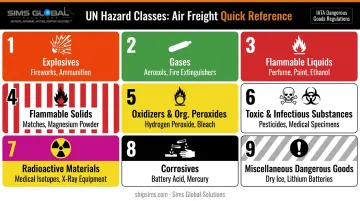
The Nine UN Hazard Classes
| Class | Description | Air Freight Examples |
|---|---|---|
| 1 | Explosives | Ammunition, cartridges, detonators, rocket motors |
| 2 | Gases | Propane, compressed oxygen, aerosols, fire extinguishers |
| 3 | Flammable Liquids | Aviation fuel samples, solvents, adhesives |
| 4 | Flammable Solids | Matches, magnesium powder, self-heating products |
| 5 | Oxidizers & Organic Peroxides | Chemical oxygen generators, hydrogen peroxide formulations |
| 6 | Toxic & Infectious Substances | Pesticides, diagnostic specimens, UN 3373 biological material |
| 7 | Radioactive Materials | Medical isotopes, industrial radiography sources |
| 8 | Corrosives | Acids, alkalis, wet batteries filled with acid |
| 9 | Miscellaneous | Lithium-ion batteries (UN 3480), dry ice (UN 1845), magnetized material (UN 2807) |
Governing Regulations: ICAO, IATA, and the FAA
Three distinct regulatory layers govern dangerous goods by air. U.S. shippers must understand all three — and how they interact.
ICAO Technical Instructions
The International Civil Aviation Organization (ICAO) sets the international baseline through Doc 9284, its Technical Instructions for the Safe Transport of Dangerous Goods by Air. The current 2025–2026 edition applies through December 31, 2026, on a two-year publication cycle. ICAO's Annex 18 supplies the overarching international principles; Doc 9284 provides the operational detail.
IATA Dangerous Goods Regulations
The IATA Dangerous Goods Regulations (DGR) — currently the 67th Edition for 2026 — build on ICAO TI with greater operational detail and a more practical format. Published annually, airlines and freight professionals worldwide use it as their day-to-day reference.
IATA DGR is not an official regulatory document. It cannot be less restrictive than the law, and individual airlines may impose carrier-specific restrictions that go beyond even the DGR. FedEx, for instance, explicitly states that its operator variations can be more restrictive than IATA standards.
U.S. HMR and FAA Enforcement
In the U.S., the Hazardous Materials Regulations (HMR) appear at Title 49 of the Code of Federal Regulations, Parts 171–180, written by DOT's PHMSA. The FAA enforces HMR compliance specifically for air transportation.
Key U.S.-specific rules:
- 49 CFR 175.30 governs an air carrier's duty to refuse noncompliant dangerous goods shipments
- 14 CFR Parts 121 and 135 require approved hazardous materials training programs for air carrier personnel, with 24-month recurrent training
- 49 CFR 171.22 authorizes use of ICAO TI for international shipments, while 49 CFR 171.24 adds U.S.-specific requirements that still apply
How the Three Frameworks Interact
| Layer | Function | Key Consideration |
|---|---|---|
| ICAO TI | International technical baseline | Biennial; permits state variations |
| IATA DGR | Annual operational manual | More usable; does not replace national law |
| U.S. HMR/FAA | Binding U.S. rules | ICAO TI usable only under 171.22/171.24 conditions |
| Carrier variations | Contract-specific restrictions | May be stricter than IATA/ICAO; check before booking |
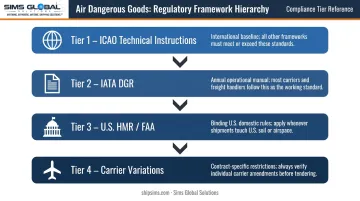
In practice: a DGR entry determines classification and aircraft eligibility, national law adds enforceable conditions, and the accepting carrier may further restrict what it will carry.
Packaging, Labeling, and Documentation Requirements
Packaging Standards
Dangerous goods must be packaged in UN-approved containers meeting ICAO and IATA packing group standards:
- Packing Group I — high danger
- Packing Group II — medium danger
- Packing Group III — low danger
Packaging must be leak-proof, pressure-resistant, and tested to UN specifications for in-flight conditions. Incompatible substances cannot be packed together in the same container.
Limited Quantity exception: Goods shipped below threshold quantities may qualify for relaxed packaging requirements under 49 CFR 173.27. These packages must still carry the "Y" mark per 49 CFR 172.315, indicating conformity with the more restrictive air limited-quantity provisions.
Labeling and Marking
Required external markings include:
- UN/ID number and proper shipping name per IATA DGR
- Primary and subsidiary hazard labels (flammable, toxic, radioactive, etc.)
- Shipper and consignee names and addresses
- Orientation arrows for qualifying liquids
- "Cargo Aircraft Only" label where required — meaning the shipment cannot travel on passenger aircraft under any circumstances
- Specification package marks where applicable
All labels must include an English-language version. IATA DGR specifies minimum label dimensions (at least 100mm × 100mm for most hazard labels) and requires placement on the same surface as the UN number where package size allows.
Required Documentation
Two core documents accompany every regulated dangerous goods air shipment:
| Document | Purpose | Completed By |
|---|---|---|
| Shipper's Declaration for Dangerous Goods (DGD) | Certifies classification, packaging, and ICAO/IATA compliance; details UN number, shipping name, packing group, quantity, and emergency contact | Shipper (must sign; kept on record) |
| Air Waybill (AWB) | Identifies package quantity, hazard category, and confirms correct packaging and labeling; travels with the shipment | Freight carrier/forwarder |
Beyond these two required documents, a Safety Data Sheet (SDS) is a useful starting point for classification decisions — but it is not a mandatory transport document and does not need to accompany the shipment.
Training, Liability, and Consequences of Non-Compliance
Training Requirements
Under IATA DGR and ICAO standards, anyone involved in classifying, packing, labeling, or handling dangerous goods for air transport must complete approved dangerous goods training, with recurrent training required every 24 months.
Three regulatory standards govern different groups:
- IATA DGR / ICAO: 24-month recurrent cycle for personnel handling dangerous goods in air transport
- 49 CFR 172.704 (U.S. hazmat employees): Initial training within 90 days of assignment, recurrence at least every three years
- 14 CFR Parts 121 and 135 (air carrier personnel): Independent 24-month recurrent cycle
Shippers should confirm which standard governs their specific role — the two timelines apply to different populations and are not interchangeable.
Shipper Liability
Shippers bear primary liability for every aspect of classification, packaging, labeling, and documentation. If an accident results from a missing or incorrect declaration, the sender is generally held responsible for damages. Other parties — ground handlers, freight forwarders, airlines — share responsibilities but do not absorb the shipper's liability.
Penalties for Non-Compliance
That liability exposure is backed by enforceable penalties at every level:
- Civil penalties: Up to $102,348 per violation under 49 CFR 107.329 — rising to $238,809 when a violation results in death, serious illness, severe injury, or substantial property destruction
- Criminal liability: Under 49 USC 5124, knowing or willful violations carry up to five years imprisonment, escalating to ten years when a release causes death or bodily injury
- Operational consequences: Shipment rejection, cargo delays, and strained carrier relationships
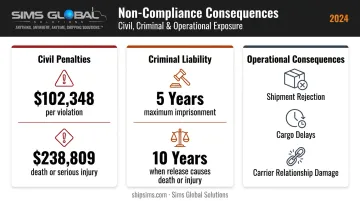
IATA reports over 1.25 million declared dangerous goods shipments annually — and undeclared or misdeclared shipments remain a leading cause of in-flight incidents and enforcement actions.
Working with a Freight Partner for Dangerous Goods Compliance
For industries that regularly handle regulated materials — aerospace, defense, munitions, medical devices — dangerous goods compliance isn't an occasional challenge. It's a routine operational requirement that demands consistent execution.
An experienced logistics partner adds real value here. A knowledgeable 3PL can:
- Identify classification issues before they cause shipment rejections
- Confirm documentation is complete and correctly formatted
- Navigate carrier-specific restrictions and advance notification requirements
- Coordinate across carriers when CAO routing is required
Sims Global Solutions has worked with customers across aerospace, defense, munitions, and medical device manufacturing — industries where regulated materials move regularly. With a carrier network exceeding 150,000 vetted carriers, multi-modal air freight capabilities, a dedicated operations team, and A+ rated supplemental cargo insurance for high-value freight, Sims handles compliant dangerous goods shipments from planning through delivery.
If you're shipping hazardous cargo by air and want to reduce compliance risk, contact Sims Global Solutions or call 855-326-8671 to discuss your requirements.
Frequently Asked Questions
Can dangerous goods be shipped by air freight?
Yes, many dangerous goods can be shipped by air under strict compliance with ICAO Technical Instructions, IATA DGR, and U.S. HMR/FAA regulations. Some goods are prohibited entirely, and others are restricted to cargo-only aircraft, so classification must be verified against the current IATA DGR before booking.
What dangerous goods are permitted for air freight?
Most of the nine UN hazard classes are permitted with proper packaging, labeling, and documentation, though quantity limits and aircraft-type restrictions apply per entry. Certain explosives and some radioactive materials face stricter or outright prohibitions — always verify against the current IATA DGR and ICAO prohibited articles list.
What is a dangerous goods note for air freight?
A dangerous goods note, formally called the Shipper's Declaration for Dangerous Goods (DGD), is a mandatory document completed by the shipper certifying the goods are properly classified, packaged, labeled, and compliant with ICAO/IATA standards. It must accompany every regulated dangerous goods air shipment.
Who is responsible for declaring dangerous goods in air freight?
The shipper holds primary responsibility for correctly identifying, classifying, declaring, packaging, and labeling dangerous goods before handoff to a carrier or freight forwarder. Other parties share handling responsibilities but do not absorb the shipper's liability.
What happens if dangerous goods are not declared correctly?
Consequences include shipment refusal, civil penalties up to $102,348 per violation (or $238,809 for severe outcomes), potential criminal liability for intentional violations, and direct safety risks to aircraft, crew, and ground personnel.
What training is required to ship dangerous goods by air?
IATA DGR and ICAO require all personnel involved in preparing or handling dangerous goods to complete approved training, with recurrent training every 24 months. U.S. hazmat employees under 49 CFR 172.704 follow a separate three-year recurrence schedule. Confirm which standard applies to your specific role before booking.