Introduction
Type "double drop" into a search bar and you'll get DJ mixing tutorials, slang definitions, and eventually, if you scroll far enough, the trucking answer you actually need.
In freight and logistics, a double drop is a specialized flatbed trailer built to haul cargo too tall for a standard flatbed.
Shippers moving tall, heavy, or oversized equipment often don't know which trailer fits their load. Guess wrong, and you're looking at permit delays, cargo damage, or a shipment that never leaves the yard because it can't legally clear a bridge.
This guide breaks down what a double drop trailer is, its typical specs, how it compares to step decks and RGNs, and when you actually need one.
Key Takeaways
- Double drop trailers have two deck drops, creating a lowered center well for tall cargo.
- The lowered well lets shippers haul freight closer to legal height limits.
- Double drops differ from step decks (single drop) and RGNs (drive-on loading).
- Matching trailer type, permits, and carrier to your load prevents costly delays.
What Is a Double Drop Trailer?
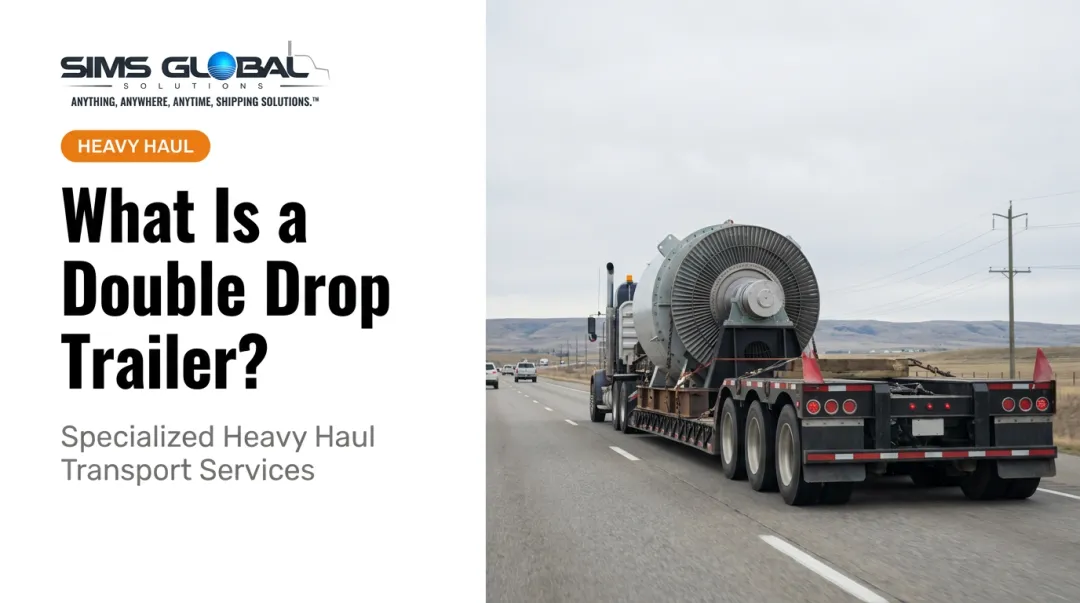
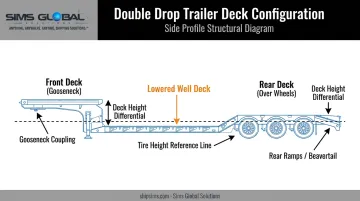
A double drop trailer is a flatbed with three distinct deck sections instead of one flat surface. There's a raised front deck that sits over the gooseneck, a lowered "well" section in the middle, and a raised rear deck over the wheels.
The name comes from how the deck level changes. It drops once right behind the gooseneck, then rises again before the rear axles. That's two drops, hence "double drop." A step deck, by contrast, only drops once, which is why it's sometimes called a single-drop trailer.
The defining feature is that the well sits below the top of the trailer's tires. This is what creates the extra vertical clearance. On a standard flatbed, deck height is fixed by tire size. On a double drop, the middle section drops below that line entirely, opening up several extra inches (sometimes over a foot) of usable cargo height within legal limits.
Core Components
Every double drop trailer shares a few structural pieces:
- Gooseneck coupling – connects the trailer to the tractor and sets the front deck height
- Lowered well deck – the main cargo area, positioned between the axle groups
- Rear ramps or beavertail – used on many fixed-neck models for loading equipment onto the well
Together, these components exist to solve one problem: legal compliance. Double drops let carriers move taller or bulkier freight that would otherwise bust height restrictions on a regular flatbed. That's why they're a staple in heavy haul and oversized freight — you'll see them hauling industrial machinery, construction equipment, oilfield tanks, and other freight that simply won't fit anywhere else.
Double Drop Trailer Dimensions & Specifications
Double drop specs vary by manufacturer and model, but a few patterns hold across the industry.
Well deck height on standard double drops typically runs 12 to 22 inches loaded, depending on the trailer. Talbert's 30–55 ton double drop series, for example, lists an 18-inch deck height with 6 inches of road clearance, while lighter Fontaine models run closer to 12–14 inches.
Height Limits and Usable Clearance
There's no single federal height limit for commercial vehicles. The Federal Highway Administration confirms there's no federal maximum vehicle height — states set their own rules, and most fall between 13 feet 6 inches and 14 feet.
Here's why the well matters. Say your state caps total height at 13'6" and your trailer's well deck sits 18 inches off the ground. That leaves roughly 12 feet of usable vertical space before you hit the ceiling. Shave inches off the deck height, and you buy more room for the freight itself.
Length and Weight Capacity
Well length ranges vary widely:
- Closed deck length: roughly 28 to 34 feet on most standard models
- Extendable versions: can stretch to nearly 60 feet for long equipment
- Weight capacity: commonly 50,000 to 90,000+ lbs, depending on axle count and spacing
Axle configuration matters more than axle count alone. According to Talbert's double drop series specifications, capacity depends on the full combination of axle spacing, suspension, and load concentration length, not just how many axles are bolted on. A three-axle trailer isn't automatically rated higher than a two-axle one.
Always confirm exact specs with your carrier or broker before booking. A mismatch between your cargo's dimensions and the trailer's actual well length or height can mean a failed pickup.
Double Drop vs. Step Deck vs. RGN: Which Trailer Do You Need?
These three trailer types get lumped together constantly, but they solve different problems.
Step deck trailers (single drop) have one deck level below the front, typically around 33 to 40 inches high. They work well for moderately tall cargo that doesn't need the extreme clearance a double drop offers, and they're generally simpler and cheaper to book.
Removable gooseneck (RGN) trailers feature a front end that detaches, letting equipment drive directly onto the well without cranes or forklifts. This makes RGNs the go-to choice for wheeled or tracked machinery that can move under its own power.
Double drop trailers sit in between structurally but often exceed both in vertical clearance. Loading typically happens via crane, forklift, or rear ramps on fixed-neck models. RGN and double drop aren't always separate categories: some manufacturers build double drops with removable necks, combining both features into one trailer.
| Feature | Step Deck | Double Drop | RGN |
|---|---|---|---|
| Deck height | ~33-40 in | ~12-22 in | Varies by model |
| Loading method | Ramps, crane, forklift | Crane, forklift, or rear ramps | Drive-on after neck removal |
| Best for | Moderately tall cargo | Very tall or bulky freight | Wheeled/tracked equipment |
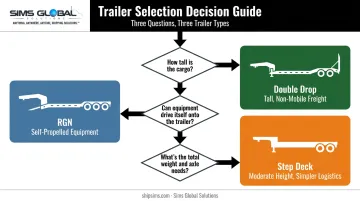
Which one should you pick? Ask three questions:
- How tall is the cargo, and how much clearance does it need?
- Can the equipment drive itself onto the trailer?
- What's the total weight, and does it require added axles?
Tall, non-mobile freight points toward a double drop. Self-propelled equipment points toward an RGN. Everything in between often works fine on a step deck. Sims Global Solutions operates its own fleet of RGN, lowboy, and multi-axle trailers, so heavy haul shippers can match the right equipment to a load without waiting on outside carrier availability.
Common Cargo, Industries & Permits for Double Drop Shipments
Double drops show up wherever oversized, heavy equipment needs to move legally on public roads.
Common cargo types include:
- Construction and industrial equipment
- Agricultural machinery
- Small to mid-size machinery that doesn't need drive-on loading
- Specialized commercial and industrial gear
Industries that lean on double drops most include construction, energy, manufacturing, and material handling. These sectors regularly move equipment too tall for standard flatbeds but not always wheeled enough for an RGN.
That equipment mix creates a compliance challenge: once a load exceeds legal height, width, or weight, permits and sometimes escort vehicles come into play. Rules vary by state and even by route:
- Texas: Escort requirements kick in once a load exceeds 14 to 16 feet wide, with additional height-pole escorts above 17 feet on certain roads.
- Virginia: Sets different thresholds for interstate versus non-interstate routes.
Never assume one state's permit rules apply nationwide. Route-specific planning matters just as much as trailer selection.
Partner With an Experienced Heavy Haul Carrier for Double Drop Shipments
Booking a double drop trailer isn't just about finding an available truck. It takes a carrier network wide enough to match your cargo's exact specs, plus real expertise in permitting, routing, and insurance for oversized loads.
Sims Global Solutions operates as both an asset-based carrier and a freight broker, giving shippers access to its own heavy haul fleet alongside a network of over 150,000 vetted carriers. That hybrid model matters for double drop shipments, where equipment availability can be tight depending on load dimensions and route.
The company's proprietary SimsTrak platform supports the full shipment lifecycle for flatbed and double drop freight:
- Real-time quoting across local, regional, and national carriers
- Booking and scheduling coordination between shippers and carriers
- GPS tracking with automated location updates for high-value or time-sensitive loads
- Consolidated billing and reporting once the shipment closes
For high-value or oversized freight, Sims also offers A+ rated supplemental cargo insurance. That added protection matters when you're moving equipment worth hundreds of thousands of dollars on a trailer with limited clearance margins.
Coverage matters, but so does choosing the right trailer type. If you're unsure whether your cargo needs a double drop, a step deck, or an RGN, talking through the load specifics with an experienced heavy haul team beats guessing. That conversation alone can save you from a failed pickup or an unexpected permit delay down the road.
Frequently Asked Questions
What is a double drop?
A double drop is a flatbed trailer with a lowered center deck sitting between two raised sections. The lowered well allows shippers to haul tall or oversized freight while staying within legal height limits.
What is the difference between a double drop and a lowboy trailer?
"Lowboy" is often used interchangeably with double drop and RGN trailers in everyday conversation. Technically, lowboy usually refers to RGN-style trailers with drive-on loading capability.
How tall can a load be on a double drop trailer?
Load height depends on the well deck height (typically 12-22 inches) and your state's legal limit, commonly around 13 feet 6 inches total. Taller loads may require permits and route surveys.
What is the maximum weight a double drop trailer can carry?
Weight capacity varies by axle configuration and trailer model, generally ranging from 50,000 to 90,000+ lbs. Heavier loads may need additional axles, spread-axle configurations, or overweight permits.
Do double drop trailer shipments require special permits?
Oversize or overweight loads on double drops often require state-issued permits, and sometimes pilot car escorts, once dimensions exceed legal thresholds. Requirements vary by state and by specific route.
When should I use a double drop instead of a step deck trailer?
Choose a double drop when cargo needs maximum vertical clearance to stay legal. Step decks work better for moderately tall loads where simpler logistics and lower cost matter more than extra height.