This isn't a small operational detail. The US LTL market alone generated $52.8 billion in revenue in 2024, with nearly 670,000 shipments moving daily — and that's just the LTL side of the equation.
Whether you're a retailer shipping a few pallets to a regional distributor or a manufacturer moving components to a production facility, the freight mode you choose directly affects delivery speed, cargo safety, and your bottom line. This guide breaks down how each mode works, where each one wins, and how to make the call with confidence.
Key Takeaways
- FTL gives you a dedicated trailer; LTL means sharing space and cost with other shippers
- LTL generally suits shipments of 1–6 pallets or under 10,000 lbs; FTL fits larger, time-sensitive, or fragile loads
- FTL moves point-to-point with no stops; LTL routes through terminals, making transit times less predictable
- LTL freight is handled multiple times in transit, raising damage risk; FTL loads are sealed and delivered direct
- In the 4–6 pallet gray zone, quote both modes — cost depends on weight, route, and accessorial fees
FTL vs LTL: Quick Comparison
| Factor | FTL | LTL |
|---|---|---|
| Cost | Pay for full trailer regardless of fill | Pay only for space used; accessorials can add up |
| Transit Time | Direct, point-to-point; firm windows | Hub-and-spoke routing; estimated delivery windows |
| Cargo Handling | Loaded once, sealed, delivered | Loaded/unloaded multiple times at terminals |
| Ideal Size | 6+ pallets or loads over 10,000 lbs | 1–6 pallets, roughly 150–10,000 lbs |
| Best For | High volume, fragile goods, tight deadlines | Cost-sensitive, flexible shipments |
A 53-foot dry van trailer holds approximately 26–30 standard pallets, depending on pallet dimensions. If your shipment fills roughly half that trailer or more, the per-pallet cost gap between FTL and LTL narrows fast — and FTL's speed and handling advantages often tip the decision.

What Is FTL (Full Truckload)?
FTL means one shipper, one truck, one destination. The carrier loads your freight, seals the trailer, and drives directly to your specified drop point — no consolidation with other shippers, no intermediate stops. Critically, you don't have to fill the trailer to book FTL. If your cargo is fragile, high-value, or time-sensitive, you can reserve the entire truck even at lower pallet counts.
Key Operational Advantages
- Direct routing — no terminal transfers means faster, more predictable transit
- Firm scheduling — pickup and delivery windows are committed, not estimated
- Minimal handling — freight is touched twice: once at load, once at delivery
- Lower damage exposure — a sealed trailer that never opens in transit protects cargo integrity
These advantages compound quickly in real operations. A manufacturer on a tight production schedule can't absorb a two-day transit variance, and a retailer running fixed replenishment cycles needs confirmed arrival windows — not estimates. FTL delivers that level of control.
The Primary Drawback
You pay for the full trailer whether it's full or not. If you're shipping 4 pallets on a 53-foot trailer, you're paying for 26 empty pallet positions. The math only makes sense when speed, cargo protection, or scheduling control outweighs the cost of unused capacity.
When FTL Is the Clear Choice
Despite the cost tradeoff, FTL is the obvious call in several scenarios:
- Shipments of 6 or more pallets, or loads exceeding 10,000 lbs
- Fragile, perishable, or high-value freight where minimizing handling is critical
- Time-critical deliveries with firm arrival requirements
- High-security cargo where a sealed, dedicated trailer is required
Industries that consistently lean on FTL include manufacturers moving raw materials or finished goods between facilities, retailers on fixed replenishment cycles, and aerospace, defense, and medical device companies where handling precision isn't optional.
What Is LTL (Less-than-Truckload)?
LTL consolidates multiple shippers' freight into a single trailer. You pay only for the space your shipment occupies — the carrier fills the rest with other customers' freight heading in the same direction. Operationally, your freight moves through a sortation hub, transfers between trailers at terminals, and arrives after multiple stops along the route.
Key Advantages
- Cost efficiency — you split transportation costs with other shippers instead of absorbing the full truckload rate
- Shipping flexibility — no need to wait until you have enough freight to fill a truck
- Frequent shipping — you can move smaller quantities more often, reducing warehousing pressure and improving inventory flow
For growing businesses not yet generating full truckload volumes on most lanes, LTL is often what makes regular outbound shipping financially viable.
Important Drawbacks to Understand
LTL comes with real tradeoffs worth understanding before you commit to a carrier:
- Transit time variability — hub-and-spoke routing means longer and less predictable delivery windows compared to FTL
- Increased handling — freight moves through multiple terminals and may be transferred between trailers, creating more opportunities for damage
- Freight classification complexity — LTL pricing is governed by NMFC codes, which classify freight across 18 classes (50 through 500) based on density, handling difficulty, stowability, and liability. Misclassify your freight and you'll face reclassification charges after the fact
- Accessorial fees — liftgate service, residential delivery, inside delivery, redelivery, and detention are all billed separately and can significantly inflate the final invoice

Note that Phase 1 of NMFTA's 2025 classification changes took effect July 19, 2025 — shippers using older class references may be working with outdated data.
When LTL Is the Right Fit
- Shipments of 1–6 pallets weighing under 10,000 lbs
- Non-urgent freight where a delivery window of a few days is acceptable
- Businesses shipping small quantities frequently and prioritizing cost efficiency
- Companies in earlier growth stages building toward higher freight volumes
Managing those carrier relationships and classification rules adds up fast. Sims Global Solutions connects directly via API to more than 70 LTL carriers, so shippers can compare rates, transit times, and pricing across carriers in one place without maintaining separate accounts with each one.
How to Choose Between FTL and LTL
No single rule covers every shipment. Here are the five factors that should drive the decision.
1. Shipment Size and Weight
The rough guideline: 1–6 pallets or under 10,000 lbs points toward LTL; 6+ pallets or heavier loads lean toward FTL. But carrier thresholds vary — Estes, for example, defines its Volume LTL product at 5,000 lbs or 8 linear feet, while its truckload product starts at 30,000 lbs or 48 linear feet. Use these as starting frameworks, not hard rules.
2. Transit Time Requirements
If delivery windows are firm — production deadlines, retail compliance requirements, perishables — FTL is the safer choice. LTL delivers on estimates, not guarantees.
3. Budget
LTL wins on cost for small shipments. But once accessorial fees, freight classification adjustments, and longer transit costs are factored in, the gap narrows. For loads approaching half a trailer, FTL can be competitive or cheaper.
4. Cargo Fragility and Value
High-value or fragile freight has one strong argument for FTL: reduced handling. Every terminal transfer in LTL is a damage opportunity. For goods where a single claim could erase the cost savings of LTL, direct delivery is worth the premium.
5. Operational Complexity
A single FTL shipment is one pickup, one delivery, one invoice. Multiple LTL shipments to the same region involve coordinating different carriers, tracking multiple loads, and reconciling separate bills. For teams without dedicated logistics staff, that complexity has a real cost.

The Gray Zone: 4–6 Pallets
Shipments in this range don't have an obvious answer. Get quotes for both modes, and factor in:
- Accessorial fees that apply to your specific delivery requirements
- Your freight's NMFC classification and its effect on LTL pricing
- Route-specific transit differences
Two middle-ground options are also worth knowing:
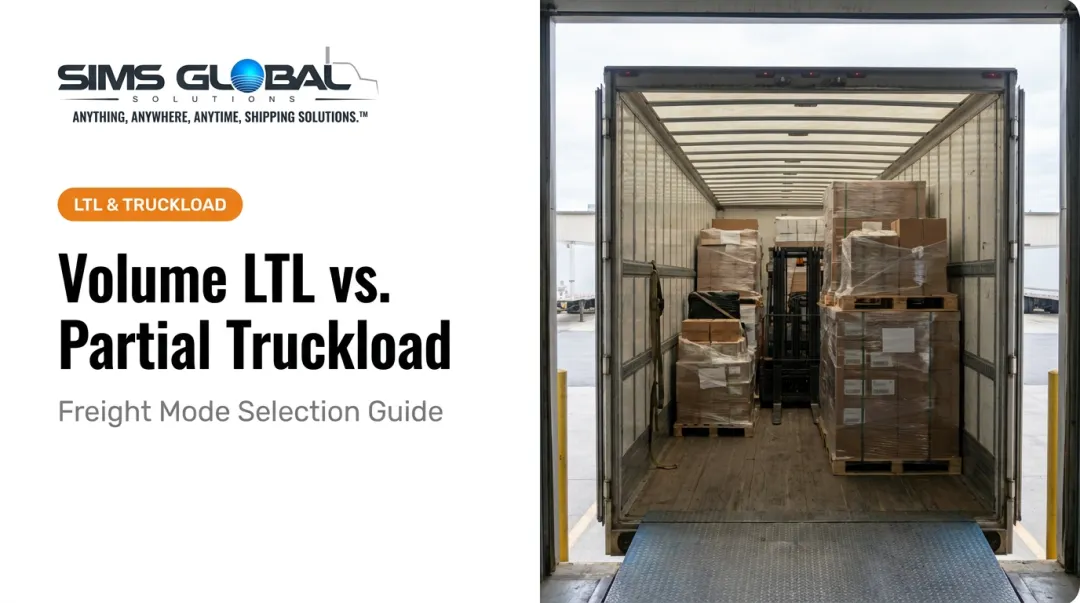
- Volume LTL — typically handles loads of 5,000+ lbs or 8+ linear feet; charges for space used and often costs less than standard LTL for heavier shipments
- Partial truckload — shares trailer space but typically moves faster than standard LTL, with less handling than hub-and-spoke routing
Real-World Scenarios
| Scenario | Right Mode | Why |
|---|---|---|
| Small retailer, 3 pallets to regional distributor, flexible timeline | LTL | Low volume, cost is priority, delivery flexibility exists |
| Manufacturer, 22 pallets of components, production deadline | FTL | Volume justifies cost; firm arrival window non-negotiable |
| Seasonal shipper consolidating infrequent small orders into one load | Possibly FTL | Even at lower pallet counts, speed and damage protection may outweigh cost |
Working With a Freight Partner
Running this analysis shipment-by-shipment gets complicated fast — especially across multiple lanes, freight types, and carrier relationships. For businesses facing that decision repeatedly, a 3PL that evaluates each load individually will consistently outperform a single-carrier or default-mode approach.
Sims Global Solutions works with shippers to assess size, weight, urgency, and cargo type — then matches each shipment to the right mode based on the full cost picture, not a blanket policy.
The SimsTrak platform connects to 70+ LTL carriers via direct API and includes proprietary truckload quoting tools across a network of 150,000+ carriers. It also identifies shipments where switching from LTL to truckload or intermodal would reduce cost or damage risk — before the load moves, not after.
To discuss your freight profile and get a mode recommendation, contact Sims Global Solutions at 855-326-8671 or ContactSims@ShipSims.com.
Conclusion
There's no universal winner between FTL and LTL. The right choice depends on how much you're shipping, how fast it needs to arrive, how fragile the cargo is, and what your budget can support. For most businesses, both modes are part of the toolkit — FTL for high-volume, time-critical, or sensitive lanes, and LTL for smaller, cost-sensitive shipments where delivery flexibility exists.
What matters is making the right call for each load, not defaulting to the same mode out of habit. Choosing the wrong mode doesn't just affect one shipment's invoice — it affects delivery reliability, product integrity, and your supply chain's predictability over time.
If your volume spans both modes, working with a provider like Sims Global Solutions — which handles FTL, LTL, and everything in between through a network of 150,000+ carriers — means you get the right recommendation for each lane, not a one-size-fits-all answer.
Frequently Asked Questions
What is FTL and LTL in logistics?
FTL (Full Truckload) means your shipment has exclusive use of a truck trailer from origin to destination. LTL (Less-than-Truckload) means your freight shares trailer space with other shippers' goods, and you pay only for the portion of the trailer your shipment occupies.
How many pallets is considered LTL vs FTL?
Shipments of 1–6 pallets generally fall into LTL territory; loads of 6 or more pallets, or those exceeding 10,000 lbs, typically make more sense as FTL. For reference, a standard 53-foot dry van trailer holds approximately 26–30 pallets depending on dimensions and loading pattern.
Is LTL always cheaper than FTL?
Not always. LTL is usually cheaper for small shipments since you share the cost, but as loads grow toward half a trailer, FTL becomes competitive, particularly once you factor in LTL accessorial fees, freight classification charges, and the cost of longer transit times.
What happens if my shipment falls between LTL and FTL size?
Quote it both ways. Shipments in the 4–6 pallet range sit in a gray zone where either mode could be cheaper depending on weight, route, and accessorial requirements. Volume LTL and partial truckload are also worth exploring as options with distinct pricing and transit profiles.
Can I use both LTL and FTL in my supply chain?
Mixing modes is common and often the right strategy. Many businesses use FTL for high-volume predictable lanes and LTL for smaller or less frequent shipments. Freight volumes, seasonal patterns, and route characteristics typically dictate which mode makes sense at any given time.
Why is LTL freight more prone to damage than FTL?
LTL freight is loaded and unloaded multiple times at sortation terminals as it moves through the carrier's hub-and-spoke network. Each handling event is an opportunity for damage — particularly for fragile or irregularly shaped goods. FTL freight is sealed at origin and delivered without any intermediate handling.