Introduction
Hauling heavy equipment isn't as simple as hitching up any trailer and hitting the road. The trailer you choose determines whether a shipment moves legally, arrives without damage, and stays on budget.
Choose the wrong trailer, and you risk blocked permits, rejected routes, or machinery that shifts mid-transit. The right trailer keeps the load moving smoothly from pickup to delivery.
Trailer selection has become more critical as oversized freight faces tighter dimension limits, rising permit costs, and stricter enforcement across state lines. This guide breaks down the main types of heavy equipment trailers, how they differ, and how to match the right one to your specific load.
TL;DR
- Trailer type depends on deck height, axle configuration, and loading style, risking fines, delays, or damage if wrong
- Five main categories dominate heavy haul: flatbed, step deck, double drop deck, lowboy, and RGN trailers
- Selecting the right trailer requires matching cargo height, weight, loading method, and route restrictions such as bridges and permits
- An experienced heavy haul partner matches equipment to the right trailer and secures permits in advance
What Is a Heavy Equipment Trailer and Why Does It Matter for Hauling?
A heavy equipment trailer is a specialized semitrailer built to legally and safely move oversized or overweight machinery that exceeds standard freight dimensions. Think bulldozers, excavators, generators, and industrial tanks: cargo that a standard box trailer simply can't handle.
Federal guidelines set the baseline for when a load crosses into oversize territory. The Federal Highway Administration's size regulations cap width at 102 inches (8 ft 6 in) on the National Network and set Interstate weight limits at 80,000 lbs gross vehicle weight (GVW). Height is a different story: there's no federal height limit, but most states set their own threshold around 13 ft 6 in to 14 ft.
Why does trailer type matter so much? Because it directly affects:
- Permit costs: taller or wider loads trigger state permit fees and processing time
- Route options: the wrong deck height can rule out roads with low bridges or overpasses
- Loading time: some trailers need cranes; others let equipment drive right on
- Damage risk: an unstable or mismatched trailer increases the odds of shifting cargo
What Goes Wrong With the Wrong Trailer
Choosing incorrectly doesn't just create inconvenience. It creates real costs:
- Re-permitting after a load is discovered to exceed the original application's dimensions
- Blocked routes when a bridge or overpass can't clear the trailer's height
- Unsafe loading conditions when equipment doesn't match the trailer's loading method
- Fines and delays from state DOT enforcement stops
This is where working with a heavy haul specialist pays off. Sims Global Solutions' Heavy Haul Trucking division combines its own trucking assets (including flatbed, step deck, lowboy, and RGN trailers) with a nationwide network of over 150,000 vetted carriers. That hybrid model means a shipper doesn't need to own specialized equipment to move oversized freight correctly the first time.

Types of Heavy Equipment Trailers for Hauling
No single trailer works for every load. The right type depends on the equipment's height, weight, loading method, and the legal limits along its route. Many of these trailers can also be extended with additional deck length or extra axles for custom configurations, so the categories below represent starting points, not rigid boxes.
Flatbed Trailers
A flatbed is an open deck trailer with no sides or roof, so freight can be loaded from any angle using a crane or forklift. It's the workhorse of the industry.
- Best suited for: steel beams, palletized freight, and equipment within standard legal height limits
- Key strength: versatile and cost-effective for straightforward loads, with a 60-inch deck height and capacity up to roughly 48,000 lbs
- Limitation: no weather protection, and cargo is capped at standard legal height without special permits
Step Deck (Drop Deck) Trailers
A step deck features two deck heights: a lower rear deck for taller cargo and a higher front deck for additional freight. It's a flatbed with a step down built into the frame.
- Best suited for: agricultural equipment, HVAC units, and medium-height construction machinery that would exceed flatbed height limits
- Key strength: allows taller loads — up to around 10 feet — without triggering a permit in many states, while keeping loading straightforward
- Limitation: slightly less total deck space than a flatbed, and the upper deck still faces height restrictions
Double Drop Deck Trailers
A double drop has a recessed center "well" between two raised deck sections. That well drops the load's center of gravity, which matters for tall, top-heavy cargo.
- Best suited for: turbines, generators, industrial tanks, and machinery too tall for a step deck
- Key strength: stabilizes top-heavy loads and reaches roughly 11.5 feet tall without a permit in some states, per FreightWaves' industry benchmarks
- Limitation: limited well space, and typically higher booking costs due to lower trailer availability
Lowboy Trailers
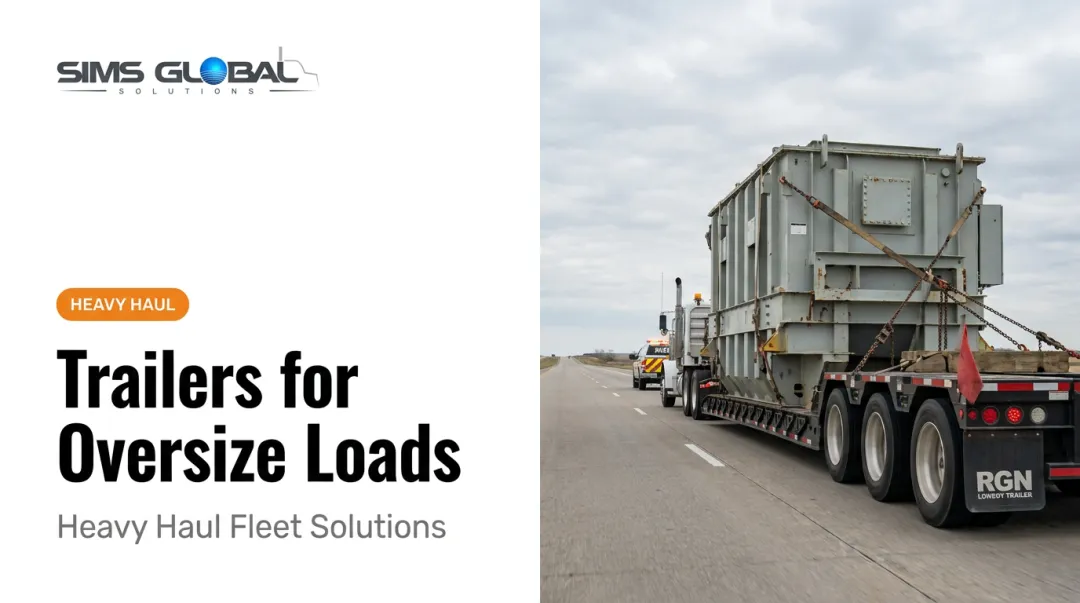
Lowboys are purpose-built with a deck sitting only about 18-24 inches off the ground, using fixed-neck, hydraulic, or mechanical designs.
- Best suited for: very heavy, tall machinery like bulldozers, cranes, and loaders that must clear bridges and overpasses
- Key strength: can add axles to handle extremely heavy loads while keeping overall height low
- Limitation: almost always requires special permits, and loading takes longer compared to drive-on trailers
Removable Gooseneck (RGN) Trailers
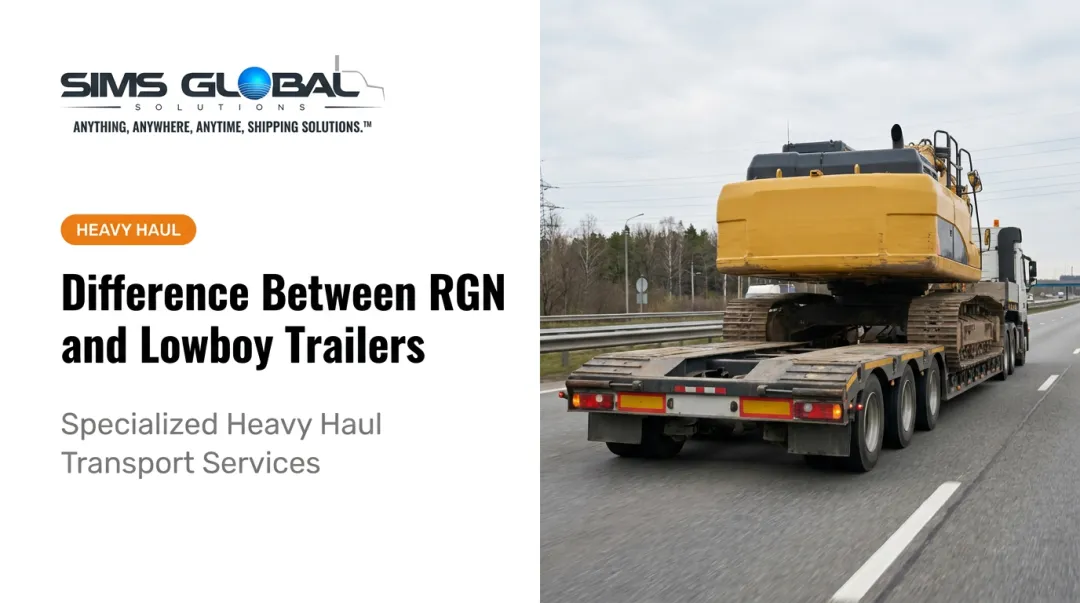
An RGN is similar to a lowboy, but the front gooseneck detaches and lowers to create a ramp. Equipment drives straight onto the deck instead of being lifted or craned.
- Best suited for: self-propelled machinery like excavators, dozers, and tracked or wheeled construction equipment
- Key strength: fast drive-on/drive-off loading, plus configurable axle counts that scale up to handle extremely heavy freight
- Limitation: costs more to operate and needs extra space to detach and lower the gooseneck for loading

Sims Global Solutions operates its own fleet of RGN, lowboy, and multi-axle trailers for heavy haul freight, backed by a network of 150,000+ carriers for equipment that falls outside that fleet.
How to Choose the Right Type of Heavy Equipment Trailer
The right trailer matches your equipment's specs and your shipment's constraints, not whichever type happens to be most available. Here's how to work through the decision.
Measure load dimensions and weight first. Height, width, length, and gross weight immediately narrow your legal trailer options. A 12-foot-tall generator, for instance, rules out a standard flatbed before you even consider anything else.
Determine the loading method. Self-propelled equipment like excavators favors an RGN's drive-on capability. Static machinery that needs a crane or forklift points toward a flatbed or step deck instead.
Check route restrictions. Low bridges, narrow roads, or weight-restricted bridges can rule out certain deck heights before you ever book a trailer. This is where a route survey earns its cost.
Factor in permit and escort requirements. States, not the federal government, issue oversize and overweight permits, and rules vary widely: Kansas requires escorts for loads over 14 feet wide, while California's Caltrans needs 20+ business days to review oversize variances. Build that lead time into your schedule.
Weigh budget against availability. Specialized trailers like double drops and RGNs cost more to book and are harder to find on short notice than standard flatbeds.
A quick gut check: if a flatbed or step deck legally and safely handles the load, there's rarely a reason to pay for something more specialized.
Partnering with a freight provider that offers multiple trailer types and a large carrier network removes much of this guesswork.
Sims Global Solutions' Heavy Haul Trucking division pairs its own fleet with a network of over 150,000 carriers, so shippers get matched to the correct trailer type without owning specialized equipment themselves, and without the trial-and-error of calling around to a dozen carriers.
Mistakes to Avoid When Selecting a Heavy Haul Trailer
Even experienced shippers fall into a few predictable traps. Watch for these:
- Overpaying for capability you don't need. Booking an RGN when a flatbed or step deck would legally and safely handle the load wastes money and often adds lead time.
- Ignoring a trailer's physical limits. Booking a double drop without confirming the well-space dimensions actually fit the equipment leads to last-minute rebooking.
- Underestimating permit and escort timelines. Certain trailer and height combinations trigger longer state review windows and added escort vehicle costs, which shippers need to factor in before quoting a delivery date.
- Choosing based on carrier availability instead of fit. Just because a carrier has a trailer sitting idle doesn't mean it's legal or safe for your specific cargo.

Each of these mistakes traces back to the same root cause: skipping the measurement and route-check steps before booking. It's the cheapest insurance policy in heavy haul.
Conclusion
Choosing the right heavy equipment trailer directly determines how safely, legally, and cost-effectively oversized freight moves. Flatbed, step deck, double drop, lowboy, and RGN trailers each serve different equipment types and load constraints — there's no universal answer.
Understanding these differences, or working with a heavy haul logistics partner who already does, leads to fewer delays, lower costs, and safer hauls. Sims Global Solutions' combination of owned trucking assets and a nationwide carrier network exists precisely to remove that guesswork.
Frequently Asked Questions
What is the difference between a lowboy and an RGN trailer?
Both sit low to the ground for tall cargo, but an RGN's gooseneck detaches to let equipment drive directly on and off. A standard lowboy typically requires crane or ramp loading instead.
How much weight can a heavy haul trailer carry?
Capacity varies widely by trailer type and axle configuration: roughly 47,000-48,000 lbs on standard flatbeds, scaling up to 150,000+ lbs on multi-axle RGNs with added axles.
Do I need a permit to haul oversized equipment?
Yes, once a load exceeds standard limits: generally 8.5 ft wide, 13.5 ft tall, or 80,000 lbs. Exact thresholds and permit processes vary by state.
What trailer is best for hauling an excavator?
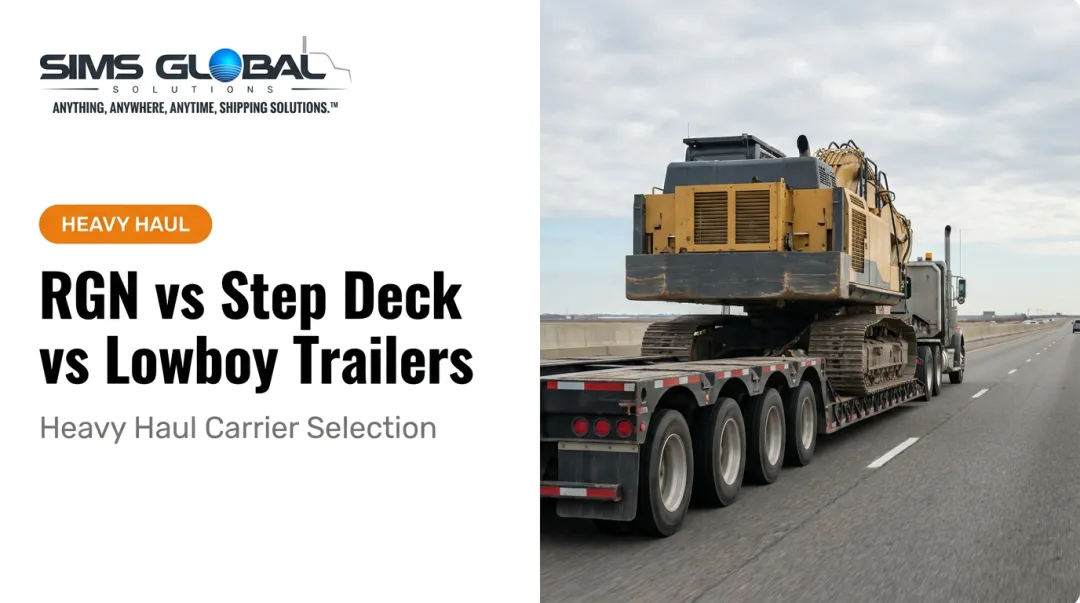
RGN trailers are generally preferred for tracked equipment like excavators because of their drive-on/drive-off loading capability, which avoids the need for a crane.
What's the difference between a step deck and a double drop trailer?
A step deck has one lower rear deck section. A double drop has a recessed well between two raised ends, allowing for taller cargo than a step deck can carry.
How do I choose the right heavy haul trailer for my equipment?
Match your cargo's dimensions, weight, and loading method to a trailer's deck height and axle capacity, then check route and permit requirements, or consult a heavy haul logistics provider directly.