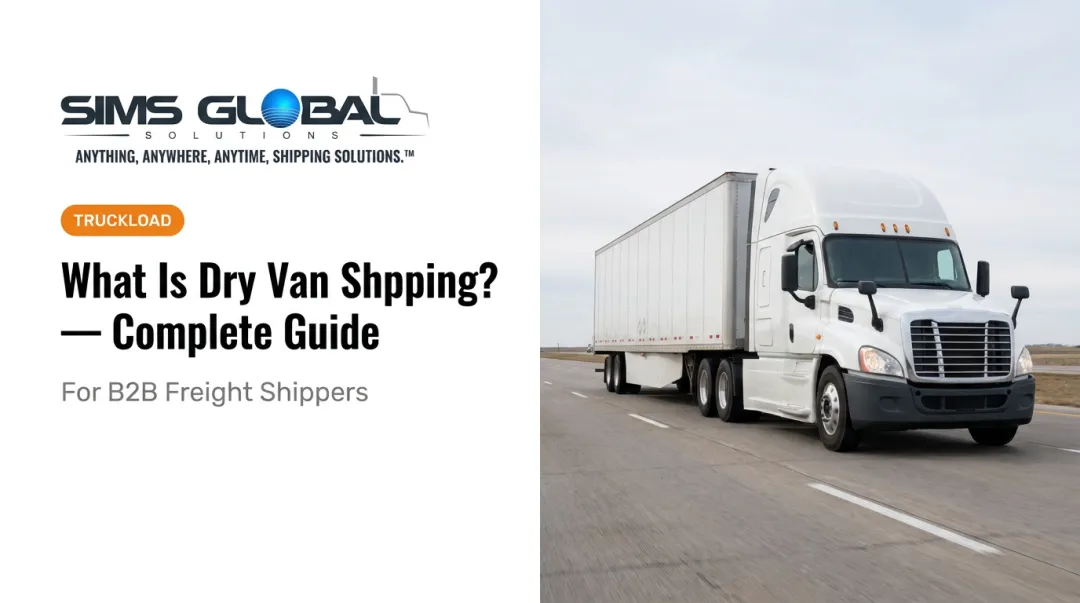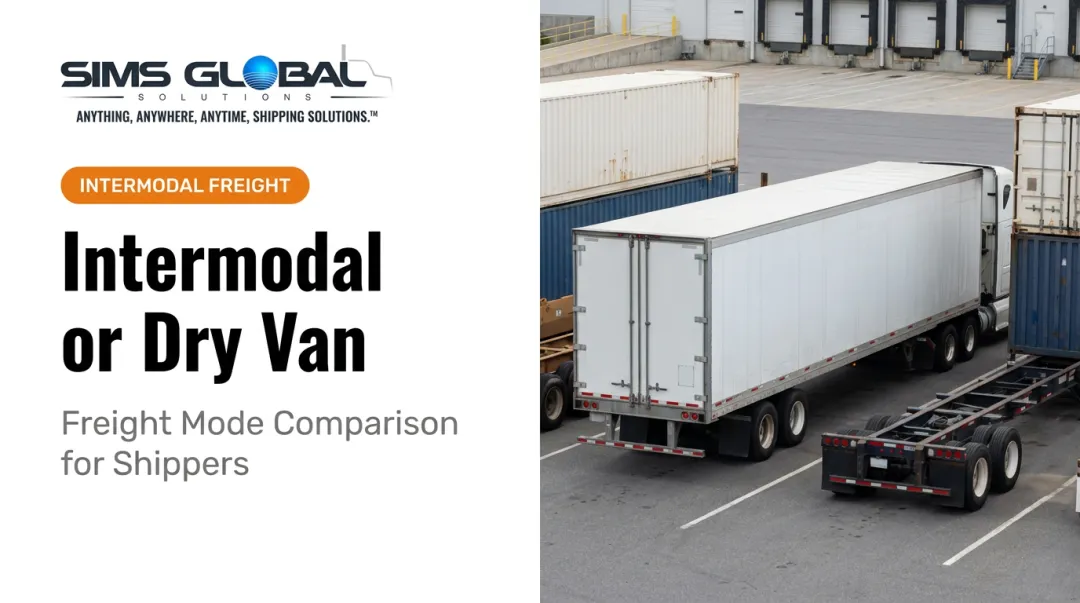
Yet the term causes real confusion. Shippers often mix up "dry van" road trailers with ISO ocean containers, then struggle to figure out which size, type, or cost applies to their freight.
Some context on scale: dry vans made up 61% of US trailer production between 2017 and 2021, according to ACT Research, and that number climbs past 75% when you add refrigerated vans into the mix. That's manufacturing output, not a share of freight volume, but it tells you how dominant this equipment category is.
This guide breaks down what a dry van actually is, the sizes and dimensions you'll encounter, what it can and can't haul, how it stacks up against other trailer types, and how a logistics partner like Sims Global Solutions takes the guesswork out of booking one.
Key Takeaways
- Dry vans are enclosed, non-temperature-controlled trailers built for non-perishable freight.
- Sizes range from 20ft/40ft ISO containers to 28ft-53ft trailers, holding up to 44,000+ lbs.
- Cost, availability, and weather protection make dry vans trucking's top choice.
- They're the wrong fit for perishables, oversized loads, or bulk liquids
- Matching container size to cargo affects cost, transit time, and damage risk.
What Is a Dry Van Shipping Container?
A dry van is an enclosed box: rigid walls, a solid roof, and a flat floor, built from steel or aluminum. There's no refrigeration unit, no ventilation system, no climate control of any kind. Just a sealed, weatherproof space designed to keep cargo dry and secure between pickup and delivery.
Two versions of this equipment exist, and mixing them up trips up a lot of shippers: ISO dry containers are detachable steel boxes designed for ocean vessels, rail cars, and chassis transfers, while domestic dry van trailers are wheeled semitrailers pulled by a road tractor and built specifically for over-the-road trucking.

Both share the same core concept. Neither has moving parts for temperature regulation, which is exactly why they're the most common piece of freight equipment on the road.
How Dry Van Containers Work
Loading happens through rear double doors, which swing open wide enough for forklifts to drive straight in. Crews load palletized freight from the back, push it forward, and secure it against shifting during transit.
Most units come with:
- Rear swing doors with locking bar mechanisms
- E-track or logistic track systems along interior walls for strapping cargo
- Wood or composite flooring rated for forklift traffic
- Sealed seams to keep out rain, dust, and road debris
Once loaded, the doors lock and seal, and the cargo stays untouched until it reaches its destination.
What Can You Ship in a Dry Van?
Dry vans handle the bulk of everyday commercial freight. Common categories include:
- Retail goods and packaged consumer products
- Furniture and household items
- Electronics and appliances
- Automotive parts and components
- Industrial equipment and machinery parts
- Palletized or boxed cargo of nearly any kind
The one hard rule: freight has to be stowable and non-temperature-sensitive. That rules out anything requiring refrigeration, oversized equipment that won't fit through standard door openings, and bulk liquids that need tank containment.
Dry Van Container Types, Dimensions & Cost
Size confusion is the number one reason shippers overpay or under-load their equipment. Here's how the standard ISO sizes break down, based on Hapag-Lloyd's published container specifications:
| ISO Container | External (L x W x H) | Internal (L x W x H) | Max Gross Weight |
|---|---|---|---|
| 20-ft Standard | 19'10" x 8' x 8'6" | 19'4" x 7'8" x 7'10" | ~71,650 lbs |
| 40-ft Standard | 40' x 8' x 8'6" | 39'5" x 7'8" x 7'10" | ~71,650 lbs |
| 40-ft High Cube | 40' x 8' x 9'6" | 39'5" x 7'8" x 8'10" | ~71,650 lbs |
| 45-ft High Cube | 45' x 8' x 9'6" | 44'5" x 7'8" x 8'10" | ~71,650 lbs |
Domestic Trailer Sizes
Road trucking uses a different set of dimensions entirely. A standard 53-foot dry van trailer, the workhorse of US truckload freight, typically runs:
- Interior width: 98 inches
- Interior height: 107 inches
- Pallet capacity: 26-30 standard pallets
- Max cargo weight: up to 44,000 lbs
- Floor: wood, rated for forklift traffic
- Securement: E-track load bars
Shorter 28-foot "pup" trailers hold around 14 pallets with roughly 22,500 lbs capacity, useful for smaller loads or tighter delivery routes.
What Does a Dry Van Cost?
Pricing depends heavily on whether you're buying, leasing, or booking freight capacity.
For a 20-ft ISO container, Container xChange's 2025 pricing guide puts used units at $1,500 to $3,000 and new units at $2,500 to $5,000, with condition, location, and port proximity driving most of the variance.
On the trucking side, DAT reported a national dry van linehaul rate of $2.49 per mile, excluding fuel surcharge. That number moves constantly.
Key cost drivers to watch:
- Load-to-truck ratio (supply vs. demand in your lane)
- Fuel surcharge fluctuations
- Distance and route congestion
- New vs. used, purchased vs. leased equipment
- Ocean/intermodal pricing vs. domestic trucking rates (these aren't directly comparable)
Because rates shift week to week, static benchmarks go stale fast. That's why Sims Global Solutions relies on its proprietary SimsTrak platform to compare live carrier pricing across lanes, rather than publishing static rate cards.

Dry Van vs. Other Container & Trailer Types
Picking the wrong equipment type costs money and, sometimes, the freight itself. Here's how dry van compares:
Dry Van vs. Reefer Reefers add refrigeration units and insulation for temperature-sensitive cargo like produce, dairy, and pharmaceuticals. Dry vans skip that entirely, which keeps them cheaper and simpler but useless for anything needing climate control.
Dry Van vs. Flatbed Flatbeds have no walls or roof. That's a disadvantage for weather protection but an advantage for oversized or irregularly shaped cargo (think lumber, machinery, or steel coils) that won't fit through a dry van's door opening.
Dry Van vs. Tanker Tankers carry bulk unpackaged liquids or gases in a rated tank. Dry vans can still handle packaged liquids (drums, totes, cases), just not bulk product pumped directly into a tank shell.
Standard vs. High Cube: What Changes?
High cube containers add roughly 1 foot (305mm) of external height compared to standard units, per Hapag-Lloyd's specs. That extra vertical space adds meaningful cubic capacity for light, bulky freight.
The tradeoff: high cubes need clearance checks near low bridges and tunnels before you commit to a route.
Quick decision guide:
| Cargo Type | Best Equipment |
|---|---|
| Boxed/palletized, non-perishable | Dry van |
| Temperature-sensitive | Reefer |
| Oversized or irregular shape | Flatbed |
| Bulk liquid/gas | Tanker |
| Light, bulky, high-volume | High cube dry van |
Sims Global Solutions works across all five equipment types, matching your freight to the right trailer through our carrier network and asset-based heavy haul fleet.
Pros and Cons of Dry Van Shipping
Dry van shipping wins on cost and availability, but it's not the right fit for every load.
Advantages:
- Most affordable equipment type — no refrigeration components to maintain or fuel
- Versatile across nearly every industry, from retail to industrial parts
- Enclosed design protects cargo from weather, dust, and theft
- Widely available, meaning less time waiting for capacity
Drawbacks:
- Zero temperature control, so perishables and pharma freight need a reefer instead
- Fixed door opening and interior envelope rule out oversized cargo
- Wood flooring and interior panels are vulnerable to moisture and road-salt corrosion over time if not inspected regularly
In short: if your freight is boxed, palletized, and doesn't need climate control, a dry van is almost always the most cost-effective choice. Anything oversized, temperature-sensitive, or bulk liquid needs different equipment entirely.

Why Partner with Sims Global Solutions for Dry Van Shipping
Finding reliable dry van capacity at a fair rate gets harder every year as freight demand fluctuates lane by lane. Sims Global Solutions solves that through scale, technology, and a nationwide carrier network.
What that looks like in practice:
- Access to a network of 150,000+ carriers, including 35,000+ truckload carriers, so dry van capacity is available even in tight markets
- SimsTrak, our proprietary TMS, gives real-time GPS tracking and transparent status updates across dry van, LTL, intermodal, and drayage shipments
- Pre-negotiated pricing with national, regional, and local carriers, so you're not stuck with one carrier's rate quote
- A+ rated supplemental cargo insurance for high-value dry van freight like electronics, pharmaceuticals, and cosmetics
- 24/7 agent support and dedicated operations teams that handle booking, tracking, and issue resolution from pickup to delivery
Whether you're moving a single truckload of retail goods or coordinating recurring lanes for a national account, our team builds your dry van quote around your specific freight. You won't get a generic rate sheet.
Ready to book your next dry van shipment? Contact Sims Global Solutions or call 855-326-8671 for a quote backed by real carrier data and round-the-clock support.
Frequently Asked Questions
How much does a 20 ft dry van shipping container cost?
Used 20-ft containers typically run $1,500 to $3,000, while new units cost $2,500 to $5,000. Actual price depends on condition, location, and current market demand.
What is a dry van shipping container?
It's a fully enclosed, non-temperature-controlled trailer or container used to transport non-perishable freight. Rigid walls, a solid roof, and a sealed floor protect cargo from weather and theft during transit.
What is the difference between a dry van shipping container and other containers?
Dry vans lack climate control, unlike reefers built for temperature-sensitive freight. Flatbeds handle oversized or irregular cargo that won't fit inside an enclosed box, while tankers carry bulk unpackaged liquids or gases.
What is the difference between a dry van shipping container and a high cube container?
High cube containers stand about 1 foot taller than standard dry vans, adding extra cubic capacity for bulky freight. That added height means checking bridge and tunnel clearances before routing a shipment.
How much weight can a dry van shipping container hold?
Standard 53-foot domestic trailers typically max out around 44,000 lbs, while 20-ft and 40-ft ISO containers carry a max gross weight near 71,650 lbs including tare weight. Exact limits vary by unit and legal axle restrictions.
Are dry van shipping containers weatherproof?
Yes. Their enclosed, sealed design keeps out rain and dust, and reduces theft risk during transit. Long-term moisture exposure can still wear down wood flooring, so regular inspection matters.