The pressure is real. E-commerce growth has permanently reset consumer expectations around speed and visibility, and businesses of all sizes now face the same logistical challenge: how do you get products to end destinations quickly, reliably, and without hemorrhaging margin?
This guide breaks down what last mile delivery actually is, why it remains so difficult to optimize, how the process works end-to-end, and what strategies actually move the needle on cost and performance.
Key Takeaways
- Last mile delivery — the final leg from distribution hub to end destination — accounts for 41% of total logistics supply-chain costs, per Capgemini
- Core challenges include route inefficiency, failed deliveries, rising fuel and labor costs, and growing pressure on delivery speed
- Proven improvement strategies include dynamic route optimization, distributed inventory placement, broader carrier access, and real-time tracking
- A 3PL partner provides instant access to carrier networks, warehousing, and logistics technology — no capital investment required
What Is Last Mile Delivery?
Last mile delivery is the movement of goods from a final transportation or distribution hub to their end destination — a residential address, retail storefront, or business facility. The "last mile" is figurative: actual distances range from a few city blocks to several hundred miles depending on geography and network design.
B2C vs. B2B Last Mile
The mechanics differ significantly based on who's receiving the shipment:
- B2C (e-commerce): The destination is a consumer's home. Speed and convenience dominate — shoppers expect tight delivery windows and real-time updates
- B2B: The destination is a factory, warehouse, or commercial facility. Expect bulk freight, scheduled dock appointments, LTL coordination, and specialized handling — with little tolerance for missed windows
First Mile vs. Last Mile
First mile covers the movement of goods from a manufacturer or supplier to a distribution hub. Last mile picks up from there.
| First Mile | Last Mile | |
|---|---|---|
| Movement | Manufacturer → distribution hub | Hub → end destination |
| Volume | High-volume, consolidated loads | Individual stops, small payloads |
| Customer impact | Invisible to end customer | Directly shapes customer experience |
| Primary challenge | Supplier coordination, inbound scheduling | Cost per stop, routing efficiency |
Why Last Mile Costs So Much
According to Capgemini Research Institute, last mile delivery accounts for 41% of total logistics supply-chain costs — a disproportionate share driven by the economics of individual stop delivery:
- Many stops per vehicle, each with small payloads
- High fuel and labor consumption relative to cargo moved
- Dense urban routing or wide rural spacing, each adding empty miles or excessive stop time
The goal of any last mile strategy is straightforward: deliver goods as quickly and cost-effectively as possible while meeting customer expectations. What makes it hard is that every variable — stop density, traffic, access constraints, delivery windows — compounds against you at the exact moment a customer is paying attention.
Why Last Mile Delivery Is So Challenging
Last mile delivery is the most expensive leg of the supply chain — and the most operationally complex. Several compounding factors make it uniquely difficult to control.
High Operating Costs
Unlike long-haul freight — where a single truck moves thousands of miles of freight efficiently — last mile delivery requires vehicles to make dozens of individual stops with small payloads. McKinsey modeled conventional last-mile delivery costs at approximately EUR 1.50 to more than EUR 4.00 per parcel in European urban markets — a range that translates similarly in US metro areas. Those per-unit costs scale fast at volume.
Route Inefficiency
Geography shapes how inefficiency plays out:
- Urban areas: Traffic congestion and unpredictable stop density slow routes and compress delivery windows
- Rural areas: Wide gaps between stops mean more fuel and driver time per delivery, even with lighter traffic
Both scenarios inflate cost per delivery — just for different reasons.
Failed and Missed Deliveries
A failed first delivery attempt isn't just inconvenient — it's expensive. Loqate's research found that 8% of US first-time deliveries fail, at an average cost of $17.20 per failed order. At 10,000 monthly deliveries, that's over $13,700 in re-delivery costs alone — before accounting for lost customer trust. Unattended packages also create theft and damage exposure that reflects poorly on the brand, not just the carrier.
Labor and Fuel Pressures
Failed deliveries compound an already expensive cost structure. Last mile is labor-intensive in ways that long-haul freight simply isn't. Every route requires a driver, dispatch coordination, and proof-of-delivery processes. ATRI reported 2024 average trucking costs of $2.26 per mile nationally — and with the median annual wage for US light truck drivers at $44,140, labor alone represents a substantial fixed cost that doesn't compress easily.
Rising Customer Expectations
Same-day and two-day shipping norms, established by major retailers, have reset what customers consider standard. Businesses that can't deliver on speed and visibility don't just lose individual orders — they lose repeat customers.
How Last Mile Delivery Works
Step-by-Step Process
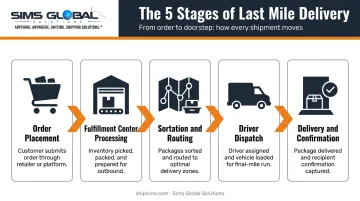
- Order placement — A customer order is placed and enters a centralized tracking system, triggering fulfillment workflows
- Fulfillment center processing — The order is picked, packed, and assigned to a last mile carrier based on destination, service level, and cost
- Sortation and routing — The carrier sorts the package at a local delivery hub and assigns it to an optimized route
- Driver dispatch — A driver departs with a sequenced route, typically generated by routing software to minimize drive time and failed attempts
- Delivery and confirmation — The package is delivered and proof of delivery is captured — photo, signature, or digital timestamp
The Role of the Distribution Hub
The distribution hub is the critical handoff point between long-haul freight and last mile delivery. Large consolidated shipments arrive, get broken down into individual parcels, and staged for local delivery runs. Hub efficiency — how fast that sorting and staging happens — directly determines how well the last mile performs downstream.
B2B Last Mile Complexity
Where residential delivery is relatively straightforward, B2B last mile adds several coordination layers that standard parcel carriers aren't built to handle:
- LTL coordination for freight that doesn't fill a full truck
- Scheduled dock appointments with limited receiving windows
- Specialized equipment — flatbed, liftgate, or expedited carriers depending on freight type
- Receiving team communication to confirm readiness and avoid detention charges
These requirements make B2B last mile a fundamentally different operational challenge — one where carrier selection and pre-delivery coordination matter as much as the delivery itself.
Key Strategies to Improve Last Mile Delivery
Route Optimization
Dynamic routing software calculates the most efficient stop sequence in real time, factoring in traffic conditions, delivery windows, vehicle capacity, and driver availability. The results are measurable: UPS reported that its ORION routing system achieved reductions of 6–8 driving miles per route per day, with the company later reporting 100 million fewer miles driven annually across its US network.
Manual routing simply can't keep pace — too many variables, recalculated too slowly, against volumes that change by the hour.
Real-Time Tracking and Customer Communication
Customers who know where their package is generate fewer "where's my order" inquiries and report higher satisfaction — even when delays occur. Giving customers visibility from dispatch to doorstep reduces support costs and builds trust that static estimated delivery windows never can.
For B2B shippers, real-time tracking has additional value: it enables receiving teams to prepare dock resources, reducing wait times and failed appointments.
Strategic Inventory Placement
Positioning inventory closer to end customers directly cuts last mile costs and transit times. Amazon's fulfillment regionalization offers a concrete example: after restructuring into eight largely self-sufficient US regions, in-region fulfillment rose from 62% to 76%, customer distance fell 15%, and US cost-to-serve dropped by more than $0.45 per unit in 2023.
Distributed warehouse networks and regional fulfillment centers accomplish the same thing at smaller scale — shortening the last mile physically before any other optimization is applied.
Broadening Carrier Access
Physical proximity reduces distance, but carrier flexibility determines whether you can actually execute when demand spikes. Single-carrier dependency becomes a liability during peak seasons or when a carrier hits capacity constraints in a specific lane. Businesses with access to a wide carrier network can:
- Compare rates across multiple providers in real time
- Route shipments to regional carriers with better lane coverage
- Maintain service continuity when primary carriers are constrained
Proof of Delivery and Data-Driven Improvement
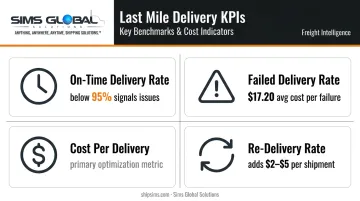
Capturing delivery confirmation — photos, signatures, timestamps — protects businesses in disputes and creates an audit trail that manual processes can't replicate. Beyond dispute resolution, delivery data enables continuous improvement. Track these KPIs consistently:
- On-time delivery rate — your baseline indicator; a rate below 95% typically signals routing, capacity, or carrier issues worth investigating
- Failed delivery rate — flags whether failures stem from bad addresses, missed windows, or carrier performance — each has a different fix
- Cost per delivery — the clearest measure of whether your optimization efforts are actually moving the needle
- Re-delivery rate — even a 5% re-delivery rate can add $2–$5 per shipment in hidden costs, making it one of the fastest levers to pull
The companies that close the loop — pulling data, identifying the pattern, and adjusting the process — are the ones that consistently lower cost per delivery over time.
The Role of Freight Partners in Last Mile Success
For businesses without in-house logistics infrastructure, building last mile capability from scratch is expensive and slow. Carrier relationships, routing technology, and warehousing capacity each represent significant investment that must be absorbed before a single shipment moves.
For businesses managing B2B freight across LTL, expedited, or specialized modes, that kind of infrastructure through a single provider relationship eliminates the need to build it independently.
The right partner also adds accountability. Visibility into delivery performance, carrier compliance, and shipment status throughout the last mile gives businesses the data to act on problems before they reach the customer.
Frequently Asked Questions
What is the last mile in logistics?
The last mile in logistics refers to the final stage of the supply chain, where goods move from a distribution or transportation hub to their end destination — a home, retail store, or business. It's consistently the most expensive and operationally complex segment of the supply chain.
Who are last mile logistics providers?
Last mile providers include major national carriers like FedEx, UPS, and USPS, alongside regional carriers, freight brokers, and third-party logistics companies. The right provider depends on shipment characteristics — freight brokers and specialized operators handle larger or more complex B2B deliveries, while parcel couriers serve small-package needs.
Are last mile logistics carriers legitimate?
Established last mile carriers and logistics providers are licensed, regulated businesses. Before partnering with any carrier or broker, verify their FMCSA operating authority, insurance coverage, and safety record through FMCSA's public lookup tools. TIA membership adds a voluntary professional conduct standard on top of those regulatory requirements.
How do I contact last mile logistics providers?
Businesses can reach last mile providers directly through their websites or through a licensed freight broker that maintains an existing network of vetted carriers — simplifying the process of finding the right provider for a specific lane, shipment type, or service level.
What percentage of shipping costs does last mile delivery account for?
Capgemini reported that last mile delivery accounts for 41% of total logistics supply-chain costs, making it the single most expensive stage of the supply chain. Some sources cite figures as high as 53%, though the methodology behind that number is less consistently documented.
What is the difference between first mile and last mile delivery?
First mile delivery moves goods from a manufacturer or supplier to a distribution hub. Last mile covers the final stretch from that hub to the end customer. Both stages matter, but last mile has the most direct impact on delivery speed, cost, and the customer experience that determines repeat business.