Here's the problem: picking the wrong crane provider doesn't just cost money. It can shut down a job site, trigger an OSHA citation, or damage a six-figure piece of equipment. Getting the crane and rigging strategy right the first time matters more than most project timelines allow for.
This guide breaks down the basics of crane rental and rigging, how to vet a Maryland provider, the permits and regulations you can't skip, and a logistics piece that gets overlooked far too often: getting the crane itself to your site.
Key Takeaways
- Crane rental provides the equipment; rigging expertise ensures safe, accurate lifts
- NCCCO certification, OSHA compliance, and insurance proof are all non-negotiable
- MDOT SHA and local jurisdictions require permits before cranes mobilize in Maryland
- Moving crane components requires specialized heavy-haul trucking, not standard freight
- Construction, aerospace, material handling, and event staging rely on tailored lift plans
What Are Crane Rental and Rigging Services?
Crane rental is exactly what it sounds like: temporary access to mobile, crawler, or tower cranes without the six- or seven-figure cost of owning one. For a short-term lift or a specialized job, renting makes far more financial sense than buying.
Rigging services are the specialized work of securing, lifting, and positioning heavy or awkward loads. Riggers use slings, shackles, spreader bars, and other hardware to make sure a load moves exactly where it needs to go, without shifting, swinging, or dropping.
The two work as a team. The crane supplies raw lifting capacity. The rigger controls how the load is attached, balanced, and guided through the air. Skip either piece and you've got either a machine with no plan or a plan with no muscle behind it.
Common Crane Types on Maryland Job Sites
Different sites call for different equipment:
- Rough terrain cranes – built for uneven, off-road construction sites; common on suburban and rural builds
- All-terrain cranes – multi-axle mobile cranes that travel on highways and adapt to varied site conditions
- Crawler cranes – track-mounted for stability on soft or uneven ground, often used on large industrial projects
- Tower cranes – fixed or rail-mounted, standard on tall vertical builds in dense areas like downtown Baltimore
- Boom trucks – truck-mounted and road-mobile, useful for quicker, smaller lifts

The right choice depends on load chart specs, site access, and ground conditions, not just the label on the crane.
Why Rigger Certification Isn't Optional
Selecting the right crane only solves half the equation. The rigger controlling that load determines whether the lift goes smoothly or turns into a safety statistic. Between 2011 and 2017, cranes were involved in an average of 42 worker deaths per year, with more than half classified as struck-by incidents, according to Bureau of Labor Statistics data.
NCCCO's rigger certifications reflect two distinct skill levels:
| Certification | Scope of Work |
|---|---|
| Level I | Handles simple, repetitive tasks when load weight and configuration are already known |
| Level II | Covers unsupervised work estimating load weight, center of gravity, and non-routine rigging setups |
A provider should be able to tell you which level their riggers hold and why it matches your lift.
How to Choose the Right Crane Rental and Rigging Company in Maryland
Not every provider is built for every job site. A company that's spent years working Baltimore's tight urban streets will plan a lift differently than one that mostly serves the Eastern Shore's open, rural terrain. Local experience shows up in the details: street closures, overhead utility clearance, and neighbor notifications that a rural-focused crew might not think to plan for.
Before signing a contract, verify:
- Licensing and insurance – confirm active liability coverage and proper business licensing for Maryland operations
- Operator credentials – ask for NCCCO certification and OSHA 30 training records for every operator and rigger assigned to your job
- Fleet condition – request maintenance logs and equipment age; older, poorly maintained cranes fail at the worst possible moment
- Safety record – ask directly about past incidents and how the company builds site-specific lift plans and pre-lift inspections
- Logistics coordination – confirm whether they manage or partner with a heavy-haul transport provider for full project execution
Finally, get a written, itemized quote that separates:
- Mobilization costs
- Hourly or daily rental rates
- Permit fees
A vague lump-sum number almost always hides charges you'll discover later, usually mid-project.
Maryland Permits, Regulations & Safety Compliance
Crane work in Maryland runs through more than one regulatory layer, and missing any of them can stall mobilization by days.
State-level permitting (MDOT SHA): Maryland's overdimensional permit rules kick in once a load crosses specific size thresholds:
- Widths over 102 inches, heights over 13 feet 6 inches, or lengths over 70 feet (indivisible loads) require authorization
- Superloads (over 150,000 pounds, 120 feet long, or 16 feet wide or high) trigger a full engineering review
- Escort requirements scale with size, starting at one escort vehicle and reaching a police escort for the largest, heaviest moves

Local jurisdiction rules: Cities and counties add their own layers on top of state permits.
- Baltimore City lists cranes as a specific right-of-way permit type, with a standard 15-day processing window, and restricts construction noise from 7 p.m. to 7 a.m.
- Montgomery County requires a mobile crane permit whenever operations involve traffic control in county right-of-way, with quiet hours running 9 p.m. to 7 a.m. on weekdays
Beyond permits and local ordinances, federal safety rules apply on every job site regardless of location.
OSHA Subpart CC: Federal rules under 1926 Subpart CC set baseline safety requirements. Multiple-crane lifts require a documented lift plan built by a qualified person. Every signal person must meet specific OSHA qualification standards, with that qualification verified and documented before work begins.
Skipping any of these steps doesn't just risk a fine. It can shut down a lift entirely on the day it's scheduled.
Industries Across Maryland That Rely on Crane Rental Services
Construction remains the largest user of crane and rigging services statewide, driven by ongoing Baltimore redevelopment and steady DC-metro growth. Transit projects, capital infrastructure work, and the wave of new data center builds in Frederick County all depend on reliable lift capacity.
Beyond construction, a few specialized industries stand out:
- Aerospace and defense: facilities handling sensitive test equipment and clean-room components need precision rigging with zero margin for error
- Material handling and manufacturing: Maryland's port operations, including Seagirt's container terminal with its fleet of Neo-Panamax cranes, depend on heavy lifting daily
- Event and concert staging: venues and festivals rely on temporary rigging for stage structures, lighting rigs, and aerial equipment, each inspected before every use
Each of these sectors requires a provider experienced in the specific safety and technical demands of that particular load.
Why Heavy-Haul Trucking Is the Backbone of Successful Crane & Rigging Logistics
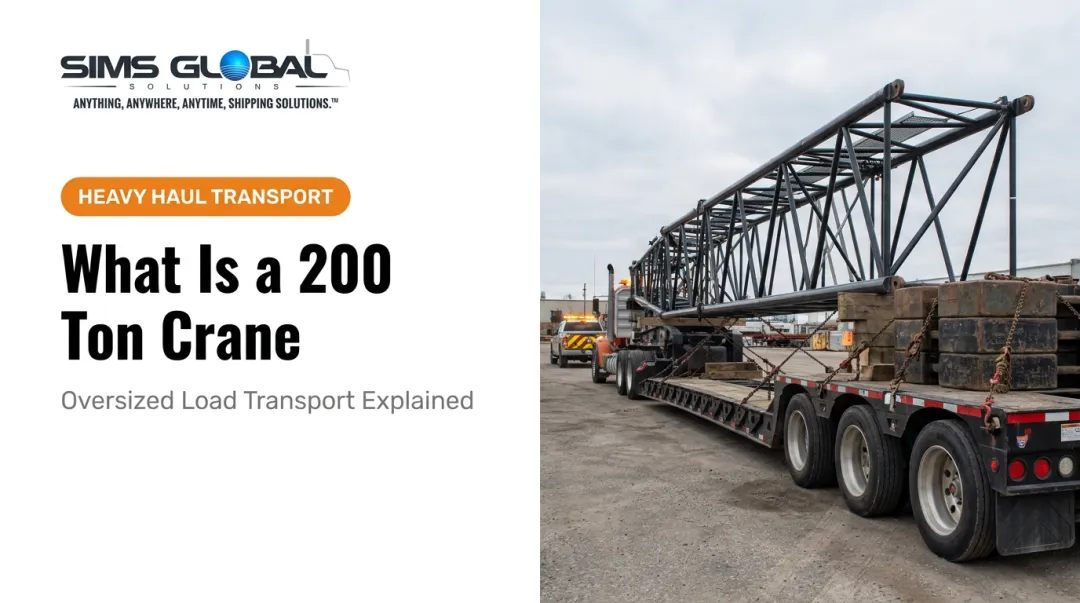
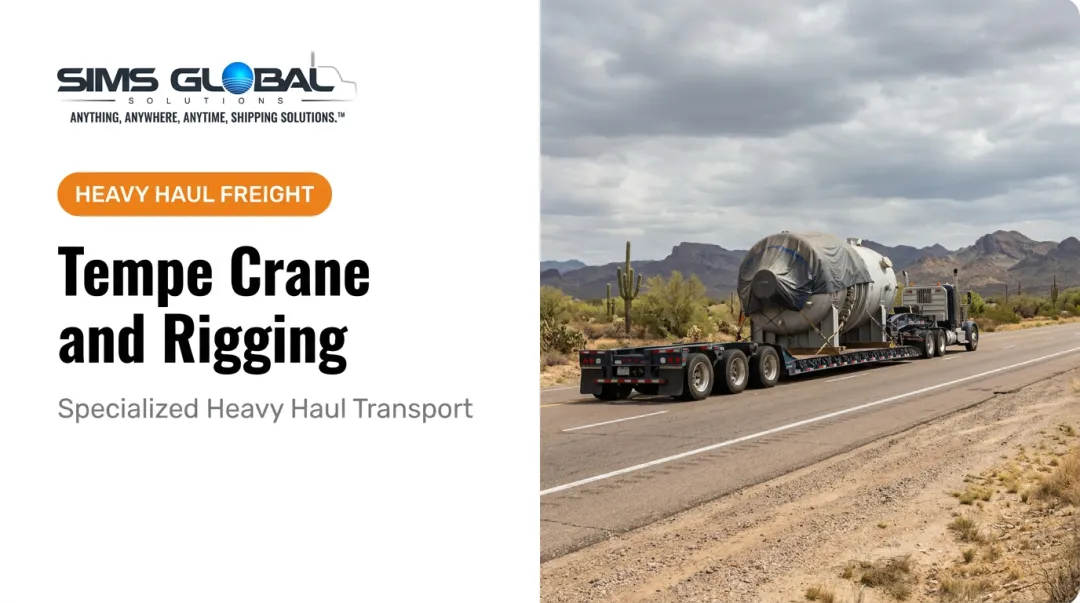
Cranes almost never move in one piece. Boom sections, counterweights, and outriggers get disassembled and hauled separately, often as oversized loads requiring their own permits and escorts. This step gets overlooked constantly, and it's usually where project delays start.
Moving these components across Maryland, and often across state lines into Virginia, Pennsylvania, or Delaware, means coordinating separate permit applications, route surveys, and escort vehicles for each jurisdiction. A crane sitting idle at a border checkpoint because of a missed permit is a delay nobody budgets for.
This is where a dedicated logistics partner earns its keep. Sims Global Solutions operates an asset-based heavy-haul fleet alongside a network of more than 150,000 vetted carriers, giving project teams flexibility whether they need dedicated equipment or broader carrier reach for a specific route.
A few things that separate this kind of logistics support from relying on a crane company's limited in-house transport:
- Tracks shipments in real time through the SimsTrak Transportation Management System, so project managers know exactly where equipment sits at any point in transit
- Vets and manages carriers in-house, handling compliance instead of leaving it to whoever's available
- Consolidates billing and reporting across multi-shipment projects, cutting the administrative work of tracking multiple invoices
- Manages DOT and FMCSA compliance, including permitting and escort coordination, before the truck ever leaves the yard

For crane and rigging companies moving equipment across Maryland's borders with Virginia, Pennsylvania, and Delaware, choosing a logistics partner that treats heavy-haul transport as a specialty, not an afterthought, directly cuts the liability and schedule risk tied to multi-state moves.
Frequently Asked Questions
What's the difference between crane rental and rigging services?
Crane rental provides the physical lifting equipment for a project. Rigging services provide the expertise, hardware, and labor needed to safely secure and move the load once it's attached to the crane.
How much does it cost to rent a crane in Maryland?
Costs vary based on crane type, project duration, and mobilization distance to your site. Request an itemized quote covering mobilization, hourly or daily rates, and permit costs for an accurate number.
What permits are required for crane operations in Maryland?
MDOT SHA requires permits for oversized or overweight loads traveling on state roads, with thresholds based on width, height, length, and weight. Local jurisdictions like Baltimore City and Montgomery County may require additional right-of-way permits.
How do I determine the right crane size for my project?
Load weight, lift height, and site access constraints all factor into crane sizing. Work with your provider's engineering team to review load charts against your specific site conditions before finalizing equipment.
Who is responsible for transporting a crane to and from the job site?
This is typically coordinated between the crane rental company and a heavy-haul trucking partner, especially when boom sections or counterweights need separate, disassembled transport.
What certifications should crane operators and riggers have?
Look for NCCCO certification appropriate to the equipment and lift complexity, plus OSHA training records. OSHA 30 is supervisor-level safety training, not a substitute for operator or rigger certification.