Introduction
A hospital needs to move a 12-ton MRI machine into a third-floor imaging suite. A manufacturer has to relocate a 40-foot industrial press across the country, while an aerospace contractor needs a satellite component lifted with zero margin for error. In every one of these situations, a standard freight truck and a forklift simply won't cut it.
This is where specialty rigging comes in. It's the intersection of engineering, purpose-built equipment, and hands-on expertise required to safely lift, secure, and move loads that fall outside the boundaries of ordinary shipping.
This guide breaks down what specialty rigging actually involves:
- Types of rigging by industry
- Equipment behind the scenes
- Real project examples
- Safety standards that govern the work
- How to choose a provider who can handle both the lift and the haul
Key Takeaways
- Specialty rigging combines engineering and specialized equipment to move loads standard freight can't handle
- Five categories exist: industrial, structural, aerospace/defense, medical/tech, and event rigging
- Success hinges on rated equipment (cranes, slings, spreader bars, custom trailers) and certified riggers
- Rigging is only step one: safe transport also requires permitting, route surveys, and the right trailer setup
What Is Specialty Rigging?
At its most basic, rigging is the process of lifting, moving, and positioning heavy or awkward loads using ropes, cables, pulleys, hoists, and other mechanical devices. Construction crews use rigging every day to set steel beams or hoist equipment onto rooftops.
Specialty rigging is a different animal. It kicks in when a load has:
- Non-standard dimensions that won't fit conventional lifting points
- Extreme weight that exceeds typical crane or sling capacities
- Fragility or sensitivity, such as vibration-sensitive electronics
- High value, where a mistake carries significant financial risk
- Unusual shape or center of gravity, requiring custom engineering

Because of these variables, specialty rigging almost always requires load calculations, an engineered lift plan, and site-specific permits before a single cable is attached.
Riggers on these projects typically hold credentials beyond general construction training. NCCCO certification comes in two tiers:
| Certification | Scope |
|---|---|
| Level I | Supervised, repetitive rigging tasks |
| Level II | Independently determines weight, center of gravity, and load dynamics on complex lifts |
Specialty rigging rarely stands alone. Once a load is secured, it still needs to move, meaning route surveys, permitting, and escort vehicles typically follow right behind the lift plan.
Demand for this kind of work isn't slowing down. The broader industrial services market, which includes engineering, installation, and specialized equipment handling, was valued at $34.41 billion in 2025 and is projected to reach $54.69 billion by 2030, according to a 2025 market analysis from MarketsandMarkets.
That growth signals oversized and complex equipment moves are becoming more common across manufacturing, aerospace, and infrastructure sectors.
Types of Specialty Rigging
Specialty rigging isn't one skill set. Each industry brings its own load types, tolerances, and regulatory environment.
Industrial & Machinery Rigging
This covers factory relocations, turbines, generators, and heavy manufacturing equipment. Loads are often oversized and awkwardly shaped, requiring dismantling and custom lifting points. Moving equipment from the plant floor to its next destination also demands tight coordination between rigging crews and heavy haul transport.
Structural & Construction Rigging
Steel beams, precast concrete panels, and other structural components have to be rigged with trade-specific attachment methods. OSHA requires precast lifting hardware to support at least five times the maximum intended load. Steel erection work, meanwhile, must be handled by a qualified rigger under federal construction standards.
Aerospace & Defense Rigging
Satellites, aircraft sections, and munitions demand extreme precision and, often, restricted-access facilities. NASA's team used synchronized tandem cranes rated at 325 tons and 175 tons to lift and rotate a 212-foot, 228,000-pound Space Launch System pathfinder mock-up inside a controlled high bay. Custom fixtures and rehearsed movements replaced guesswork, showing how high-consequence lifts demand precision planning.
Medical & Technology Equipment Rigging
MRI machines, CT scanners, and data center hardware are heavy, but their real risk is tilt and vibration sensitivity. Every OEM sets its own shipping angle, floor-loading, and shock limits, so rigging plans for this category are built around manufacturer specs rather than generic weight charts.
Event & Entertainment Rigging
Concert stages, sound systems, and lighting rigs require rigging that's fast and repeatable, with consistent safety standards across dozens of tour venues. Industry codes require temporary rigging to be preplanned by a competent person using equipment that's traceable and regularly inspected.

Equipment Used in Specialty Rigging
The right equipment depends on load weight, shape, and site access — there's no one-size-fits-all setup.
Primary lifting equipment includes:
- Mobile cranes for public-road accessible sites
- Crawler cranes for soft or uneven ground where track mobility matters
- Gantry systems, including hydraulic variants, for confined spaces without overhead crane access
Lifting equipment only gets the load airborne; rigging hardware is what keeps it secure once it's up. Core rigging hardware distributes load weight safely and includes slings, shackles, spreader bars, chain hoists, and turnbuckles. Every piece carries a marked working load limit that can't legally be exceeded, and OSHA requires this equipment to be inspected before each shift.
Once the load is rigged, it needs the right ride. That's where transport equipment pairs directly with the rigging plan:
- RGN (removable gooseneck) trailers for low-deck loading of tall equipment
- Lowboy trailers for heavy construction and industrial machinery
- Extendable flatbeds for loads that exceed standard trailer length
- Multi-axle configurations for weights climbing well past 100,000 pounds
Before any of this happens, engineering software like 3D lift-planning tools models crane placement, load path, and collision risk. And increasingly, load sensors and GPS tracking give project managers live visibility into a rigged load in transit. Sims Global Solutions' SimsTrak platform delivers this kind of shipment visibility directly, giving heavy haul customers real-time status updates rather than a phone call and a guess.
Real-World Examples of Specialty Rigging
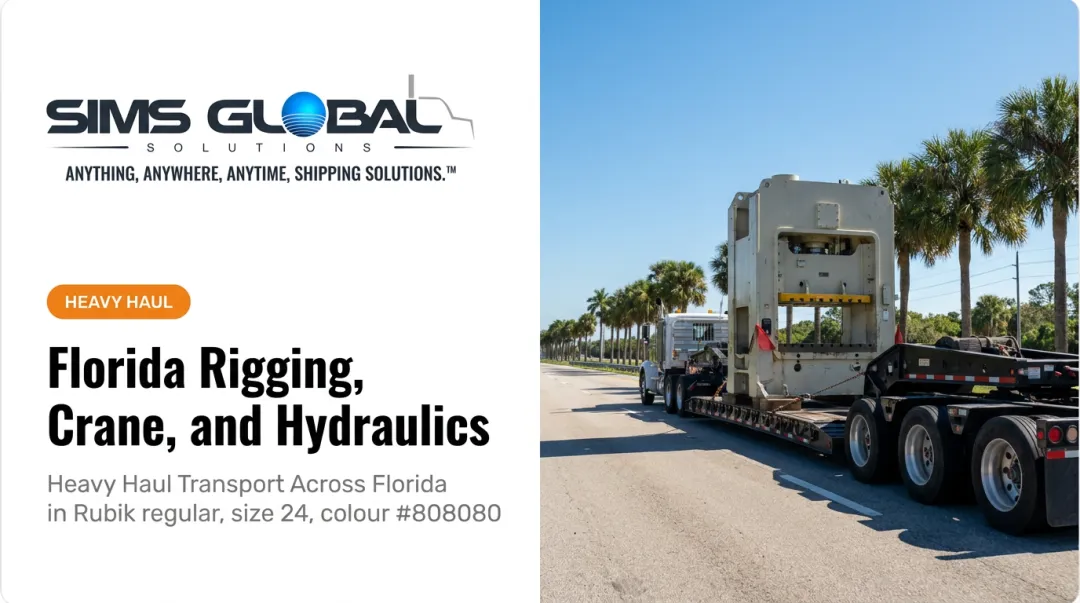
Industrial machinery relocation. Moving a multi-ton industrial press or turbine typically means disassembling components on-site, rigging each section for lift, and coordinating a heavy haul trailer for the road move. One documented Specialized Carriers & Rigging Association (SC&RA) award-winning project involved relocating an engine weighing almost a million pounds — a job that took six months of engineering and planning before the first crane moved.
Aerospace and defense components. These loads often require climate-controlled, secure handling and custom fixtures built for a single project. NASA's synchronized crane lift of its SLS pathfinder mock-up is a clear example of how precision and redundancy take priority over speed.
Event and entertainment installs. Touring productions push rigging to its dynamic-load limits. Madonna's Celebration Tour used a system supporting 164,842 pounds across 160 rigging points, with wireless load cells tracking moving gantry and mirror-ball loads across 81 shows over eight months. This real-time monitoring lets crews adjust rigging loads instantly, show after show, rather than relying on static, one-time calculations.
Safety Standards & Certifications
Specialty rigging carries real consequences when something goes wrong, which is why the work is governed by strict standards.
- OSHA regulations require qualified riggers for crane assembly, disassembly, and any lift where workers enter the fall zone
- ASME B30 series standards cover slings (B30.9), below-the-hook devices (B30.20), and rigging hardware (B30.26)
- Rigging equipment inspections happen before every shift to catch wear or damage early
- Shackles and other hardware can never exceed their marked working load limit
Before hiring any rigging provider, ask for proof of insurance and certification. It's a two-minute request that can save weeks of downtime if equipment fails.
Engineered lift plans and pre-job site surveys are also standard practice on any complex lift. ASME's P30.1 standard separates routine "Standard" lift plans from higher-risk "Critical" lift plans — a distinction that matters when ground conditions, load weight, or lift geometry push beyond typical parameters.
Why Partner With a Specialty Rigging & Heavy Haul Provider
Rigging the load is only half the job. Once it's secured, that equipment still has to get from point A to point B, and that means permitting, route planning, and the right trailer sitting in the right spot at the right time.
This is where Sims Global Solutions' Heavy Haul Trucking division fits into the picture. The team combines company-owned trailer assets with access to a network of more than 150,000 carriers, giving customers flexibility whether they need a dedicated RGN trailer or a broader capacity search across the country.
Sims Global Solutions' heavy haul specialists follow a structured five-step planning process on every project:
- Equipment determination: selecting the right trailer for the load's weight and dimensions
- Route creation: mapping a path that accounts for bridge, height, and weight restrictions
- Route survey and review: verifying the route holds up to real conditions
- Permitting: securing state-specific oversize and overweight permits
- En route logistics coordination: managing weather, traffic, and schedule changes in real time

This process supports industries where a missed permit or the wrong trailer can stall an entire project, including:
- Aerospace and defense
- Medical device manufacturing
- Material handling
Pairing that planning with SimsTrak's real-time visibility keeps the rigging crew and the truck moving on the same schedule.
Frequently Asked Questions
What is specialty rigging?
Specialty rigging is the engineered process of lifting, securing, and moving oversized, heavy, or fragile loads using custom equipment and certified riggers. It applies when standard rigging methods and freight equipment can't safely handle the job.
What are the types of specialty rigging?
The main categories include industrial and machinery, structural and construction, aerospace and defense, medical and technology equipment, and event and entertainment rigging. Each carries distinct load types and regulatory requirements.
What are examples of specialty rigging?
Common examples include relocating industrial presses or turbines, lifting aerospace components like satellite sections, moving MRI or CT machines into hospitals, and installing concert stage rigging within tight show windows.
What equipment is used for specialty rigging?
Projects typically combine mobile or crawler cranes, hydraulic gantries, slings, shackles, and spreader bars for the lift, paired with RGN or lowboy trailers for transport. Engineering software helps plan the lift before equipment ever arrives on-site.
Who typically needs specialty rigging services?
Industries like aerospace, defense, medical device manufacturing, material handling, and event production most often need specialty rigging. Any company moving equipment too large, heavy, or sensitive for standard freight falls into this category.
How much does specialty rigging cost?
Cost depends on load weight, distance, trailer type, permitting requirements, and whether escort vehicles are needed. Because every project varies, it's best to request a custom quote based on your specific dimensions and route.