Rates in 2026 are not fixed. According to FreightWaves, hot shot rates currently range from roughly $1.00/mile on straightforward competitive loads to $3.00+/mile for urgent or complex freight. The actual number any operator or shipper sees depends on load type, urgency, geography, equipment, and cost structure — which is exactly why understanding the variables matters more than memorizing a single number.
This guide covers 2026 rate ranges by load type, the key cost drivers, how operators calculate a defensible rate floor, seasonal demand patterns, and the most common pricing mistakes on both sides of the transaction.
Key Takeaways
- Hot shot rates in 2026 range from $1.00–$1.25/mile on basic competitive loads to $3.00+/mile for urgent or complex freight
- Shippers receive flat-rate quotes; divide by miles to find the per-mile equivalent
- Operators must calculate cost per mile over all miles — loaded and deadhead — before accepting any load
- Urgency, load complexity, and geography are the three biggest rate drivers
- A logistics partner with a vetted carrier network can source competitive hot shot rates faster than going direct
Hot Shot Trucking Rates Per Mile in 2026: What to Expect
Hot shot pricing is negotiated, not posted on a menu board. Rates shift daily based on market demand, lane supply, and what a given load actually requires of the operator. Most shippers receive a flat-rate quote — dividing that number by miles gives you the per-mile equivalent.
Example: A $750 flat quote on a 300-mile haul works out to $2.50/mile.
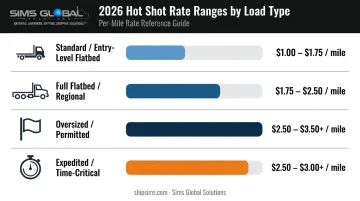
Standard / Entry-Level Loads ($1.00–$1.75/mile)
These are the most competitive loads on any load board.
What's typically included:
- Partial flatbed loads or LTL freight
- Local or short-haul runs under 150 miles
- Flexible delivery timelines
- Lower-weight, lower-complexity cargo
Best for: Operators filling deadhead miles or building route density; shippers moving non-urgent cargo on well-traveled lanes. Competition is highest at this tier.
Mid-Range / Full Flatbed and Regional Loads ($1.75–$2.50/mile)
This is where most experienced operators spend most of their time.
What's typically included:
- Full flatbed loads on regional runs of 100–400 miles
- Construction materials, machinery, auto parts, oilfield equipment
- Loads requiring proper securement and sometimes specialty trailer setups
Best for: Operators with reliable equipment and established broker relationships, and shippers moving specialized cargo without same-day urgency.
Premium / Expedited and Complex Loads ($2.50–$3.00+/mile)
FreightWaves confirms that urgent or complex hot shot loads regularly reach $3.00/mile or higher in 2026.
What's typically included:
- Same-day or next-day delivery requirements
- Oversized or permitted loads
- HAZMAT materials or oilfield emergency freight
- Cross-region hauls requiring Class A CDL, permits, or pilot cars
Best for: Operators running gooseneck or lowboy setups who can roll on short notice — and shippers where downtime is not an option.
Rate Reference Table
| Load Type | Typical 2026 Rate Range |
|---|---|
| Standard / Entry-Level Flatbed | $1.00–$1.75/mile |
| Full Flatbed / Regional | $1.75–$2.50/mile |
| Oversized / Permitted | $2.50–$3.50+/mile |
| Expedited / Time-Critical | $2.50–$3.00+/mile |
Key Factors That Affect Hot Shot Rates Per Mile
Hot shot pricing reflects a combination of operational reality and market conditions. Six variables move the number more than anything else.
Load Type, Size, and Weight
Complexity commands a premium. A partial load of palletized building materials on a standard flatbed competes with dozens of other carriers on any load board. An oversized piece of oilfield equipment requiring permits, special securement, and a pilot car has far fewer qualified operators — and rates reflect that scarcity.
The practical rule: the more a load demands of the operator in terms of equipment, compliance, and handling, the higher the rate it should command.
Urgency and Delivery Timeline
Urgency is one of the most significant rate drivers in hot shot trucking. A same-day or next-day load disrupts the operator's planned schedule, eliminates their ability to batch loads efficiently, and forces them to prioritize one shipper's emergency above everything else.
Truckstop notes that urgent loads represent the upper end of the hot shot rate spectrum, as operators must account for both disrupted scheduling and opportunity cost when pricing expedited runs.
Geography, Lane, and Regional Demand
Where freight originates and where it's going matters enormously. High-density freight corridors generate more load volume, which means operators face less deadhead risk and can be more selective about what they haul. Active examples include:
- Construction-heavy markets in the Southeast and Mountain West
- Energy-producing regions across the Permian Basin and Bakken formation
- Heavy industrial zones around the Great Lakes and Gulf Coast
Sparse freight markets in rural or low-activity regions produce the opposite effect: more deadhead, fewer return loads, and lower effective rates even when the posted rate looks reasonable.
Fuel Costs and Deadhead Miles
Diesel hit $4.796/gallon nationally on July 13, 2026, according to EIA data — a meaningful input cost for any operator running loaded and empty miles across a week.
Deadhead (driving empty to a pickup or returning home without a load) quietly destroys margin. A $2.50/mile loaded rate looks strong until you factor in 150 miles of empty driving to reach the pickup — the cost calculation section below breaks down exactly how that math shifts.
Equipment Type and CDL Status
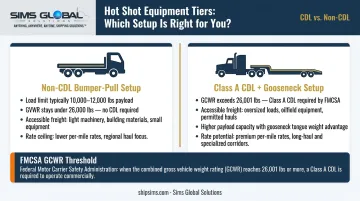
Equipment sets a ceiling on which loads an operator can legally and practically accept. A Class A CDL combined with a 40-foot gooseneck opens higher-paying freight — oversized loads, heavier oilfield equipment, permitted cargo — that a non-CDL bumper-pull setup simply cannot touch.
Per FMCSA regulations, a Class A CDL is required when the gross combination weight rating (GCWR) reaches 26,001 lbs or more and the towed unit exceeds 10,000 lbs. Operators who invest in compliant, capable equipment access a different tier of freight — one with less competition and better pay.
How to Calculate Your Hot Shot Cost Per Mile
Before accepting any load, operators need a hard number: their true cost per mile. Without it, a rate that looks profitable on paper can quietly lose money once all costs are counted.
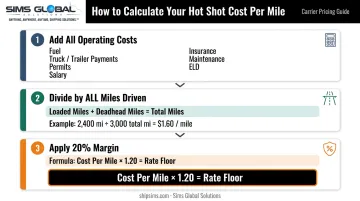
Step 1 — Add Up All Operating Costs
OOIDA's cost-per-mile methodology breaks costs into fixed and variable categories. For hot shot operators, the key line items include:
| Cost Category | Approximate Range |
|---|---|
| Fuel (varies by MPG and diesel price) | Significant variable cost |
| Truck and trailer payments | Monthly financing ÷ miles driven |
| Commercial insurance (liability minimum $750,000 per FMCSA) | Fixed monthly cost |
| Maintenance and tire reserves | Variable |
| Permits and licensing | Variable by load/state |
| ELD subscription | Truckstop plans run $42–$159/month; DAT runs $119–$169/month |
| Personal salary / owner draw | Fixed |
Add every line together. Divide by expected monthly miles. That's your baseline cost per mile.
Step 2 — Calculate Over ALL Miles, Not Just Loaded Miles
This is the most commonly overlooked step, and the one that separates profitable operators from ones who wonder why they're not making money.
Example:
- Loaded haul: 200 miles at $3.00/mile = $600 gross
- Deadhead to pickup: 150 miles (empty, zero revenue)
- Total miles driven: 350
- Effective rate: $600 ÷ 350 miles = $1.71/mile
That $3.00/mile rate just became $1.71/mile in practice. If your cost per mile is $1.50, you made $0.21/mile — not $1.50. OOIDA's framework explicitly requires dividing annual costs by total miles driven, loaded plus empty, for this exact reason.
Step 3 — Set Your Minimum Rate Floor
Once you know your true cost per mile (over all miles), add a minimum 20% margin:
Cost per mile × 1.20 = Minimum acceptable rate
If your cost per mile is $1.40, your rate floor is $1.68/mile. Any load below that floor means you're wearing out your equipment and drawing down reserves without building a business. That's the difference between running a trucking operation and just staying busy.
For shippers on the other side of this equation, working with a logistics partner like Sims Global Solutions removes the burden of sourcing and vetting carriers individually. With access to 150,000+ carriers and dedicated expedited freight capacity, Sims matches businesses to qualified hot shot operators at market-based rates.
Hot Shot Rate Trends: When Rates Rise and Fall
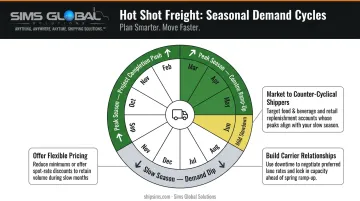
Hot shot freight follows seasonal demand cycles driven by construction activity, oilfield drilling patterns, and regional economic conditions. Operators who map their strategy to these cycles position themselves to chase higher rates during peak windows and protect margins when demand softens.
Peak Season (Spring and Fall)
Construction activity peaks in spring as contractors ramp up after winter, then again in fall as projects push toward completion before weather closes in. These windows — roughly March through June and again September through November — consistently produce stronger demand for flatbed and specialty freight.
During peak periods, operators with reliable equipment and strong broker relationships can afford to be selective. Prioritize higher-paying load types and hold out for rates that reflect the demand — peak season is when that leverage exists.
Slow Season (Winter and Mid-Summer)
December through February brings the steepest demand dips as construction halts across cold-weather regions. Mid-summer sees a milder slowdown tied to vacation schedules and reduced industrial activity.
Strategies for slow-season survival:
- Build cash reserves during peak months rather than spending up
- Schedule major maintenance during slow periods when downtime costs less
- Focus on warmer-region lanes (Texas, Florida, Arizona) where construction and oilfield activity continue year-round
- Use slower periods to improve compliance records, upgrade equipment, or pursue load types that require permits or endorsements
What Operators and Shippers Often Get Wrong About Hot Shot Pricing
Mistake 1 — Operators: Judging Rate by Loaded Miles Only
A $3.50/mile loaded rate sounds excellent. With 200 miles of deadhead attached, it may not be. Operators who evaluate rate per loaded mile — rather than rate per total miles driven — routinely accept loads that look profitable and aren't. Run the full-trip math every time, before confirming the load.
Mistake 2 — Operators: Taking Any Load to Stay Moving
A load priced below your cost per mile is not income. It's a subsidized trip that depletes fuel, adds wear, and moves your bank account in the wrong direction. Operators who habitually accept below-floor loads to "stay busy" are building a business model that burns capital without generating profit. When a load doesn't cover your costs, repositioning for a better one — or simply waiting — is the smarter financial call.
Mistake 3 — Shippers: Expecting Standard Rates on Urgent Loads
Shippers often approach hot shot carriers expecting standard flatbed pricing — then encounter sticker shock when the load is time-sensitive or involves a difficult delivery site. Urgency, limited carrier availability, specialized equipment requirements, and the disruption cost to the operator are all real — and all priced into expedited rates. That premium reflects real operator costs and risk — not arbitrary markup.
Conclusion
Hot shot trucking rates per mile in 2026 range from $1.00 on basic competitive loads to $3.00+/mile on urgent, complex, or oversized freight. The right rate is always the one that covers all true costs — fuel, insurance, truck and trailer payments, permits, deadhead miles, and downtime — plus a margin that makes the business worth running.
Operators who know their cost per mile can negotiate from a position of knowledge rather than desperation. Shippers who understand what drives pricing can budget accurately and avoid the frustration of sticker shock on time-sensitive loads.
For shippers who need qualified hot shot carriers without managing the sourcing process themselves, Sims Global Solutions connects you to a vetted network of 150,000+ carriers with expedited freight capabilities across all 50 states. With 16 years of logistics experience and transparent pricing, they're built to move time-sensitive freight when it has to arrive.
Frequently Asked Questions
Is hotshot hauling worth it?
Profitability depends on cost control, lane selection, and rate discipline. Operators who know their cost per mile, minimize deadhead, and target higher-paying load types can build sustainable income. Those who chase volume at thin margins typically struggle to stay profitable long-term.
What are average hot shot trucking rates per mile in 2026?
Average rates fall between $1.50 and $2.50 per mile across most load types, with entry-level flatbed loads on the lower end. Expedited, oversized, or oilfield freight regularly reaches $3.00+/mile depending on urgency and complexity.
What factors affect hot shot rates the most?
The biggest drivers are load type and size, urgency of delivery, geographic region and lane demand, fuel costs, and equipment capability. Expedited and oversized loads in high-demand corridors consistently command the highest rates.
How do I calculate my hot shot cost per mile?
Add up all fixed and variable expenses: fuel, insurance, truck and trailer payments, maintenance, and permits. Divide that total by miles driven (including deadhead), then add a minimum 20% margin. That number is your rate floor — accept nothing below it.
What is the difference between hot shot and expedited trucking rates?
Hot shot uses medium-duty trucks for smaller, time-sensitive loads and typically pays $1.50–$3.00+/mile. Expedited trucking can use larger equipment, including full semi-trucks, for bigger urgent freight — the distinction comes down to load size, equipment class, and delivery window flexibility.
How can shippers get the best hot shot trucking rates?
Book ahead when possible, since urgency surcharges add real cost to last-minute requests. Be specific about load dimensions and weight upfront. Working with a freight broker that has an established hot shot carrier network saves time and delivers competitive, market-based pricing.