Introduction
Picture this: you lock in an air freight quote in September, plan your Q4 launch around it, and then watch the invoice arrive 20% higher than expected. It happens more often than shippers would like.
Air cargo rates are notoriously volatile. TAC Index data showed global air freight rates jumping 21.2% over just five weeks during a recent disruption period. That kind of swing can wreck a budget built on outdated assumptions.
Here's the thing about air freight pricing: there's no single number. Cost depends on chargeable weight, the trade lane you're flying, what you're shipping, and how fast you need it there.
This guide breaks down realistic pricing ranges, the biggest cost drivers, and every line item on your invoice. It also shows you how to build a budget that won't blow up on you mid-shipment.
Key Takeaways
- Air freight lane rates ranged from $1.89 to $5.28 per kg in mid-2025, depending on the route
- Pricing is based on chargeable weight, the greater of actual or volumetric weight, not just scale weight
- Surcharges for fuel, security, and handling routinely add extra cost on top of the base linehaul rate
- Ocean freight costs far less per kg, but air freight delivers in days instead of weeks
How Much Does Air Freight Cost? (Pricing Overview)
There's no flat-rate menu for air freight. Your final invoice depends on chargeable weight, the specific lane, the season you're shipping in, and the service level you select.
These variables explain why three common budgeting mistakes trip up shippers every time:
- Comparing quotes using only the base rate, while ignoring accessorials
- Forgetting to calculate volumetric weight before requesting a quote
- Skipping door-to-door costs like trucking and customs when estimating landed cost
Typical Cost Ranges by Lane
Rates vary dramatically by direction and trade lane. According to Freightos Air Index data from May 2025, major lane pricing looked like this:
| Lane | Rate per kg |
|---|---|
| China to North America | $5.28 |
| China to North Europe | $3.51 |
| North Europe to North America | $1.89 |
These figures shift weekly based on capacity and demand, so treat them as a starting benchmark, not a fixed quote.
Price Ranges by Service Level
Beyond lane and season, your total cost also depends on which service tier you choose. Here's how the three common pricing tiers compare:
| Service Level | What's Included | Best For |
|---|---|---|
| Standard Airport-to-Airport | Base freight, fuel, and security surcharges (excludes customs and inland trucking) | Planned shipments with lead time; your team handles pickup and delivery |
| Door-to-Door with Customs Clearance | Pickup, terminal handling, air waybill, customs clearance, and final delivery in one landed cost | A single number to budget against, not five separate invoices |
| Express / Next-Flight-Out / Peak Season | Priority handling and guaranteed capacity at a premium | Urgent, high-value, or time-critical cargo where deadlines matter most |
Key Factors That Affect the Cost of Air Freight
Air freight pricing comes down to three buckets: technical factors (weight and volume), operational factors (route and timing), and cargo-specific considerations (what you're actually shipping).
Chargeable Weight: Actual vs Volumetric
Airlines don't just weigh your box. They calculate volumetric weight using the IATA formula:
Volumetric Weight (kg) = (Length × Width × Height in cm) ÷ 6,000
Whichever number is higher (actual weight or volumetric weight) becomes your chargeable weight. The industry uses a rough 167 kg per cubic meter density threshold as the tipping point.
Here's how that plays out in practice:
- Dense shipment: A pallet of machine parts weighs 100 kg and measures 60 × 50 × 40 cm (120,000 cm³). Divide by 6,000 and you get 20 kg volumetric weight. Since 100 kg (actual) is higher, you're charged on 100 kg.
- Bulky, low-density shipment: A crate of lightweight display fixtures weighs 50 kg but measures 100 × 100 × 100 cm (1,000,000 cm³). Divide by 6,000 and you get roughly 167 kg volumetric weight. Since that's higher than the 50 kg actual weight, you're charged on 167 kg, more than three times the scale weight.
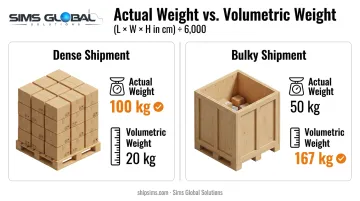
Packaging density matters just as much as what's inside the box.
Route, Timing, and Cargo Type
Beyond weight calculations, a handful of operational and cargo-specific factors shape the final rate:
- Trade lane and distance: Rates differ sharply by direction, not just by distance. Capacity shifts, like passenger airlines pulling transatlantic flights in winter, push rates up on routes where belly-cargo space suddenly tightens. High-frequency corridors with heavy competition run cheaper per kg than niche or short-haul lanes.
- Seasonality and capacity: Q4 e-commerce demand and the pre-Chinese New Year rush are the two biggest seasonal spikes in air cargo. Shippers compete for the same limited belly-cargo space during these windows, so building a separate peak-season line item into your budget saves you from sticker shock later.
- Cargo type and special handling: Dangerous goods, temperature-controlled pharma shipments, and oversized cargo all carry premium pricing tiers. Forwarder tariffs commonly add per-shipment handling fees plus daily storage charges on top of standard linehaul rates.
- Service level selected: Standard airport-to-airport, deferred/economy, and express/next-flight-out services sit on a clear pricing ladder. Deferred service trades a day or two of speed for meaningfully lower cost, worth considering if your cargo isn't truly urgent.
Working with a broker that quotes across multiple carriers, like Sims Global Solutions does for its international freight clients, helps you weigh these trade-offs before a shipment ever leaves the dock.
Full Cost Breakdown of Air Freight: Beyond the Base Rate
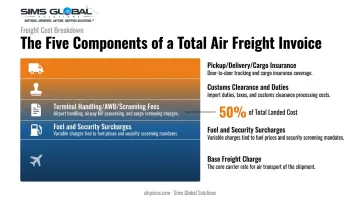
Here's something a lot of shippers don't realize until they see the invoice: the base per-kg rate is often only about half of the total landed cost. Surcharges and fees make up the rest.
The full cost stack typically includes:
- Base freight charge: Chargeable weight multiplied by the negotiated rate per kg, tied directly to your shipment size.
- Fuel and security surcharges: Indexed to jet fuel prices and updated monthly or weekly, so last quarter's rate isn't guaranteed next quarter.
- Terminal handling, AWB, and screening fees: One-time charges for airport ground handling, documentation, and mandatory security screening.
- Customs clearance and duties: A per-entry brokerage fee plus any duties owed on the goods. US formal entries also carry a government Merchandise Processing Fee, separate from broker service fees.
- Pickup, delivery, and cargo insurance: Optional origin/destination trucking (PUD) and all-risk coverage, typically priced as a percentage of cargo value.
Special Cargo Surcharges
Special cargo adds its own layer. Dangerous goods handling and temperature-controlled storage typically carry per-shipment fees plus daily rate adders, separate from your standard linehaul charge. If you're shipping pharma or hazmat, budget these separately rather than folding them into your base rate estimate.
Air Freight vs Ground and Ocean Freight: When Does It Make Sense?
Speed costs money. Air freight is expensive; the real question is whether that speed premium is worth paying for your specific shipment.
| Mode | Typical Transit Time | Best Fit |
|---|---|---|
| Air | 5-10 days | High-value, time-sensitive, perishable goods |
| Ocean (LCL/FCL) | 20-45+ days | Bulky, heavier, lower-value-density freight |
| Ground/Trucking | 1-5 days (domestic) | Regional moves, last-mile legs, time-flexible freight |
The cost gap is real. Freightos data shows an 85 kg shipment costing roughly $400 by ocean LCL versus $600 by air. Larger shipments can see even bigger multiples: a $195 ocean move sometimes runs $1,000 by air.
A useful rule of thumb: air freight tends to pencil out when freight cost stays below 15-20% of the goods' value. Above that threshold, ocean or ground almost always wins on total landed cost.
The decision is rarely all-or-nothing, though. Plenty of shipments only need speed on one leg, such as the "last mile" from the destination airport to a distribution center, while the rest of the move can run on ground transportation at a fraction of the cost.
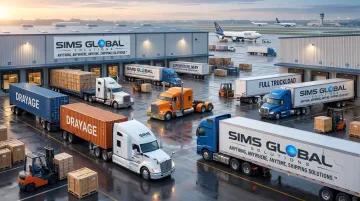
This is where a multi-modal partner earns its keep. Sims Global Solutions' nationwide TL, LTL, expedited, and drayage network gives shippers a cost-effective way to handle the ground legs of a shipment:
- Drayage out of the airport to a nearby facility
- Expedited trucking to a distribution center
- Full truckload service that replaces air entirely on lanes where speed isn't the deciding factor
How to Estimate Your Air Freight Budget (and Avoid Common Mistakes)
Building an accurate air freight estimate starts with the right inputs, not a rough guess.
Gather these before requesting quotes:
- Cargo dimensions and weight: You need both to calculate chargeable weight correctly
- Urgency level: Standard, deferred, or express changes the price tier significantly
- Volume commitment: One-off shipment or recurring monthly volume affects your negotiating leverage
- Required service level: Airport-to-airport versus full door-to-door with customs
Even with this checklist in hand, most budget overruns come from the same handful of blind spots.
The three mistakes that blow up budgets most often:
- Comparing carrier quotes on base rate alone, without normalizing for what's included
- Skipping the volumetric weight calculation and assuming actual weight will apply
- Leaving customs duties and brokerage fees out of the estimate entirely
Fix this by requesting itemized, all-in quotes and comparing them using the exact same chargeable weight and service level across every carrier. A quote that looks 10% cheaper on paper often hides a surcharge structure that erases the savings.
Working with an experienced freight partner also changes the math over time. Sims Global Solutions gives shippers access to a vetted network of over 150,000 carriers spanning air, ground, and ocean modes. A dedicated operations team helps you see the full multi-modal cost picture and negotiate better volume-based rates as your shipping history builds.
Frequently Asked Questions
How do I calculate air freight cost?
Cost equals chargeable weight (the greater of actual or volumetric weight) multiplied by the rate per kg, plus fuel, security, and handling surcharges. Door-to-door shipments add customs and delivery fees on top.
Is air freight worth it?
It depends on your shipment's value density and urgency. Air pays off for high-value, time-sensitive, or perishable goods under a certain weight threshold; heavier or bulkier freight is almost always cheaper by ocean or ground.
What does air freight mean in shipping?
Air freight is the transport of cargo via commercial or dedicated cargo aircraft. It prioritizes speed over cost compared to ocean or ground transport.
What is chargeable weight in air freight?
Chargeable weight is the higher of your shipment's actual weight or its volumetric (dimensional) weight. Carriers use whichever number is greater to calculate your invoice.
What surcharges are typically added to air freight rates?
Common surcharges include fuel, security, peak-season, and dangerous-goods handling fees. Together, these can add a meaningful amount on top of your base linehaul rate.
How can I reduce my air freight costs?
Optimize packaging to lower volumetric weight, consolidate smaller shipments into fewer larger ones, negotiate volume-based contracts, and shift the ground legs of a shipment to a multi-modal partner where speed isn't critical.