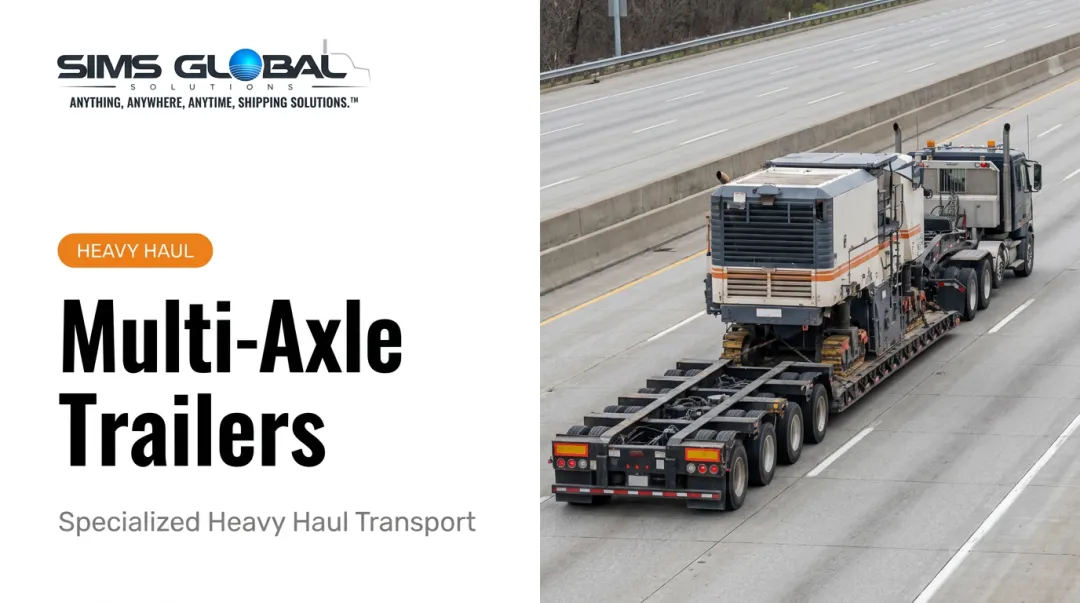

That's where multi-axle trailers come in. They spread weight across additional axle groups so a load stays within legal limits instead of triggering fines, permit rejections, or road damage.
The catch? Getting the axle count right isn't guesswork. It involves the Federal Bridge Formula, jurisdiction-specific permits, and precise weight distribution math. Miss one variable and the whole shipment stalls at a weigh station.
Industrial equipment keeps getting heavier, too. Large power transformers typically weigh 150 to 400 tons, and U.S. manufacturers reported demand spikes as high as 70% year over year in 2023-2024. This guide breaks down how to select and operate multi-axle trailers for real shipments, not textbook examples.
Key Takeaways
- Federal Bridge Formula math determines the legal axle count for overweight freight.
- Total weight, axle spacing, and state limits determine the correct axle count.
- Permits, CAD-based load plans, and escort vehicles are required before departure.
- Common freight includes data center enclosures, turbines, and heavy transformers.
- Owned equipment lowers compliance risk compared to relying solely on brokered capacity.
When Should You Use Multi-Axle Trailers?
Standard trailers max out fast. Federal Interstate limits cap a single axle at 20,000 lbs, a tandem axle group at 34,000 lbs, and gross vehicle weight at 80,000 lbs — whichever the Bridge Formula doesn't reduce further. Once your combined freight and trailer weight pushes past those numbers, you need additional axle groups to spread the load legally.
The difference is straightforward:
- Standard flatbed/tandem trailer: Handles freight comfortably under federal single- and tandem-axle caps.
- Multi-axle trailer: Required when the load would otherwise concentrate too much weight on too few contact points.

Freight That Typically Requires Multi-Axle Configurations
Certain equipment categories almost always need extra axle groups:
- Data center enclosures and power modules
- Turbines and power generation equipment
- Mining and construction machinery
- Aerospace and defense components
- Agricultural equipment, boilers, and aircraft components
Data center gear is a growing example. Rack density has climbed from roughly 6 kW to 12 kW per rack in a single year, with some deployments now hitting 60 to 100 kW per Data Center Dynamics. Heavier racks demand heavier enclosures, pushing many shipments past standard trailer limits and into multi-axle territory.
That upward trend tempts some shippers to cut corners. A common mistake: trying to squeeze borderline-heavy loads onto standard trailers to save money. That gamble risks fines, permit denial mid-route, or actual bridge damage, all of which cost far more than the extra axle group would have.
Sims Global Solutions keeps a dedicated multi-axle fleet for these scenarios, so shippers don't have to gamble.
One more wrinkle: legal limits aren't uniform. Older infrastructure in some states imposes lower per-axle thresholds, which can push the required axle count higher for the exact same shipment depending on where it travels.
What You Need Before Using Multi-Axle Trailers
Before a multi-axle trailer ever leaves the yard, three things need to be locked in.
1. Accurate weight and dimension data via a CAD drawing
You can't calculate per-axle loads or configure crossmembers correctly without precise freight dimensions, weight, and center-of-gravity data. Guessing here is how shipments end up unbalanced mid-transit.
2. All applicable permits secured in advance
The federal government doesn't issue oversize/overweight permits. That responsibility falls to every state, county, and local authority the route touches.
Illinois, for example, requires separate permission once a route leaves IDOT-controlled roads. Skipping a single jurisdiction can shut down a shipment at the state line.
3. An experienced heavy haul carrier with the right fleet and Bridge Formula expertise
Not every provider owns suitable multi-axle equipment or understands routing constraints. This is where asset-based carriers have an edge.
Sims Global Solutions operates its own heavy haul fleet, including multi-axle, RGN, lowboy, and double-drop configurations capable of six-figure loads. That fleet ownership pairs with route and permitting knowledge built from handling these moves daily.

Supervision Requirements
Depending on load width, height, and jurisdiction, escort vehicles, pilot cars, or police escorts may be mandatory. These requirements vary by state, not by a national standard.
Virginia, for instance, requires different escort counts at 12, 14, and 16 feet of width. Maryland triggers law-enforcement escorts at 16 feet width or height, 140 feet length, or 200,000 lbs. Check the specific state before you move a load.
How to Use Multi-Axle Trailers Correctly (Step-by-Step)
Multi-axle hauls follow a defined sequence. Skip a step, miscalculate axle loads, or prep the trailer wrong, and you're looking at permit violations, road damage, or a safety incident. Here's the order that actually works.
Setup and Preparation
The CAD-based load plan determines everything that happens next: crossmember placement, trailer width and length adjustments, and where the freight sits relative to each axle group. This happens before anything gets loaded.
Common setup errors to avoid:
- Uneven weight distribution across axle groups
- Axle spacing that violates Bridge Formula requirements (remember: W = 500[(LN)/(N−1) + 12N + 36] governs every consecutive axle group, not just the total)
- Skipping a route survey before finalizing trailer configuration
Initiating Use (Loading and Securing)
Loading multi-axle trailers is a supervised, largely manual process, using cranes, forklifts, or ramps depending on the freight type. There's no automated shortcut here.
You'll know it's done right when:
- Measured axle weights match the calculated load plan, group by group
- Freight sits at the correct height and center of gravity
- Securement (chains, binders, straps) is confirmed before the trailer moves an inch
Operating the Trailer During Transit
Large multi-axle trailers often rely on rear-axle steering, remote-controlled by a following escort, to navigate tight turns without excessive off-tracking. Beyond maneuverability, operators need to stick to:
- Permitted speed limits along the route
- Approved travel hours set by the permit
- Approved routes only: a legal axle configuration doesn't help if the bridge ahead is posted below your gross weight
- Posted bridge weight limits at every crossing
Proper axle load distribution isn't just a compliance checkbox. It reduces tire wear, prevents overload violations, and keeps the shipment on schedule instead of sidelined at a scale house.
Monitoring During Use
During transit, watch for:
- Real-time GPS tracking to confirm the shipment stays on its approved route
- Axle weight monitoring, where available, to confirm the load remains balanced
- Uneven tire wear, which can signal misaligned axle loads
- Trailer sag, indicating the load may exceed capacity
- Shifting cargo, a sign securement has failed
Shutting Down or Completing Use (Unloading)
Unloading should reverse the original load plan using the same rigging or crane support from loading. Improvising a different sequence here can stress the trailer frame or damage the freight itself, undoing everything the careful setup accomplished.

Best Practices for Using Multi-Axle Trailers Effectively
A few habits separate smooth multi-axle hauls from expensive problems:
- Verify per-axle weight distribution twice, against federal limits and the specific state-by-state limits on your route, before departure, not after.
- Work with carriers offering real-time visibility. GPS and TMS tracking won't prove permit compliance on their own, but they catch delays and route deviations before they become bigger problems.
- Prioritize asset-based carriers. Sims Global Solutions pairs its own heavy haul fleet with the SimsTrak TMS platform, giving clients tighter quality control and real-time updates than brokered-only capacity typically offers.
Judge success by outcomes: on-time delivery, zero road-damage incidents, and full regulatory compliance. Trailer specs matter, but they're a means to those results, not the end goal.
Conclusion
Correctly using multi-axle trailers depends on discipline, not equipment: precise weight calculation, permits secured in the right order, and a setup-to-unload sequence followed without skipping steps.
Treat proper trailer selection and carrier vetting as protection for your budget, your safety record, and your delivery schedule. For shipments that demand specialized multi-axle equipment, work with an experienced, asset-based heavy haul partner like Sims Global Solutions. It's one less variable to manage on a shipment where the margin for error is already thin.
Frequently Asked Questions
What is a multi-axle truck?
A multi-axle truck or trailer has three or more axle groups, allowing it to legally distribute heavier gross vehicle weight across more contact points on the road. This keeps per-axle weight within federal and state limits on loads that would otherwise be illegal.
What are the different types of axle trucks?
Axle types include steering axles (front, for turning), drive axles (powered, for traction), and load-carrying trailer axles. Configurations vary too: tandem (two axles), tridem (three), and spread axles (wider spacing) are all common across heavy haul setups.
How many axles do you need to haul heavy equipment?
Axle count depends on total shipment weight, calculated against the Federal Bridge Formula and state-specific per-axle weight limits. The same load might need more axles in a state with older infrastructure and lower posted limits.
What is the Federal Bridge Formula and why does it matter for heavy haul trailers?
The Federal Bridge Formula limits gross weight based on the number of axles and the distance between them, preventing concentrated weight from damaging roads and bridges. Every consecutive axle group on your trailer must pass this calculation, not just the total shipment weight.
What types of freight require multi-axle trailers?
Common examples include data center enclosures, turbines, transformers, mining equipment, and heavy industrial machinery. Agricultural equipment, boilers, and aircraft components frequently require them as well.
Do multi-axle trailers require special permits or escorts?
Yes. Oversize/overweight permits are required from every state, county, and local authority along the route. States often mandate escort or pilot vehicles too, with thresholds for width, height, length, or weight varying by location.