Introduction
A hospital's IV pump breaks down at 2 a.m. A production line in Ohio runs out of a critical part with six hours of inventory left. An ecommerce brand's best-selling SKU sells out three days before a holiday rush.
In moments like these, cost stops being the priority. Speed becomes the only thing that matters.
That's where expedited freight comes in. It's a premium shipping option built for time-critical loads, moving freight in as little as same-day to 3 days. Standard ground service typically takes 5-7 days, according to FreightWaves Ratings.
This guide breaks down what expedited freight means, how the process works, which vehicles get used, which industries depend on it most, and what it actually costs.
Key Takeaways
- Expedited freight delivers in 1-3 days (often same-day) via dedicated equipment
- Expect to pay 30% to 50% more than standard ground rates for the speed
- Vehicle options range from sprinter vans to full truckload and air charter
- Pharmaceutical, automotive, and retail sectors rely on it most to avoid disruptions
- A broker with strong carrier relationships helps you avoid overpaying for equipment
What Does Expedited Freight Mean?
Expedited freight is transportation designed to move goods faster than standard ground or air shipping. It does this by dedicating equipment to a single shipment and skipping the stops and queue delays that slow down standard freight.
Standard freight is built for cost-efficiency and scale. Carriers consolidate loads and route through multiple terminals, optimizing for the lowest price per mile across a large network. Expedited freight flips that model, putting speed first and cost second.
Core Features of an Expedited Shipment
A true expedited shipment typically includes:
- Direct, non-stop routing with no intermediate terminals or cross-docking
- Priority handling ahead of standard freight in the carrier's queue
- Real-time GPS tracking so shippers know exactly where the load is
- Flexible equipment options, from sprinter vans and straight trucks to team drivers or air charter
Expedited freight isn't limited to ground transport either. Depending on distance and urgency, it can move by air, or as a multimodal combination of both.
The Price of Speed
That priority comes at a cost. Top expediting rates typically run 30% to 50% higher than standard freight options, according to FreightWaves Ratings. That premium pays for a dedicated truck and driver working a tight schedule, plus a route with zero detours, not extra mileage.
How Does Expedited Freight Shipping Work?
The process starts the moment a shipper flags a load as "expedited." That single tag changes everything downstream, routing the request away from standard rate paths and into priority quoting.
Here's how it typically unfolds:
- Request flagged as expedited: triggers a different pricing and routing path than standard freight
- Equipment matched to urgency: a rate engine or broker identifies available dedicated equipment (sprinter van, straight truck, team drivers, or air charter) based on location and deadline
- Pickup scheduled fast: dispatch arranges same-day or next-morning pickup, and drivers receive strict delivery windows plus special handling instructions
- Direct routing begins: no intermediate terminals, no cross-docking. For long hauls, team drivers rotate to keep the truck moving around the clock
- Tracking confirms status: real-time GPS and proof-of-delivery close out the shipment quickly, giving shippers confirmation the moment it arrives

The biggest difference from standard freight is what doesn't happen. There's no waiting for a trailer to fill up. No sitting at a terminal for a connecting truck. The load moves, continuously, until it's delivered.
Working with an established freight partner makes this process considerably less stressful. Sims Global Solutions combines its own trucking assets with the SimsTrak TMS and a carrier network of 150,000+ carriers, so shippers aren't left guessing whether capacity exists.
For guaranteed LTL shipments, Sims backs delivery windows by 10 a.m., noon, or 5 p.m., with late deliveries provided free of charge. Air freight moves get overnight coast-to-coast guarantees through partner airlines.
Vehicle & Equipment Options for Expedited Freight
Not every expedited load needs a full truckload. Matching the right vehicle to the shipment size is one of the fastest ways to control cost without sacrificing speed.
| Vehicle Type | Typical Capacity | Best For |
|---|---|---|
| Sprinter Van | 500 to 1,500 lbs | Urgent single parts, documents |
| Box Truck | Up to 3,500 lbs | Regional multi-pallet loads |
| Straight Truck | 5,000 to 10,000 lbs | Regional routes, added capacity |
| Hot Shot | Oversized/irregular loads | Freight exceeding standard dimensions |
| Full Truckload (FTL) | 44,000 to 45,000 lbs | Large, long-haul shipments |
| Air Cargo | Varies | Fastest, priciest; international/urgent moves |
Sprinter Vans and Box Trucks
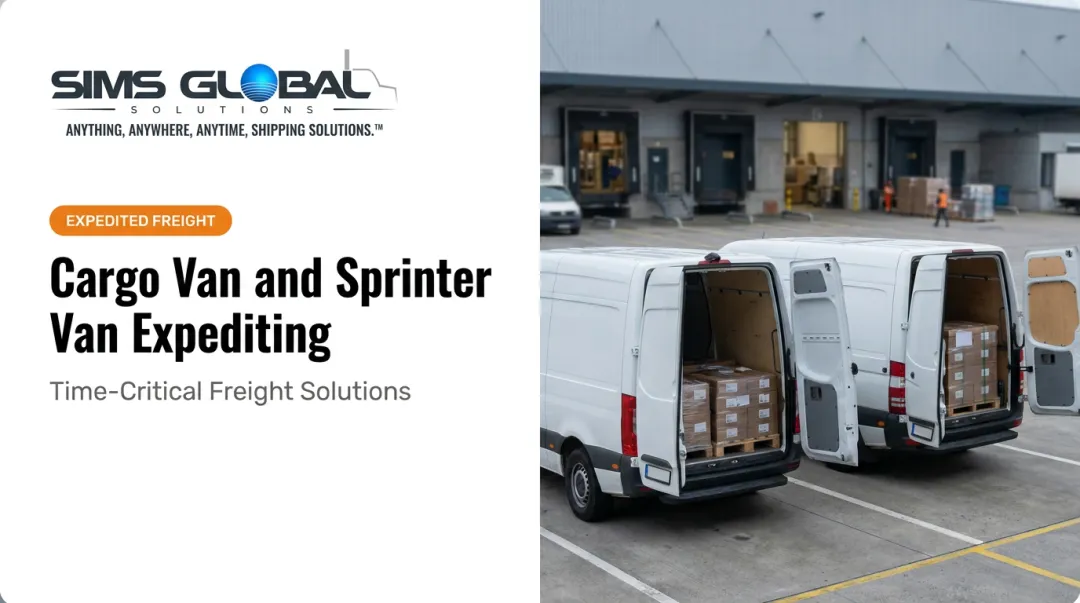
Sprinter vans handle small, urgent shipments, typically 500 to 1,500 lbs., or about 1-3 pallets. They're ideal for a single critical part or a rush document delivery where a full truck would be overkill.
Box trucks step up from there, carrying loads up to roughly 3,500 lbs. for slightly larger regional shipments. Think multiple pallets headed across a metro area or between nearby distribution centers.
Straight Trucks and Hot Shots
Straight trucks carry 5,000 to 10,000 lbs., making them a solid fit for regional expedited routes that need more capacity than a box truck but don't justify a tractor-trailer.
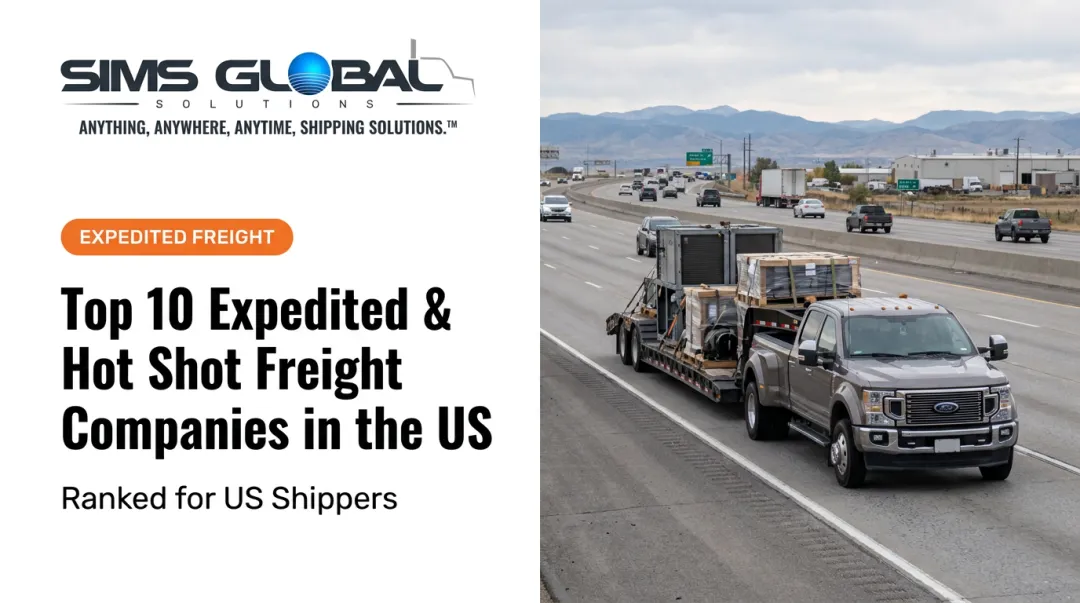
Hot shots are a different animal entirely. These are Class 3-5 pickups paired with flatbed trailers, built for oversized or irregular loads. Because they often haul freight that exceeds standard dimensions, hot shot moves frequently require state permits. Sims Global Solutions runs its own heavy haul fleet for these moves, giving shippers direct access to permitted equipment.
Full Truckload and Air Cargo
For large, long-haul expedited freight, full truckload (FTL) tractor-trailers remain the workhorse. Standard dry van cargo capacity runs 44,000 to 45,000 lbs., within the federal interstate limit of 80,000 lbs. gross vehicle weight.
Air cargo, whether charter or belly freight on a commercial flight, is the fastest option available. It's also the most expensive, reserved for international moves or shipments where hours, not days, matter.
Industries That Rely on Expedited Freight
Some sectors treat expedited shipping as a routine tool. Others reach for it only in emergencies. Either way, the underlying driver is the same: the cost of a delay outweighs the cost of speed.
- Pharmaceutical and medical supply companies: 113 U.S. drug shortages remained active as of December 2024, per the FDA's Drug Shortages Report to Congress.
- Automotive suppliers: a single missing part can halt an entire assembly line, as Toyota experienced in June 2024.
- Retail, ecommerce, and technology companies: retail out-of-stocks cost businesses an estimated $1.2 trillion worldwide in 2024, per IHL Group's inventory distortion research.

When shortages hit, pharmaceutical companies turn to expedited freight to get replacement stock to patients before care is disrupted. Toyota's June 2024 shutdown of six production lines across five plants shows how one missing part can cascade into costly downtime, the exact disruption expedited freight is built to prevent.
For retailers and tech companies, that same urgency protects revenue. A bestselling SKU running low or a failed server part needing same-day replacement can't wait for standard transit times.
Benefits and Challenges of Expedited Freight
Expedited freight solves real problems, but it isn't the right call for every shipment. Weighing both sides helps you decide when it's worth the premium.
Key Benefits
- Faster, more predictable delivery — guaranteed timeframes, often backed by refund policies for missed windows
- Reduced cargo risk — shorter transit times mean fewer handling points and less opportunity for damage
- Tighter inventory control — businesses can run leaner without constantly overstocking as a hedge against delays
Key Challenges
- Higher cost — the premium is real, and relying on expedited shipping too often can signal deeper problems in supply chain planning
- Limited capacity — expedited vehicles and carriers are far fewer in number than standard truckload or LTL options, and that gap widens during peak season
- Regulatory constraints — Hours of Service rules cap drivers at 11 hours of driving after 10 consecutive hours off duty
- Weight and permit requirements — oversized hot shot loads can trigger Federal Motor Carrier Safety Administration (FMCSA) rules or require special permits
How Much Does Expedited Freight Cost?
There's no fixed rate sheet for expedited freight. Pricing moves with the market, shaped by urgency, the truck-to-load ratio in a given lane, distance, and how complex the route is.
Here's what actually drives the price up or down:
- How much notice you give — booking early lets a broker shop multiple carriers; last-minute requests pay for whatever capacity remains
- Truck-to-load ratio — when trucks are scarce relative to demand in a lane, rates climb
- Distance and route complexity — longer hauls or routes through congested corridors cost more
- Equipment type — a sprinter van costs far less to dispatch than a full truckload or air charter
This is exactly where a broker earns their keep. Sims Global Solutions' in-house Carrier Procurement Team and direct carrier relationships help shippers avoid two costly mistakes: booking the wrong vehicle size, or paying a last-minute premium. Better planning—or a well-connected partner—could have avoided either one.
Frequently Asked Questions
What does expedited freight mean?
Expedited freight is premium, time-critical shipping that moves goods faster than standard methods using dedicated equipment, direct routing, and priority handling. It applies to ground, air, or a combination of both.
How much is expedited freight per mile?
Per-mile costs vary widely based on urgency, distance, and equipment type, but expedited rates typically run 30% to 50% higher than standard freight. Last-minute bookings push that premium even higher.
How fast is expedited shipping?
Delivery typically ranges from same-day to 3 days, depending on distance, mode, and carrier availability. Same-day service works best for shorter distances.
Is expedited shipping worth the extra cost?
It's worth it when the cost of delay, whether that's a stockout, production downtime, or a missed patient care deadline, outweighs the shipping premium. For routine, non-urgent freight, standard shipping remains more cost-effective.
What size shipments can be expedited?
Expedited freight ranges from a few pallets in a sprinter van up to full truckload quantities. The right vehicle depends entirely on shipment size and urgency.
Do I need a broker to book expedited freight?
Shippers can book directly with carriers, but a broker with an established carrier network and TMS technology, like Sims Global Solutions, simplifies sourcing capacity quickly while securing competitive rates.