Introduction
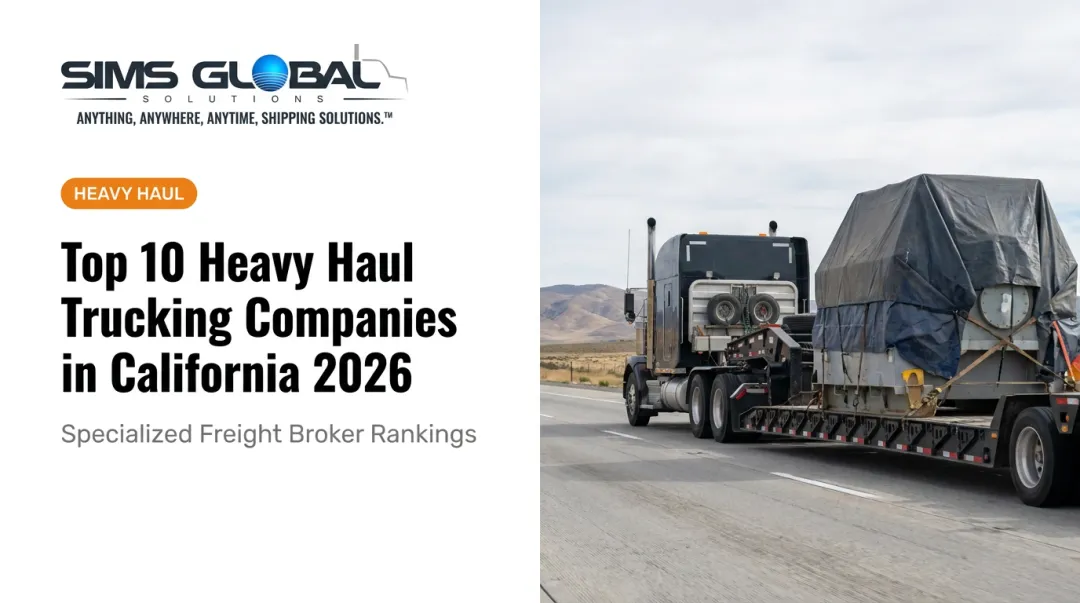
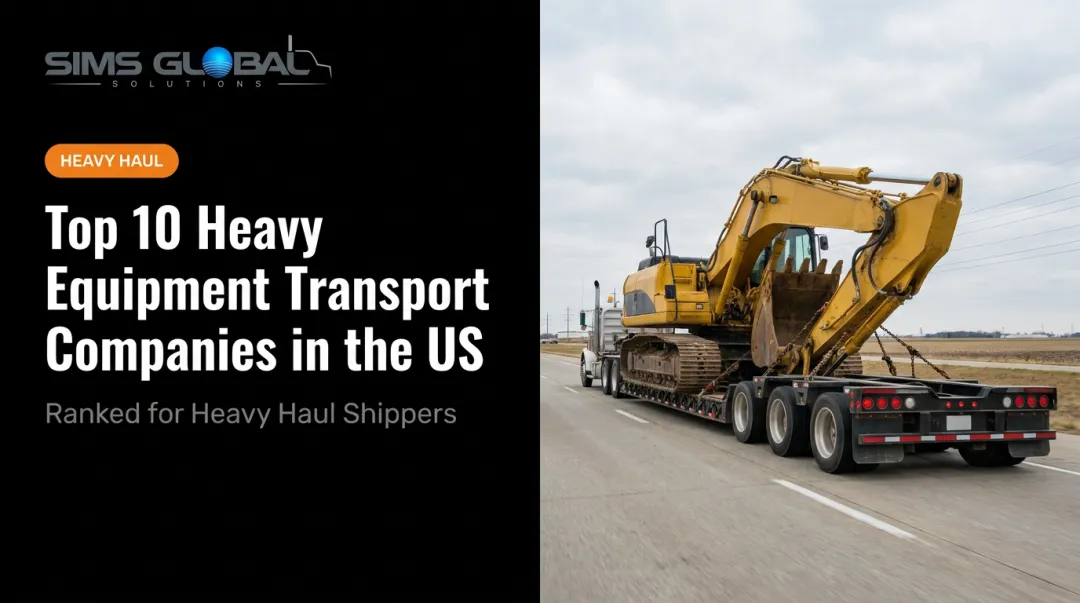
Moving freight that exceeds standard US legal limits — 80,000 lbs gross vehicle weight, 8.5 ft wide, or 13.5 ft tall — is a different business entirely from standard trucking. These loads require specialized trailers, state-issued oversize/overweight (OSOW) permits, route surveys, and sometimes utility line clearances before the truck moves.
Choosing the wrong carrier means delayed project timelines, damaged cargo, regulatory penalties, and strained client relationships. Industries that feel this risk most acutely include:
- Construction and civil infrastructure
- Energy, oil & gas, and renewables
- Mining and aggregate
- Aerospace and defense
- Industrial manufacturing
For any of these sectors, a failed heavy haul move can stall a multimillion-dollar project.
This guide covers the top 10 heavy haul trucking companies in the US — including asset-based carriers, engineered transport specialists, and managed logistics providers — plus the evaluation criteria you should apply before committing to any partner.
Key Takeaways
- Heavy haul freight exceeds federal legal limits and requires OSOW permits, specialized trailers, and route planning
- Top carriers are differentiated by equipment variety, industry tenure, safety records, and geographic reach
- Trailer selection must match your load's exact weight and dimensions — the wrong equipment creates costly delays
- A freight broker or 3PL gives shippers access to multiple vetted carriers without committing to a single provider
- Always request itemized quotes and confirm permit handling, escort coordination, and driver qualifications upfront
What Is Heavy Haul Trucking?
Heavy haul trucking covers any shipment that exceeds US federal legal thresholds: 80,000 lbs gross vehicle weight, 8.5 ft wide, or exceeding height limits set by individual states (commonly 13 ft 6 in to 14 ft). According to FHWA's federal size regulations, there is no single federal vehicle height limit — states set their own — and semitrailer length rules vary by state as well.
Moving these loads requires far more than a larger truck. Each shipment demands:
- OSOW permits issued by each state along the route (the federal government does not issue these)
- Pilot car escorts when loads exceed certain dimensional thresholds
- Route surveys to verify bridge clearances, road conditions, and overhead obstructions
- Multi-state permit coordination for cross-country moves

Industries that regularly rely on heavy haul transport include:
- Construction and civil infrastructure
- Energy (wind turbines, transformers, substations)
- Mining equipment
- Industrial manufacturing
- Aerospace and defense
Carrier experience is what separates a smooth move from a costly delay. A provider that handles permit procurement, route planning, and escort coordination in-house takes those variables off the shipper's plate entirely.
Top 10 Heavy Haul Trucking Companies in the US
Companies were selected based on fleet size and specialization, industry tenure, geographic coverage, safety record, and demonstrated capability with complex oversized freight. Use these profiles to match your load type and project scope to the right carrier.
1. Sims Global Solutions
Lenexa, KS-based Sims Global Solutions owns its own fleet of heavy haul assets — RGNs, lowboys, double drops, and multi-axle configurations — operated through its asset-based carrier, Kodiak Freight, giving it direct control over trucks and capacity. Sims pairs that foundation with a vetted carrier network exceeding 150,000 providers. That hybrid model gives shippers flexibility that asset-only carriers can't match.
Unlike direct carriers, Sims functions as a single accountable partner across the full move. Key differentiators include:
- 30-point carrier vetting run by an in-house Carrier Procurement Team
- SimsTrak TMS providing real-time GPS tracking and consolidated billing
- A+ rated supplemental cargo insurance for high-value and oversized freight
- All 50 states coverage serving Fortune 100 companies to aerospace, defense, and material handling operations
| Detail | Info |
|---|---|
| Founded / HQ | 2010 / Lenexa, KS |
| Key Equipment / Capabilities | Own fleet (RGN, lowboy, double drop, multi-axle) + 150,000+ carrier network |
| Coverage | All 50 states; North America |
| Contact | shipsims.com |

Best for: Shippers who need flexible access to vetted heavy haul capacity across multiple regions, load types, or industries — without being locked into a single direct carrier's equipment limitations.
2. Landstar Transportation Logistics
Jacksonville, FL-based Landstar operates one of the largest over-dimensional and heavy haul networks in North America through an owner-operator (BCO) model. That structure gives Landstar significant flexibility — specialized capacity can be scaled to match load requirements without the constraints of a fixed company-owned fleet.
Landstar reported more than 71,000 heavy haul loads moved in 2025.
| Detail | Info |
|---|---|
| Founded / HQ | Jacksonville, FL |
| Key Equipment | Lowboys, RGNs, stretch multi-axle, perimeter, blade, and schnabel trailers |
| Coverage | Nationwide; North America and Mexico |
| USDOT | 241572 (Landstar Ranger) |
Best for: Complex over-dimensional loads across energy, aerospace, industrial machinery, and construction sectors.
3. Bennett Motor Express
McDonough, GA-based Bennett has specialized in oversized and heavy haul freight since 1974. The company operates more than 500 pieces of 9–13 axle equipment and offers configurations ranging from standard multi-axle setups to custom 19-axle and 55-axle arrangements for superloads exceeding 1,000,000 lbs.
A notable project benchmark: Bennett handled 4,000+ loads and 27,000 tons of structural steel for Mercedes-Benz Stadium.
| Detail | Info |
|---|---|
| Founded / HQ | 1974 / McDonough, GA |
| Key Equipment | 3-axle to 55-axle custom configurations, RGNs, step decks |
| Coverage | Nationwide |
| USDOT | 92693 |

Best for: Superload and extreme-weight moves in aerospace, wind energy, oil and gas, and government/DOD freight.
4. TFI International (Daseke)
TFI International completed its acquisition of Daseke — formerly North America's largest specialized open-deck and heavy haul carrier — in April 2024. At the time of acquisition, Daseke's Specialized Solutions segment operated 2,430 tractors and 6,820 trailers, with the broader company reporting 4,700+ tractors and 9,600+ specialized and flatbed trailers as of year-end 2023.
TFI's portfolio includes multiple operating companies with distinct specializations, including Lone Star Transportation, providing depth across a wide range of OSOW freight types.
| Detail | Info |
|---|---|
| Founded / HQ | Daseke: Addison, TX / TFI: Montreal, QC |
| Key Equipment | Flatbed, step deck, RGN, multi-axle specialized trailers |
| Coverage | US, Canada, Mexico |
| USDOT | Lone Star: 320691 |
Best for: Shippers needing large-scale open-deck capacity with real-time telematics and multi-division expertise.
5. Mercer Transportation
Louisville, KY-based Mercer has operated since 1977, running a network of 1,700+ leased owner-operators with a dedicated OSOW division for heavy haul, military, and construction freight. Mercer handles OSOW route planning and permit coordination nationwide and maintains a recognized presence in DOD and government cargo.
| Detail | Info |
|---|---|
| Founded / HQ | 1977 / Louisville, KY |
| Key Equipment | Double drop lowboys, RGNs, step decks, flatbeds |
| Coverage | Nationwide |
| USDOT | 154712 |
Best for: Construction machinery, industrial freight, and military cargo requiring specialized OSOW coordination.
6. Maxim Crane Works
Maxim Crane Works, headquartered in Wilder, KY with 50+ locations nationwide, combines over-the-road heavy haul with engineered lifting, rigging, and project management — making it one of the few providers that handles transport and crane work as a single coordinated operation.
Their self-propelled modular trailers (SPMTs) — with Goldhofer THP/PST systems rated at 36 metric tons per axle — handle extreme superload requirements that standard multi-axle trailers cannot accommodate.
| Detail | Info |
|---|---|
| HQ | Wilder, KY (50+ US locations) |
| Key Equipment | SPMTs, hydraulic platform trailers, multi-axle, modular configurations |
| Coverage | Coast-to-coast US |
| USDOT | 343050 |
Best for: Projects requiring both heavy transport and crane or rigging services as a single coordinated operation.
7. Deep South Crane and Rigging
Baton Rouge, LA-based Deep South has operated since 1968 — over 55 years of heavy lift and transport experience. The company runs 400+ transporter lines using Scheuerle, Cometto, Nicolas, and Goldhofer self-propelled and towed systems. One documented project deployed 92 SPMT lines in a single move.
Deep South's additional heavy lift capabilities — hydraulic gantries, high-capacity cranes, and marine securing services — make it particularly strong for energy sector and petrochemical projects. Documented moves include a 692,250-lb generator and a 392,420-lb turbine for a Louisiana power station.
| Detail | Info |
|---|---|
| Founded / HQ | 1968 / Baton Rouge, LA |
| Key Equipment | Self-propelled systems, schnabel attachments, lowboys, extendable double-drops |
| Coverage | Gulf Coast focus; nationwide for complex moves |
| USDOT | 237331 |
Best for: Refinery, petrochemical, power generation, and offshore energy projects in the Gulf Coast region.
8. TMC Transportation
Des Moines, IA-based TMC Transportation has operated since March 1972, running a company-owned fleet across the 48 contiguous states. Their specialized division handles over-dimensional machinery, agricultural equipment, and freight with complex loading requirements using step decks and RGN configurations.
| Detail | Info |
|---|---|
| Founded / HQ | 1972 / Des Moines, IA |
| Key Equipment | 53-ft step decks, RGNs, flatbeds, stretch multi-axle trailers |
| Coverage | 48 contiguous states |
| USDOT | 87409 (Annett Holdings) |
Best for: Agricultural equipment, construction machinery, and over-dimensional loads requiring reliable company-fleet execution.
9. Keen Transport
Carlisle, PA-based Keen Transport has more than 50 years in heavy haul, serving construction, mining, and agricultural equipment markets. Their multi-axle equipment handles loads up to 160,000 lbs across configurations up to 13 axles. As part of the Wallenius Wilhelmsen Group (acquired 2017), Keen can bridge domestic heavy haul with international ocean transport — a connection few domestic heavy haul carriers can offer for equipment requiring overseas delivery.
| Detail | Info |
|---|---|
| In Operation | 50+ years / Carlisle, PA |
| Key Equipment | Lowboys, RGNs, I-beam decks, multi-axle up to 13 axles |
| Coverage | Nationwide; international ocean transport via parent company |
| USDOT | 120673 |
Best for: Construction, mining, and agricultural equipment requiring domestic heavy haul with potential international ocean connections.
10. Combined Transport
Central Point, OR-based Combined Transport has handled heavy haul freight since incorporating in September 1980. The company specializes in loads up to 175,000 lbs using lowboys, schnabels, and multi-axle RGN configurations, with a long-standing Pacific Northwest presence and experience spanning construction, energy, and industrial sectors.
| Detail | Info |
|---|---|
| Founded / HQ | 1980 / Central Point, OR |
| Key Equipment | Lowboys, A-frame flatbeds, schnabels, multi-axle RGNs, step decks |
| Coverage | Nationwide |
| USDOT | 194077 |
Best for: Heavy and oversized loads in the Pacific Northwest and broader Western US markets.
How to Choose the Right Heavy Haul Partner
Many shippers default to price as the primary selection criterion. That's a mistake. The factors that actually protect your cargo and timeline include:
- Fleet and equipment variety — Does the carrier have the specific trailer type your load requires, or will they force a suboptimal configuration?
- Permit and route expertise — States, not the federal government, issue OSOW permits, and requirements vary significantly by route, dimensions, and load type. In-house permit handling reduces delays.
- Safety compliance — Verify carriers through FMCSA's SAFER system. FMCSA assigns Satisfactory, Conditional, or Unsatisfactory ratings after investigated reviews.
- Geographic coverage — A carrier strong in the Gulf Coast may not have the same coverage in the Pacific Northwest.
- Real-time visibility — For high-stakes moves with firm project deadlines, live tracking is a baseline requirement — not a premium add-on.

One practical consideration: if your freight needs span multiple regions, load types, or industries, a managed logistics partner — a 3PL/4PL like Sims Global Solutions that operates its own heavy haul fleet (RGN, lowboy, and multi-axle trailers) while maintaining active relationships with 150,000+ vetted carriers — often delivers faster carrier procurement and broader equipment access than relying on a single direct carrier.
Conclusion
Choosing a heavy haul trucking company comes down to match quality, not just market reputation. The right provider has the specific trailer your load requires, the permit infrastructure to keep it moving across state lines, and the real-time tracking to keep you informed when complications arise.
Evaluate carriers on ongoing performance, not just their initial pitch. When vetting providers, ask specifically about:
- Permit handling and state-by-state compliance processes
- Escort coordination for oversized or overweight loads
- Driver qualifications for complex or specialized freight
- Scalability to support future project volumes
If you need a single partner covering all 50 states, Sims Global Solutions offers:
- Owned heavy haul fleet (RGN, lowboy, and multi-axle trailers)
- Access to 150,000+ vetted carriers nationwide
- A+ rated supplemental cargo insurance
- SimsTrak real-time tracking across every shipment
Contact Sims Global Solutions to discuss your freight requirements.
Frequently Asked Questions
What qualifies as heavy haul freight in the United States?
Heavy haul freight is any load exceeding federal legal thresholds: 80,000 lbs gross vehicle weight, 8.5 ft wide, or state-specific height limits (typically 13 ft 6 in to 14 ft). These loads require OSOW permits, specialized trailers, and often pilot car escorts before movement is permitted.
Do heavy haul shipments require permits, and who handles them?
Yes. Each state along the route issues its own oversize/overweight permits, which vary by dimensions, weight, and road conditions. Most carriers and freight brokers typically manage permit procurement, route surveys, and escort coordination on the shipper's behalf.
What is the difference between a heavy haul carrier and a freight broker for oversized loads?
A heavy haul carrier owns its equipment and employs drivers directly. A freight broker connects shippers to a network of vetted specialized carriers, offering greater equipment flexibility across a wider carrier pool — particularly useful for unusual or multi-region loads.
What types of trailers are used in heavy haul trucking?
The most common types are lowboys, removable gooseneck (RGN) trailers, step decks, multi-axle configurations, and self-propelled modular trailers (SPMTs). Trailer selection depends on the load's weight, height, length, and whether ground-level loading access is required.
How much does heavy haul trucking typically cost?
Pricing depends on load dimensions, weight, route distance, permit fees, escort requirements, and equipment type. Permit costs alone vary widely — Colorado ranges from $30 for a basic single-trip permit to $800 for a superload, separate from transport rates. Always request itemized quotes and treat unusually low bids with caution.
What industries most commonly use heavy haul trucking services?
The primary industries are construction, energy (wind, solar, oil and gas), mining, industrial manufacturing, aerospace and defense, and agriculture. All regularly move equipment or components that exceed standard freight size and weight limits.