
The U.S. third-party logistics market generated $323.4 billion in gross revenue in 2025, up 5.0% from the prior year, according to Armstrong & Associates. That growth reflects a simple reality: fewer companies want to own the trucks, warehouses, and software required to move freight themselves.
Three pain points are pushing this shift:
- Capacity constraints during seasonal surges or unexpected demand spikes
- Rising fuel and freight costs that erode margins on in-house operations
- Complexity of managing multiple shipping modes without dedicated expertise
This guide breaks down what a 3PL actually does, the different provider models, core services, real benefits, and how to pick a partner that fits your business.
Key Takeaways
- A 3PL manages transportation, warehousing, and fulfillment as an extension of your logistics team.
- Providers operate as asset-based, non-asset-based, or hybrid models, each with different trade-offs.
- Outsourcing cuts overhead and unlocks better technology without long-term contracts.
- The best partners combine broad service coverage, strong tech, and a vetted carrier network.
What Is a 3PL? Definition, History, and How It Works
A third-party logistics provider (3PL) is a company you hire to manage supply chain functions like transportation, warehousing, and order fulfillment. Rather than building your own fleet or leasing warehouse space, you contract a specialist that already has the infrastructure, carrier relationships, and technology in place.
The term didn't always mean this much. The Motor Carrier Act of 1980 loosened trucking regulations and increased competition, while the Staggers Rail Act gave railroads more flexibility to negotiate rates and contracts directly with shippers. Those two laws opened the door for logistics intermediaries to operate more freely.
By the mid-1990s, providers were mostly transactional, split between warehousing specialists, freight brokers, and dedicated carriers. The ecommerce boom changed that. Between 2015 and 2019, U.S. 3PL ecommerce revenue grew at a 14.6% CAGR, reaching $43.4 billion, forcing providers to combine fulfillment, transportation, and technology under one roof.
How a 3PL Operates Day-to-Day
A 3PL coordinates between three parties: shippers, carriers, and warehouses. It negotiates rates, books capacity, tracks freight in transit, and handles the paperwork, so your team never has to touch a load board or chase down a delivery confirmation.
Technology now sits at the center of that coordination. The 30th Annual Third-Party Logistics Study found that 73% of 3PLs and 67% of shippers now use AI or machine learning in their operations, with advanced analytics adoption topping 80% on both sides.
That said, adoption doesn't guarantee production-grade capability. Ask a prospective provider exactly how their AI tools are used, not just whether they use them.
Asset-Based vs. Non-Asset-Based 3PLs: What's the Difference?
This distinction shapes everything about how a 3PL operates:
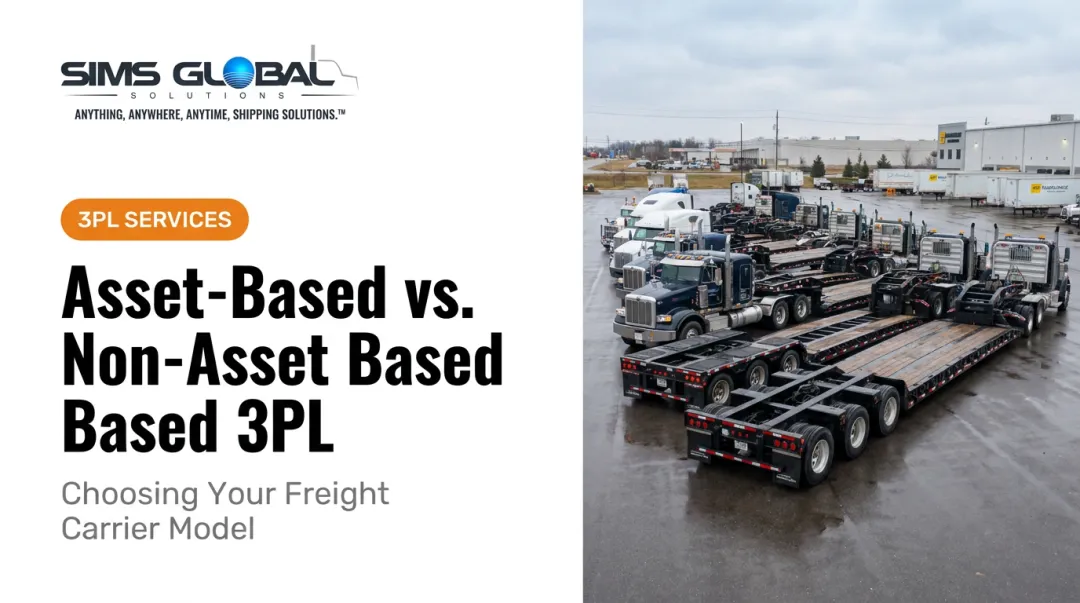
- Asset-based providers own trucks, trailers, or warehouses. They control capacity directly, which means more reliability during tight markets, but often less flexibility across niche modes.
- Non-asset-based providers broker freight through a network of carriers instead of owning equipment. They offer flexibility and access to a wider range of capacity, but rely on third parties to execute.
- Hybrid providers combine both. They own assets for specific freight types while brokering the rest through a larger carrier network.

Sims Global Solutions is a hybrid example. It owns specialized heavy haul equipment, including RGN, lowboy, double drop, and multi-axle trailers, for oversized and industrial freight, while also tapping a broker network of over 150,000 carriers for everything else. That combination gives shippers dedicated capacity for hard-to-move freight without sacrificing flexibility on standard truckload or LTL lanes.
Core Services 3PL Providers Offer in 2026
Modern 3PLs do far more than book trucks. Here's what a full-service provider typically covers:
Freight brokerage and transportation management. Matching shippers with vetted carriers across truckload, LTL, intermodal, drayage, and expedited freight. A provider with direct API integrations to LTL carriers can quote and book faster than one running manual rate comparisons.
Warehousing and distribution. Storage, inventory management, and distributed inventory strategies. Placing warehouses closer to demand centers shortens shipping distance and improves delivery speed, though savings depend on your specific network, according to MHI's analysis of shipping efficiency strategies.
Sims Global Solutions operates 33 million square feet of warehousing across 96 locations in 48 markets, giving shippers flexibility whether they need space in a major metro or a smaller market.
Order fulfillment services. Receiving, picking, packing, and shipping for B2B and wholesale channels.
Value-added services, including:
- Blanket wrap and white-glove handling for high-value freight
- Claims management for damage disputes
- Supplemental cargo insurance for specialized or high-value shipments
- LTL-to-truckload or intermodal conversion to cut costs and reduce handling
Technology and visibility tools. A modern TMS should offer real-time tracking, EDI/API integration, and consolidated billing. SimsTrak, Sims Global's proprietary platform, delivers automated GPS pings every 15 minutes on truckload freight, proprietary rate forecasting, and single-invoice billing across every carrier and mode.
Managed transportation and consulting. RFP management, carrier scorecarding, and network optimization for shippers who want to outsource strategy, not just execution.
Key Benefits of Partnering with a 3PL
The case for outsourcing comes down to three things: cost, flexibility, and expertise.
Cost savings. You skip the capital expense of trucks, warehouses, and logistics staff, and gain access to volume-based carrier rates you couldn't negotiate alone. In the 2024 Annual Third-Party Logistics Study, 80% of shippers said their 3PL contributed to lower overall logistics costs, and 89% named cost savings as a top priority in contract negotiations. That's not a guaranteed savings percentage, but it does show most shippers see real financial upside.
Scalability and flexibility. Need to ramp up capacity for a seasonal spike, then scale back down? A 3PL absorbs that variability without you carrying fixed overhead year-round.
Access to expertise and technology. Carrier vetting, regulatory compliance, and integrated TMS platforms take years to build internally. A good 3PL brings all three on day one. Sims Global Solutions, for instance, routes freight through its SimsTrak TMS, pairing real-time tracking with API integrations across 70+ LTL carriers.

Signs You Need a 3PL and How to Choose the Right Partner
Not sure if it's time to outsource? Watch for these signals:
- Shipping volume outpaces internal capacity. You're missing delivery windows or scrambling to book capacity at the last minute.
- Logistics costs keep climbing. In-house staffing, equipment, and software expenses no longer scale with your freight volume.
- You're expanding into new markets or modes. Entering intermodal, drayage, or specialized freight without existing expertise strains your team.
Once you've decided to outsource, evaluate providers against these criteria:
- Service breadth. Confirm multi-modal capabilities, TL, LTL, intermodal, drayage, warehousing, and fulfillment, so the provider can grow with you.
- Technology stack. Look for an integrated TMS and CRM, real-time tracking, and API/EDI connections for full visibility.
- Carrier network and vetting process. Ask about network size, in-house procurement teams, and available cargo insurance for high-value freight.
- Credentials and track record. Prioritize industry memberships, years in business, and dedicated support teams.
Sims Global Solutions illustrates what that combination can look like: a TIA member with 16 years in business, a carrier network of 150,000-plus, its proprietary SimsTrak TMS, and 33 million square feet of warehousing across 96 locations nationwide. Those are the kinds of specifics worth requesting from any provider you're vetting, not just general promises of "great service."
3PL vs. 4PL vs. Freight Broker: What's the Difference?
These terms get used interchangeably, but they're not the same thing.
| Provider Type | Scope of Work |
|---|---|
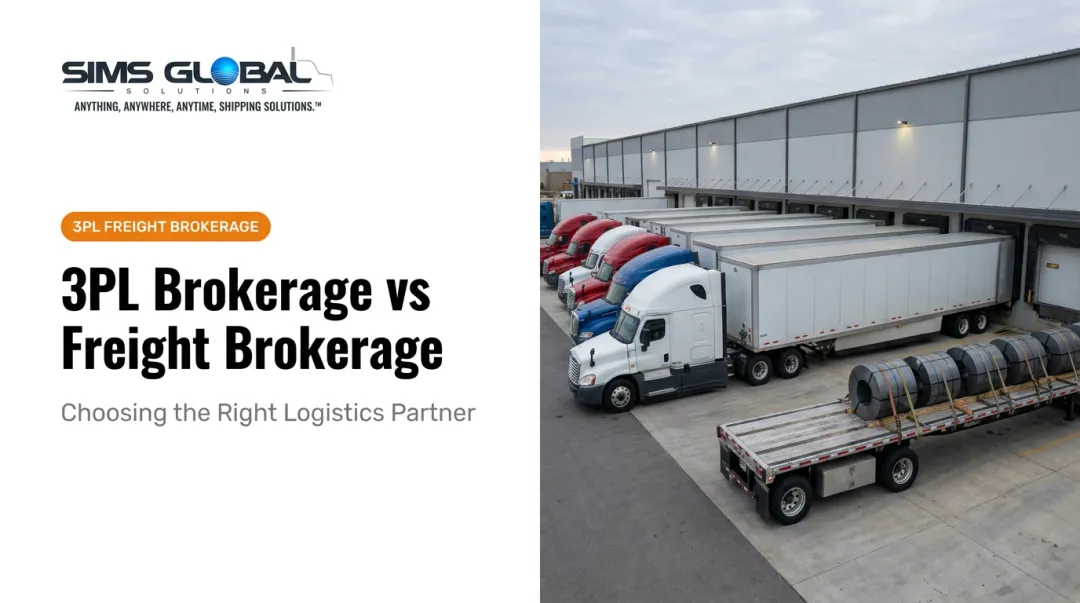
| Freight broker | Matches shippers with carriers for transportation only. No warehousing or fulfillment involved. |
| 3PL | Executes contracted logistics functions: transportation, warehousing, fulfillment, and value-added services. |
| 4PL | Manages overall supply chain strategy, overseeing multiple 3PLs and vendors as a single point of contact. |
A freight broker is narrow by design: it arranges transportation between a shipper and carrier, per FMCSA's definition of broker authority, without taking on responsibility for the shipment itself. A 3PL goes further, handling storage, fulfillment, and technology on top of transportation.
A 4PL sits a level above both, managing the entire logistics strategy instead of executing individual shipments and often coordinating several 3PLs on a client's behalf.
The right choice comes down to how much control you want to hand off:
- Single shipment, no ongoing strategy: work with a freight broker.
- Day-to-day execution across transportation and warehousing: work with a 3PL like Sims Global Solutions.
- Multi-vendor strategy managed by one accountable partner: work with a 4PL.

Frequently Asked Questions
What does 3PL stand for and what does it mean?
3PL stands for third-party logistics. It refers to outsourcing supply chain functions, such as transportation, warehousing, and fulfillment, to a specialized provider that manages these operations on your behalf.
What is the difference between a 3PL and a freight broker?
Freight brokerage is one service under the broader 3PL umbrella. A 3PL also handles warehousing, fulfillment, and value-added services that a broker typically doesn't offer.
Is a 3PL the same as a freight forwarder?
No. Freight forwarders specialize in international shipping and customs coordination, while 3PLs offer broader domestic and end-to-end logistics services across multiple modes.
What is the difference between 3PL and 4PL?
A 4PL manages your overall supply chain strategy and oversees multiple 3PL vendors as a single point of contact. A 3PL executes specific, contracted logistics tasks like transportation and warehousing.
How much do 3PL services typically cost?
Costs vary by provider and service scope, but common components include onboarding, receiving, storage, pick-and-pack, and outbound shipping. Always request a quote that breaks out each charge separately.
What industries benefit most from working with a 3PL?
Retail, manufacturing, aerospace and defense, and medical device companies commonly rely on 3PLs for scalable, specialized support. This is especially true once shipping volume or complexity outgrows in-house capacity.