Key Takeaways
- Dry van is the most common trailer type in the U.S., with over 1.7 million operating nationally
- Dry van trailers are weather-protected, not temperature-controlled — perishables require a refrigerated (reefer) trailer instead
- Standard 53-foot trailers are the industry benchmark; 28-foot pups serve LTL and regional lanes
- FTL spot rates averaged $2.48/mile all-in as of early 2025
- Choosing a freight partner with broad carrier access and real-time visibility matters as much as choosing the right trailer type
Introduction
Picture this: you're a purchasing manager at a mid-sized consumer goods company. You have a full trailer of boxed inventory headed from your Ohio distribution center to a retailer in Texas. The freight isn't temperature-sensitive, it's palletized, and you need it protected from the elements for a multi-day haul. Someone on your team mentions dry van. But what exactly does that mean, and is it the right call?
For most shippers in that situation, dry van is the straightforward answer — and the scale of the market explains why.
According to DAT, more than 1.7 million dry vans were operating in the U.S. in 2023, compared to roughly 400,000 refrigerated trailers. That scale translates directly into better availability, more competitive pricing, and broader carrier options than any other trailer type.
This guide covers what dry van shipping is, standard trailer specs, which freight it fits, what drives costs, how it stacks up against reefer and flatbed, and how to choose the right shipping partner.
What Is Dry Van Shipping?
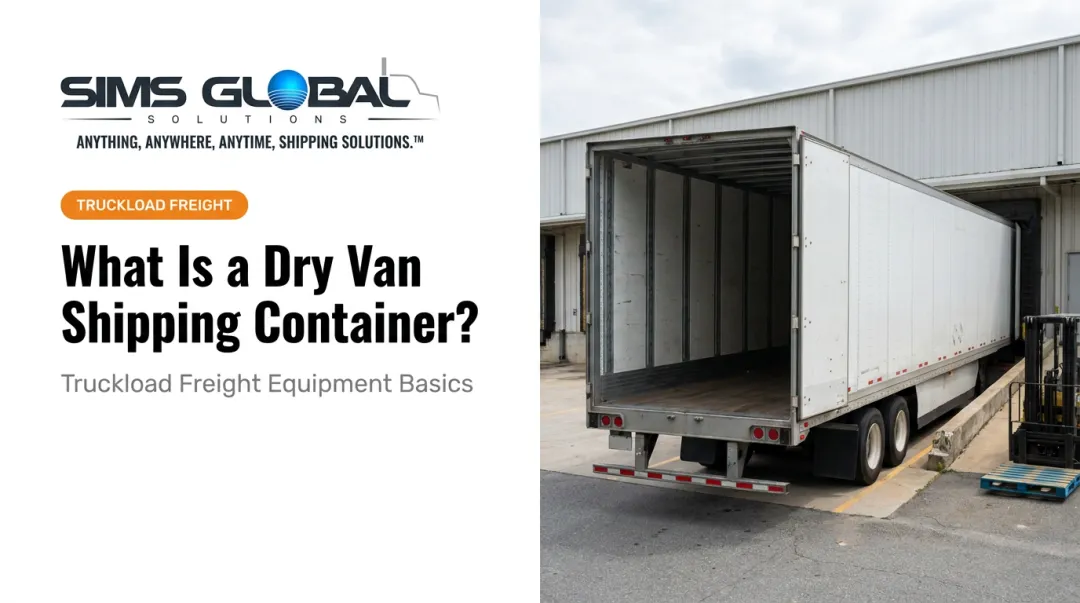
Dry van shipping is the transportation of freight inside a fully enclosed, box-style trailer pulled by a Class 8 semi-truck. The name trips people up sometimes — "dry" doesn't mean climate-controlled. It means the trailer keeps cargo dry and protected from rain, dust, wind, and road debris. There's no refrigeration unit, no temperature regulation of any kind.
How It Works End-to-End
From pickup to delivery, a standard dry van shipment follows three steps:
- Origin loading — Freight is loaded at a dock via forklift or pallet jack, typically from the rear of the trailer
- Seal and dispatch — The trailer doors are closed and can be locked, adding a layer of cargo security during transit
- Delivery — The driver pulls to the destination dock, where freight is unloaded from the rear

That rear-access-only design is worth remembering. It's what makes dry vans efficient at standard dock facilities, and it's also what limits them when cargo requires side or top loading.
Clearing Up Common Terminology
"Box trailer" is sometimes used as a synonym for dry van — that's fine. Box trucks, though, are a separate category entirely. Don't conflate the two when quoting freight or comparing options.
| Box Truck | Dry Van Trailer | |
|---|---|---|
| Size | 10–26 ft cargo area | 48–53 ft standard |
| Vehicle type | Integrated cab + cargo body | Separate tractor + trailer |
| Typical use | Local/regional deliveries | Long-haul B2B freight |
Dry Van Trailer Sizes and Dimensions
Not all dry vans are the same size. Here's a breakdown of the three most common configurations:
| Trailer Type | Length | Common Use | Pallet Capacity |
|---|---|---|---|
| Standard dry van | 53 ft | Long-haul FTL | ~26 standard pallets |
| Pup trailer | 28 ft | LTL, regional hauls | ~14 standard pallets |
| Straight/box truck | 24 ft | City deliveries | Varies |
The 53-Foot Standard Trailer
This is the industry benchmark. Hyundai's standard dry van model lists an interior length of 52 ft 6 in, interior width of 98.5 in, and interior height of 110 in.
Payload capacity varies by model — Utility's 4000D-X lists a structural capacity of 55,000 lbs, though legal over-the-road cargo limits differ by jurisdiction and axle configuration. For practical planning, most shippers work within 44,000–45,000 lbs of usable cargo weight.
The 28-Foot Pup
Pup trailers are common in LTL networks. Carriers like ABF Freight operate fleets of thousands of them. Two 28-foot pups can be linked together (called a "tandem" or "doubles" configuration) for larger loads, and they can also be split for deliveries to different destinations. That flexibility makes them a practical choice for regional distribution networks.
Construction Materials
Dry van construction is designed for durability under daily freight demands. Typical materials include:
- Galvanized high-strength steel side posts and roof bows
- Aluminum exterior panels and roof sheet
- Laminated hardwood floors (oak or similar) rated for forklift traffic
The hardwood floor holds up well under normal conditions, but it absorbs moisture when trailer doors are left open for extended periods. Inspect dropped trailers before loading and keep freight off the floor if moisture is a concern.
What Can You Ship in a Dry Van?
Dry vans handle the broadest range of freight of any trailer type. If it's non-perishable, fits through a rear door, and can be stacked or palletized, it almost certainly ships in a dry van.
Common Freight Categories
- Consumer packaged goods (CPG) and retail inventory
- Electronics and appliances
- Clothing and textiles
- Non-perishable food and beverages
- Furniture and home goods
- Auto parts
- Building materials and paper products
What Dry Vans Are NOT Suited For
Some freight categories fall outside what a dry van can handle:
- Temperature-sensitive freight — fresh produce, pharmaceuticals, flowers, frozen food. These need a reefer.
- Oversized or over-dimensional cargo — machinery, steel beams, or anything that can't physically fit through a trailer door.
- Freight requiring side or top loading — cranes, forklifts accessing from the side, or cargo loaded from above. That's flatbed territory.
If the freight doesn't require refrigeration and can be loaded from the rear, dry van is almost always the right first choice. Only consider another trailer type when a specific requirement — temperature control, oversized dimensions, or non-rear loading — rules it out.
Benefits and Limitations of Dry Van Shipping
The Core Advantages
Cargo protection is the most straightforward argument for dry van. The fully enclosed structure shields freight from weather — rain, snow, wind, road debris — throughout the entire haul. Trailers can be locked, which meaningfully reduces theft exposure compared to open flatbed loads, making dry van the default choice for high-value consumer goods.
Availability and cost work in your favor with dry van. With over 1.7 million dry vans on U.S. roads versus roughly 400,000 reefers, capacity is far easier to source. More available equipment means more competitive pricing and less scrambling during tight markets. Even during Q4 peak season — when the FreightWaves SONAR National Truckload Index climbed from $2.38 to $2.52/mile in late 2024 — dry van capacity remained more accessible than specialty options.
Operational efficiency comes from standardization. Standard dock heights and rear-access loading are universal across warehouses, distribution centers, and retail facilities. That interoperability makes loading and unloading predictable and fast.
Drop-and-hook capability is another practical advantage. Many shippers and carriers use a drop-and-hook model: a pre-loaded trailer is dropped at a facility, and the driver immediately hooks to a different loaded trailer and departs. This eliminates driver waiting time, reduces detention risk, and keeps freight moving. Dry van's standardized design makes drop-and-hook straightforward to execute across carrier networks.
The Limitations to Know
Dry van doesn't work for every load. Here's where it falls short and what to do instead:
| Limitation | What to Do About It |
|---|---|
| No temperature control | Use a reefer trailer for anything perishable or temperature-sensitive |
| Hardwood floors absorb moisture | Inspect dropped trailers before loading; elevate freight when possible |
| Rear-only access | Use flatbed for cargo requiring side or top loading |
What Affects Dry Van Shipping Costs?
Base Cost Drivers
Every dry van quote starts with three variables:
- Distance — longer lanes cost more, priced per mile for FTL
- Weight — heavier loads approach payload limits and may affect rate
- Load type — FTL or LTL
With FTL, one shipper fills the trailer and pays for the entire truck — priced per mile, with more control, faster transit, and lower damage risk. With LTL, multiple shippers share space and split costs, priced by freight class and weight. It's better for smaller shipments but involves more handling.
FreightWaves reported a dry-van spot rate of $2.48/mile all-in for the week of January 9, 2025 — up from $2.41/mile a year earlier. This is a national benchmark — your actual rate varies by origin, destination, timing, and carrier availability.
Market-Driven Variables
- Fuel surcharges — calculated based on current diesel prices and fluctuate weekly
- Seasonal demand — Q4 holiday volume, produce seasons, and back-to-school pushes tighten capacity and push rates up
- Lane imbalance — routes with more outbound freight than return loads (headhaul markets) cost more. DAT data from October 2024 showed Green River, Wyoming running 2.61 outbound loads per inbound — a premium compared to balanced markets like Atlanta
Shipper-Controlled Factors
These are levers you can actually pull:
- Lead time — booking 5–7 days out typically secures better rates than a same-day request
- Cube utilization — a trailer that's full to its legal weight limit costs the same as one that's half-empty; maximize it
- On-time readiness — carriers track which shippers have freight ready at pickup time. A reputation for smooth loading gets you preferred rates over time

Accessorial Charges to Clarify Upfront
- Liftgate fees (when there's no dock)
- Detention (driver wait time beyond free time allowance)
- Layover charges (overnight delays)
- Fuel surcharges (sometimes quoted separately from linehaul)
Always ask for these line items when getting a quote. A carrier that won't itemize accessorials upfront is a carrier worth replacing.
Dry Van vs. Reefer vs. Flatbed: Choosing the Right Trailer
The three most common trailer types serve fundamentally different purposes. Here's how they compare:
| Factor | Dry Van | Reefer | Flatbed |
|---|---|---|---|
| Temperature control | None | Active, programmable | None |
| Cargo protection | Fully enclosed | Fully enclosed | Open/exposed |
| Equipment availability | Very high (1.7M+) | Moderate (~400K) | Lower |
| Relative cost | Lowest | Higher | Moderate |
| Best for | Standard non-perishable freight | Perishables, pharmaceuticals | Oversized, side/top-loaded cargo |

The right choice depends on your cargo type and loading requirements:
- Dry van: Best for standard boxed or palletized freight that doesn't require refrigeration and loads from the rear
- Reefer: Required when cargo must stay within a specific temperature range — fresh food, frozen goods, flowers, or most pharmaceuticals
- Flatbed: The go-to for oversized or irregularly shaped loads requiring crane or forklift access from the side or top, such as steel coils, lumber, or large machinery — trading weather protection for loading flexibility
How to Choose the Right Dry Van Shipping Partner
The trailer type is just one piece. The partner you work with determines whether your freight actually moves reliably, at competitive rates, with visibility into where it is.
What to Look For
- Carrier network size and vetting — larger vetted networks mean more options during tight markets
- Real-time shipment visibility — GPS-level tracking, not just check calls
- Multi-modal options — a partner who can only book dry van will push you toward dry van even when another mode would serve you better
- Transparent pricing — accessorials (extra fees like detention, fuel surcharges, or liftgate) disclosed upfront, not discovered on the invoice
- Responsive support — someone who answers when there's a problem, not just an automated portal
Broker or 3PL vs. Direct Carrier
Booking directly with a carrier works well if you have consistent high-volume lanes and strong carrier relationships. For everyone else, a freight broker or 3PL offers meaningful advantages:
- Access to hundreds or thousands of vetted carriers across all lanes
- Rate comparison across multiple options simultaneously
- Documentation, claims handling, and compliance managed on your behalf
- Flexibility when your freight needs change
Sims Global Solutions, for example, provides access to a network of 150,000+ vetted carriers — including over 35,000 truckload carriers — real-time GPS tracking through their SimsTrak platform, and multi-modal capabilities across truckload, LTL, intermodal, and expedited. Their in-house claims team handles loss and damage disputes directly, which means shippers don't have to chase resolution through a third party.
Questions to Ask Before Committing
- How do you vet the carriers in your network?
- What cargo insurance coverage is included, and when does supplemental coverage apply?
- How is detention handled if loading runs long?
- What's the escalation process if a shipment is delayed or a carrier goes dark?
The answers reveal more about a provider's reliability than any marketing claim will.
Frequently Asked Questions
What does "dry van" mean in shipping?
"Dry" refers to the trailer's enclosed, weather-protected design — it keeps cargo dry from rain, dust, and road debris. "Van" refers to the box-style enclosed body. The term has nothing to do with climate control; dry vans are not refrigerated.
What is the average cost of dry van transport?
Costs vary based on distance, lane, fuel prices, and load type (FTL vs. LTL). As a national benchmark, dry-van spot rates averaged $2.48/mile all-in as of January 2025, according to FreightWaves. Your lane-specific quote will differ.
What is the difference between a dry van and a reefer trailer?
A reefer (refrigerated trailer) includes an active cooling and heating unit that maintains a set temperature range for perishable or temperature-sensitive cargo. A dry van is enclosed but not climate-controlled. Reefers cost more to operate and are less available than dry vans.
How many pallets fit in a 53-foot dry van?
A standard 53-foot dry van holds approximately 26 standard pallets, depending on pallet dimensions and load distribution. Maximum practical payload runs around 44,000–45,000 lbs for over-the-road use.
Can you use a dry van for LTL shipments?
Yes. Dry vans carry both FTL and LTL freight. In LTL shipping, the trailer space is shared among multiple shippers, with each paying only for the portion their freight occupies.
What industries use dry van shipping the most?
Retail, consumer packaged goods, electronics, furniture, automotive parts, building materials, and non-perishable food and beverage are the heaviest dry van users. Any industry moving non-temperature-sensitive goods in standard quantities depends on dry van capacity.