
Many shippers treat dimensions as an afterthought, measuring "close enough" and hoping the numbers hold. According to NMFTA's freight packaging guidelines, standard LTL shipments typically range from 100 to 10,000 pounds, though some carriers extend that ceiling to 20,000 pounds. Fall outside a carrier's accepted range, or measure inaccurately, and you're looking at added charges, delays, or a shift to a different pricing tier.
This article breaks down what LTL dimensions actually represent, the typical ranges and boundary limits across major carriers, how those numbers get measured and verified, and what happens when a shipment doesn't fit the mold.
Key Takeaways
- LTL shipments typically run 100-20,000 lbs, filling 6-12 pallets of trailer space
- Pallet height limits vary by carrier, typically 84 to 99 inches, with no universal standard
- Weight and dimensions combine to create density, which drives NMFC freight class and price
- Exceeding a limit usually triggers a re-rate or accessorial fee, not automatic refusal
- Measuring before booking, not estimating, remains the fastest way to control LTL costs
What LTL Freight Dimensions Represent
LTL freight dimensions are the combined weight, length, width, height, and cubic space a shipment occupies inside a standard 53-foot trailer. Every LTL trailer carries multiple shippers' freight at once. Your pallet's footprint determines how much space remains for everyone else sharing that trailer.

Dimensions function as an input variable in how carriers price and route freight. They determine:
- Freight class assignment under the NMFC system
- Dimensional weight calculations for bulky, lightweight loads
- How much trailer space gets allocated to your shipment versus others
Dimensions serve two functions. They start as a packaging decision built at your dock, covering how you build, palletize, and stack freight before it ships. They become an operating variable once carriers price and handle that freight inside their network. Get the packaging wrong, and the operating side gets expensive fast.
Weight and dimensions don't act alone. Together they create density (pounds per cubic foot), the primary factor NMFTA uses to assign freight class. Denser freight tends to earn a lower class and a lower rate; lighter, bulkier freight usually costs more per pound to move.
Factors That Influence Dimensions in Real-World Shipping
The dimensions you measure at your dock rarely match the numbers a carrier records at the terminal. That gap causes most re-rate disputes:
- Packaging choices: Pallet type, stacking method, and overhang all change a shipment's effective footprint, even when the product itself hasn't changed.
- Terminal equipment: Dock height, forklift capacity, and trailer type vary by carrier and location, affecting what's actually accepted at pickup versus what was quoted.
- Handling and consolidation: Freight often passes through multiple terminals before final delivery. Each touchpoint is a chance for pallets to shift, crush, or get restacked.
- Shrink-wrap bulge and rounding: Small measurement habits, like rounding down or ignoring wrap expansion, add up to real discrepancies.
None of this stems from carelessness. It reflects the nature of freight moving through a shared network with dozens of touchpoints.
Range of LTL Freight Dimensions
LTL carriers apply two different gates to every shipment: a weight threshold and a space threshold. Whichever one your freight hits first determines how it gets priced. A shipment can sit well under the weight cap and still get bumped to volume pricing purely because of how much floor space it consumes.
Nominal Operating Range
Most standard LTL shipments fall between 100 and 10,000 pounds, per NMFTA (National Motor Freight Traffic Association), though several major carriers extend that ceiling to 20,000 pounds before requiring truckload or volume pricing. XPO and Saia, for example, both draw their LTL-versus-truckload line at the 20,000-pound mark.
This range generally assumes:
- Freight is palletized and stackable
- Nothing is hazardous or requires special handling
- Terminal handling follows normal dock procedures
Step outside those assumptions, and you're likely looking at a different pricing category regardless of weight.
Allowable Tolerance and Boundary Limits
Published limits vary more by carrier than most shippers expect. There's no single industry-wide pallet height or per-skid weight cap. A few real examples:
| Carrier | Pallet dimension rule | Notes |
|---|---|---|
| Saia | 40 x 48 x 84 in (pallet program) | Nonconforming freight reverts to standard LTL rating |
| Old Dominion | 48 x 48 x 99 in, ~3,000 lb/pallet | Excess weight rated in 3,000-lb increments |
| AAA Cooper | Cube/density minimums at 8-12+ linear ft | Threshold depends on density |
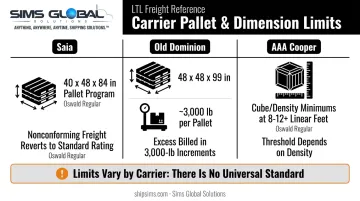
Linear feet triggers vary just as widely. Some carriers apply capacity-load pricing around 20 linear feet or 20,000 pounds; others flag freight well before that, depending on width, height, or floor space consumed.
The key distinction: short-term exceptions (a carrier accepts your freight with a surcharge) differ from hard limits (the carrier refuses or requires specialized equipment). Confirm which applies to your lane before booking, not after.
Safe Operating Margin
Published limits are ceilings, not targets. Smart shippers measure with a buffer, because:
- Tape-measure readings round differently than terminal dimensioners
- Shrink-wrap adds bulge that inflates footprint
- Pallet overhang beyond the skid edge often goes unmeasured until it's a problem
Operate too close to a boundary, and you risk re-rating, terminal delays, or in worst cases, refusal at pickup. A half-inch of margin on paper rarely survives contact with a forklift.
Key Technical Properties of LTL Dimensions
Raw size alone doesn't determine cost. What matters is how weight, class, and carrier pricing logic interact with the numbers on your BOL.
Dimensional Weight and Variability
Parcel carriers commonly bill using a dimensional weight formula: length x width x height in inches, divided by a set factor, often cited as 139. That math matters for bulky, lightweight freight, since it can push billed weight well above actual scale weight.
For standard LTL, the picture is different. Rather than a single universal divisor, most LTL carriers price based on density (pounds per cubic foot), which penalizes freight that takes up more space than it weighs.
Either way, the outcome is the same for shippers: light, bulky freight almost always costs more per pound than dense freight.
Measurement inconsistency compounds the problem. A tape measure at your dock and a terminal dimensioner scanning the same pallet won't always agree. Rounding habits, wrap bulge, and uneven stacking all create small gaps that add up to real invoice adjustments.
Freight Class Coupling and Trade-offs
Dimensions combine with weight to produce density, and density is the core input NMFTA uses to assign freight class. Classes range from Class 50 (dense, compact freight) to Class 500 (very light, bulky freight).
Under NMFTA's density scale, freight at 50 pounds per cubic foot or more typically lands in the lowest class, while freight below 1 pound per cubic foot lands near the top.
That creates a genuine trade-off, plus a coupling most shippers miss entirely:
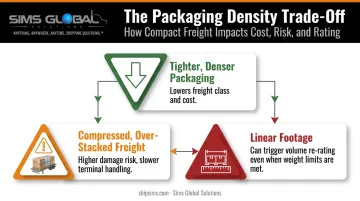
- Tighter, denser packaging lowers freight class and reduces cost
- Compressed or over-stacked freight carries higher damage risk and slows terminal handling
- Linear footage can trigger volume LTL re-rating even when a shipment clears every weight limit, especially with irregular or non-stackable pieces
Weight and space are independent gates. Clearing one doesn't clear the other.
How LTL Dimensions Are Specified, Measured, and Validated
Dimensions live two lives in LTL shipping: what gets quoted before pickup, and what actually gets billed after the carrier verifies it. Understanding both stages explains why invoices sometimes look different from the original quote.
Specification and Documentation
Every shipment's dimensions get documented on the Bill of Lading, along with the NMFC classification used to rate it. These figures start as shipper-declared, meaning you or your broker supply them based on your own measurements.
Carriers treat that declared data as a starting point, not a final answer. Once freight hits the terminal, it's subject to carrier-verified re-measurement, and that number, not your original estimate, is what determines your final invoice.
Measurement and Verification Methods
Shippers typically rely on a tape measure or ruler for manual checks before booking. Carriers increasingly use terminal dimensioners and integrated freight scales that capture length, width, height, and weight in seconds, often with a photo record attached.
FreightWaves reported that roughly 1,000 to 1,200 of these dimensioning devices were already active across the industry.
This gap between manual and automated measurement is where most discrepancies originate:
- Tape measurements round to the nearest inch; dimensioners don't
- Shrink wrap and pallet overhang get missed on manual checks
- Unevenly stacked pieces are harder to measure by hand than by scanner
That gap is exactly why quote-to-invoice adjustments happen even on freight that looked correctly measured at the dock.
Working with a freight partner that has direct visibility into carrier rules before a shipment leaves the dock changes this equation.
At Sims Global Solutions, our SimsTrak platform uses direct API integrations with more than 70 LTL carriers, letting our team check declared dimensions against live carrier pricing rules before booking.
That step doesn't eliminate every terminal re-measurement, but it catches the discrepancies that would otherwise turn into a surprise accessorial charge weeks later.
Implications of Exceeding Dimensional Limits and Common Misinterpretations
Exceeding a weight, height, or linear-foot threshold almost never means your freight gets turned away. It usually means a re-rate: the carrier reprices the shipment under a different rule, then bills accordingly.
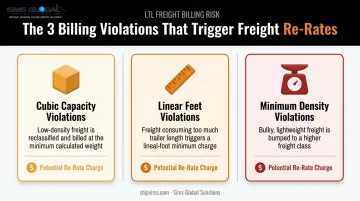
Three violations account for most dimension-related re-rates:
- Cubic capacity violations: Low-density freight exceeding a carrier's cubic-foot threshold gets reclassified and billed at a minimum calculated weight
- Linear feet violations: Freight consuming too much trailer length triggers a lineal-foot minimum charge, sometimes several hundred dollars
- Minimum density violations: Bulky, lightweight freight below a carrier's pounds-per-cubic-foot floor gets bumped to a higher class automatically
Overlength fees alone can run from roughly $300 for freight in the 8-to-12-foot range up to $1,300 or more for anything past 20 feet, depending on the carrier.
Two misinterpretations cause most of the surprise here:
"Published ranges are hard limits." They're not. Carrier and terminal-specific exceptions are common. A pallet height that's fine at one terminal might get flagged at another. Confirm limits for your specific carrier and lane before booking.
"Quoted dimensions equal billed dimensions." They don't. The quote reflects what you measured; the invoice reflects what the terminal measured. One Old Dominion case study found weight and length re-rates dropped from 25% to just 1% of shipments after adopting more precise dimensioning practices.
Dimensions actively govern how LTL freight gets priced and routed, not just a passive label on a shipment. Measuring accurately before booking, and confirming limits with a broker who has real carrier network visibility, remains the most reliable way to avoid a bill that doesn't match your quote.
Frequently Asked Questions
What does LTL mean for load size?
LTL stands for less-than-truckload, generally covering shipments between roughly 100 and 20,000 pounds. These loads typically take up about 6 to 12 pallets or up to 12 linear feet of trailer space, sharing the trailer with other shippers' freight.
What is the load size difference between TL and LTL?
LTL shares trailer space with other shipments and usually stays under 10 to 12 pallets. Truckload (TL) fills an entire trailer for one shipper, typically starting around 10,000 to 15,000 pounds with no shared space.
What is the maximum weight for LTL shipping?
Most carriers cap standard LTL pricing around 20,000 pounds, with per-pallet limits often near 3,000 pounds depending on the carrier's pallet program. Heavier freight usually gets quoted as truckload instead.
How tall can an LTL pallet be?
Maximum pallet height commonly falls between 84 and 99 inches including the pallet itself, but this varies significantly by carrier and terminal equipment. Confirm the exact limit with your carrier before booking.
What happens if my LTL shipment exceeds carrier dimension limits?
Exceeding limits usually triggers a re-rate to volume LTL or truckload pricing, or an overlength and overhang accessorial fee. Outright refusal is rare unless the excess is only discovered after pickup.
What is dimensional weight and how does it affect LTL pricing?
Dimensional weight estimates billed weight based on a shipment's length, width, and height instead of its actual scale weight. LTL carriers typically price by density (pounds per cubic foot), which has a similar effect on cost for bulky, lightweight freight.