Introduction
"3PL brokerage" and "freight brokerage" get thrown around like they mean the same thing. They don't.
One manages your entire fulfillment cycle: storage, inventory, packing, and shipping. The other focuses on one job: getting your freight from point A to point B through the right carrier.
Mixing up the two costs businesses in two directions. Pick a full-service 3PL when you only need transportation help, and you're paying for warehouse space you don't use.
Pick a standalone freight broker when your SKU count is exploding and you need pick-and-pack support, and you'll hit a wall the moment your in-house fulfillment can't keep up.
This guide breaks down what separates the two models, where each one fits, and how to figure out which one matches where your business actually stands today.
Key Takeaways
- 3PL brokerage covers the full order lifecycle; freight brokerage only matches carriers to shippers.
- All freight brokerages are 3PLs, but not all 3PLs specialize in freight brokerage.
- Freight brokerage tends to cost less if you already have warehousing in place.
- The right choice depends on order complexity, current capacity, and outsourcing needs.
3PL Brokerage vs Freight Brokerage: Quick Comparison
Here's the side-by-side breakdown before we dig into the details:
| Dimension | 3PL Brokerage | Freight Brokerage |
|---|---|---|
| Cost structure | Bundled pricing (storage, handling, transportation); higher upfront but can lower total vendor spend | Transportation-focused, typically margin-based on the shipment |
| Scope of services | Warehousing, inventory management, order fulfillment, transportation | Carrier sourcing, rate negotiation, shipment tracking |
| Level of control | Business hands off more of the supply chain | Business keeps control of warehousing/fulfillment, outsources transport only |
| Technology & visibility | Combines WMS, TMS, and inventory tools | Primarily TMS-driven, focused on load tracking |
| Best fit for | Ecommerce, retail, manufacturers needing storage + shipping | Businesses with existing warehousing that need carrier capacity |
A quick way to think about it: freight brokerage is one function; 3PL brokerage is a system of functions. The Council of Supply Chain Management Professionals defines logistics management as encompassing transportation, warehousing, materials handling, order fulfillment, inventory management, and packaging — not transportation alone.
That distinction shapes the cost, control, and technology tradeoffs covered in the sections ahead.
What is a 3PL Brokerage?
A 3PL brokerage is a third-party logistics provider that manages the full fulfillment cycle. That means inventory, warehousing, order fulfillment, and transportation, not just matching a load to a truck.
The operational payoff shows up in a few specific ways:
- Lower overhead from not leasing or staffing your own warehouse
- Better order accuracy through dedicated fulfillment teams running pick/pack processes daily
- Cost savings from bulk carrier rate negotiation across a larger shipment volume than you'd generate alone
Asset-Based vs. Non-Asset-Based Models
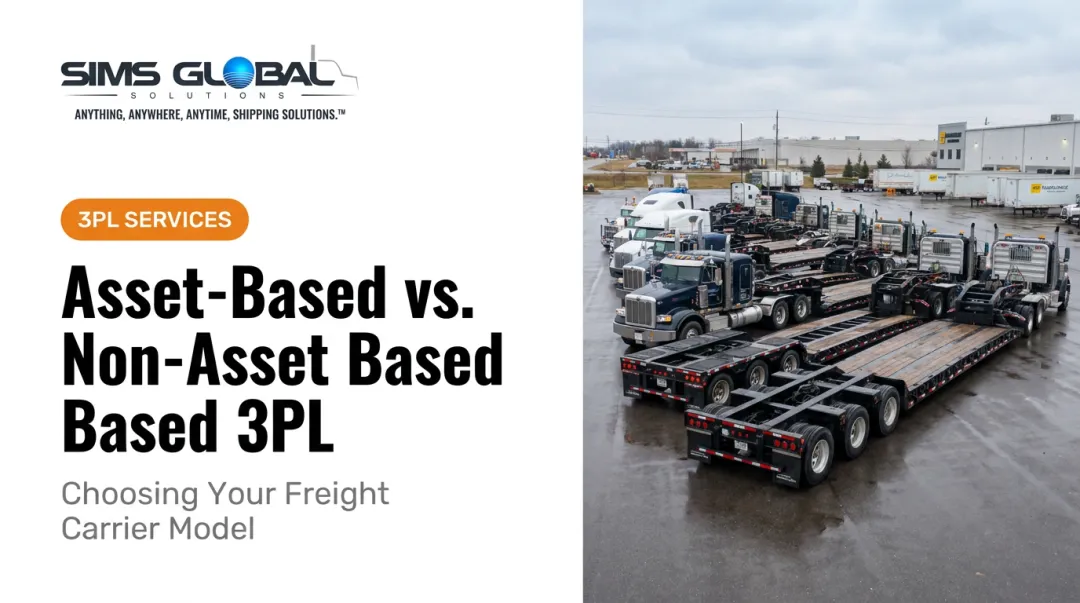
Not all 3PLs operate the same way. Some own their warehouses and trucks (asset-based). Others coordinate everything through a partner network without owning the physical infrastructure (non-asset-based).
Many providers, Sims Global Solutions included, run a hybrid model: owning specialized equipment for certain freight types while brokering the rest through a vetted carrier network. This gives shippers flexibility without forcing them into a one-size-fits-all setup.
Use Cases of 3PL Brokerage
3PL brokerage tends to show up wherever storage and shipping have to work together, not separately:
- Ecommerce businesses managing multi-SKU inventory across seasonal demand swings
- Seasonal retailers that need storage capacity that flexes up and down
- Manufacturers requiring pick/pack/ship support without building internal fulfillment teams
Industries where this model dominates include retail, ecommerce, medical device, and consumer goods. In these sectors, warehousing and transportation need to move as one connected process rather than two separate vendor relationships.
Real-world data backs this up. Armstrong & Associates analyzed more than 7,700 active 3PL customer relationships and found customers use an average of 2.71 services per relationship. Most shippers who go the 3PL route aren't outsourcing transportation alone — they're bundling it with warehousing, inventory management, or value-added services.

What is a Freight Brokerage?
A freight brokerage is an intermediary that connects shippers with carriers to move goods. Nothing more, nothing less. No warehousing. No fulfillment. Just transportation logistics.
The FMCSA defines a broker as the "middle person" between a shipper and a motor carrier — someone who arranges transportation but doesn't operate the vehicles or take on responsibility for the cargo. That's the legal boundary, the point where freight brokerage responsibilities stop.
Core benefits of working with a freight broker:
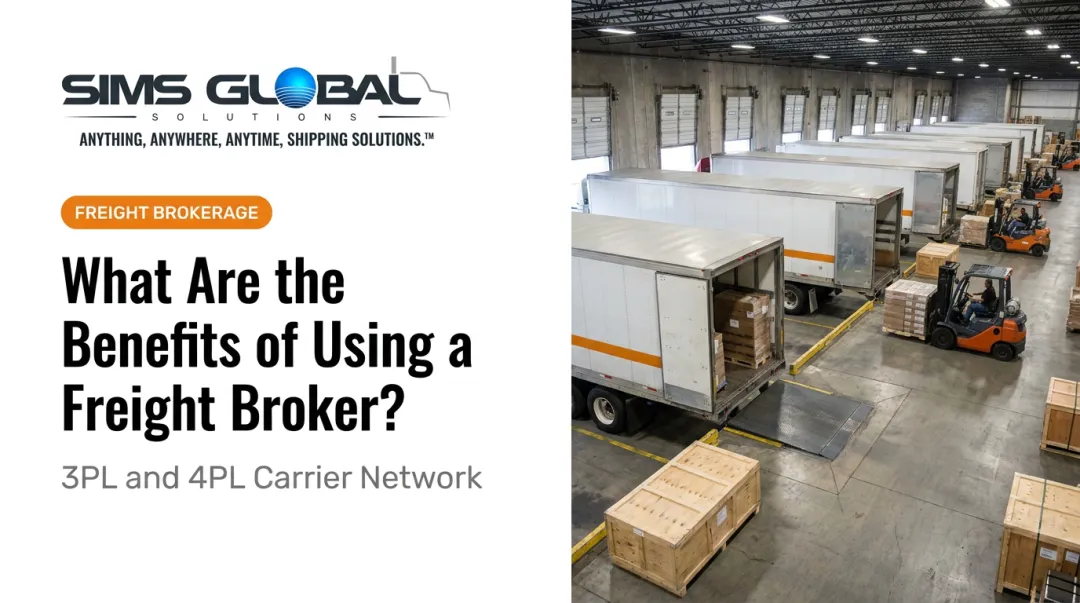
- Access to large carrier networks without spending internal time vetting every carrier
- Competitive rates driven by combined volume across many shippers
- Support with documentation, compliance paperwork, and load tracking
Modes and Specializations
Brokers typically specialize by mode. Truckload, LTL, intermodal, expedited, and drayage are the common categories, and many businesses need more than one depending on shipment size and urgency.
Sims Global Solutions operates across all of these modes through a network of more than 150,000 vetted carriers, including direct API integrations with over 70 top LTL carriers and a dedicated network of 35,000+ truckload carriers. That range matters because a business shipping a single pallet one week and a full trailer the next shouldn't need three different broker relationships to cover it, especially when carrier capacity tightens during peak shipping seasons.

Use Cases of Freight Brokerage
Freight brokerage fits best when warehousing is already handled. The gap is purely on the transportation side, usually because:
- Carrier capacity is inconsistent, especially during peak seasons
- Rate negotiation takes more time than the business has internally
- Freight is heavy, oversized, or specialized enough to need dependable, vetted capacity
Industries that lean heavily on freight brokerage include manufacturers, aerospace and defense, and material handling companies moving heavy or specialized freight where reliable capacity, not storage, is the bottleneck.
3PL Brokerage vs Freight Brokerage: Which is Better for Your Business?
There's no universal winner here. The right call depends on four factors:
- Order complexity: how many SKUs, how many order types, how much variability
- Existing warehouse capacity: do you already have storage and staff, or would you be starting from zero
- Budget: bundled pricing vs. pay-per-shipment margin
- Outsourcing scope: how many parts of the fulfillment process (storage, packing, transport) actually need help
A Simple Decision Framework
- Choose freight brokerage if warehousing and fulfillment are already handled in-house, and the gap is purely carrier capacity and rate negotiation.
- Choose 3PL brokerage if you need help across the entire order cycle, storage through delivery.
- Consider a hybrid approach if you're growing fast and don't yet know where your ceiling is.

That third option is more common than most businesses expect. A retailer might start with freight brokerage alone, just needing reliable capacity for outbound shipments.
As SKU count climbs and order volume grows past what internal staff can pick and pack accurately, warehousing and fulfillment support gets layered in. The transportation relationship doesn't change; the scope around it does.
Sims Global Solutions supports both ends of that path. Standalone freight brokerage runs across truckload, LTL, expedited, intermodal, and drayage. When fulfillment becomes the bottleneck, the same relationship can extend into 33 million square feet of warehousing space across 96 locations, without switching vendors or rebuilding integrations from scratch.
Cost-efficiency note: 3PL services aren't automatically the pricier option. Running separate vendors for warehousing, fulfillment, and transportation means multiple invoices, individual account managers, and more potential points of failure. Consolidating into one bundled partner often lowers total logistics spend by cutting the administrative overhead of managing multiple relationships, even before comparing line-item pricing.
Conclusion
Neither model is universally "better." Freight brokerage suits businesses with fulfillment capability already in place. 3PL brokerage suits those needing end-to-end support from storage through delivery.
The right fit depends on where your business stands right now, and that answer changes as you grow. A partner offering both multi-modal freight brokerage and warehousing access, like Sims Global Solutions, means the decision doesn't have to be permanent.
You can start with what you need today and add capacity as order volume, SKU complexity, or fulfillment demands increase.
Frequently Asked Questions
What is a 3PL brokerage?
A 3PL brokerage is a logistics provider that manages warehousing, fulfillment, and transportation as one connected service. This distinguishes it from a standalone freight broker, which only arranges transportation.
How does a 3PL make money?
3PLs earn revenue through service fees for warehousing and fulfillment, plus margins on transportation. These are often bundled into a single pricing structure covering the full order cycle.
Is a freight broker the same as a 3PL?
Freight brokers are a narrower type of 3PL, focused only on transportation. "3PL" is the broader umbrella term that can include warehousing and fulfillment too.
Can I use both a 3PL and a freight broker at the same time?
Yes, many businesses do. Some pair in-house or 3PL warehousing with a separate freight broker; others use one hybrid provider that handles both.
Which is more cost-effective: 3PL or freight brokerage?
Freight brokerage is usually cheaper if you only need transportation help. A 3PL can lower total costs if you also need warehousing and fulfillment, since bundling reduces vendor overhead.
How do I know if my business needs a 3PL instead of a freight broker?
Signs include limited warehouse space, growing SKU complexity, or a need for pick/pack and fulfillment support that goes beyond just moving freight.