


Why carrier sourcing and vetting must test the whole shipment story
At 2:17 p.m., an available truck can look perfect on paper. The carrier has active authority. Its insurance appears current. The equipment matches. The rate works. Pickup is close enough to make the appointment.
That is where a simple carrier search ends and real carrier sourcing begins.
A carrier can be a legitimate business and still be the wrong fit for a particular shipment. A legitimate carrier’s identity can also be stolen, its email compromised, or its operating authority transferred. The practical question is whether the carrier, the person communicating on its behalf, the equipment and the proposed movement make sense together right now.
That question drives how Sims Global Solutions sources capacity. We built a dedicated team and equipped it with specialized identity, compliance, safety and performance tools because the carrier decision is one of the most important controls in a shipment.
Availability Is Only the First Filter
Finding an open truck is a matching exercise. Finding the right carrier is a judgment exercise. The lowest quote can become the most expensive option when it introduces a missed appointment, an insurance problem, or a stolen shipment. Good sourcing therefore starts with fit, not price alone.
| Criteria | Industry Standard | Sims Global Standard |
|---|---|---|
| Experience | Carrier is available | Has relevant lane and freight experience |
| Equipment | Has required trailer | Has load-specific equipment |
| Rate | Lowest price | Balances competitive pricing with reliability and service |
| Performance | Relies on carrier availability and basic qualifications | Documented service history |
Credentials Are the Beginning of the Review
Operating authority and insurance are essential point-in-time facts. A disciplined review looks for agreement across multiple sources and for changes that deserve a second look. If a carrier offers a truck for a West Coast lane while its recent operating pattern is concentrated in the Northeast, that does not prove wrongdoing, but it does create a question that should be resolved before dispatch.
Document examination is critical. Even insurance certificates can be fraudulent.
Federal Motor Carrier Safety Administration
The FMCSA agency advises companies to confirm contact information through its SAFER system and to call the number on record when the information supplied does not match.
Fraud Often Arrives Wearing a Familiar Name
The hardest fraud to spot does not look obviously fake. Criminals may use a real carrier name, a valid motor carrier number, a lookalike email domain or a phone number that appears familiar. In some cases, they exploit an authority with years of legitimate history. The records look credible because much of the information is real; the person using it is not authorized.
Note: These figures represent Highway network data only, not industry-wide totals. Furthermore, Verisk CargoNet recorded 767 supply-chain crime events in the U.S. and Canada in Q1 2026, with estimated losses of $131.58 million.
The Transportation Intermediaries Association found a similar burden in its April 2025 member survey. Twenty-two percent of respondents said they had lost more than $200,000 to fraud during the previous six months, while 10 percent reported spending more than $200,000 on prevention.
Carrier Networks Are Getting Smaller on Purpose
Recent industry moves show that carrier-network size is no longer a useful quality signal by itself.
- Landstar: Over 100,000 approved carriers (2022) → ~64,600 (Q2 2026)
- Circle Logistics: ~60,000 carriers → ~22,000
Nuance Note: Removal from an approved network does not prove that a carrier was fraudulent; networks often clear inactive carriers or those who no longer meet updated standards.
The important signal is the investment required to maintain a useful network. Approval is not a one-time administrative event. It requires current information, defined standards, documentation and people who can make difficult calls.
How Sims Global Approaches the Decision
We do not publish every threshold, signal or escalation step. Effective controls lose value when bad actors can study the full playbook.
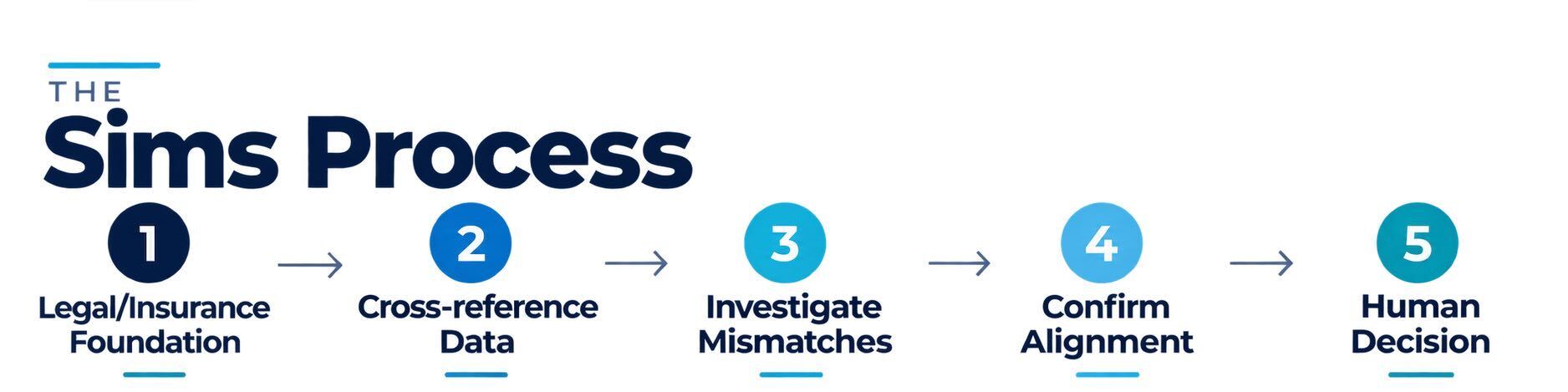
Our process uses layers because no single database, document or score can explain the whole shipment. We begin with the carrier’s legal and insurance foundation, then examine whether the operating details support the load being offered. We cross-reference trusted data sources and review changes or mismatches that could alter the risk before making a decision.
Technology makes that review faster and more consistent. It can monitor large data sets, surface changes and flag unusual patterns. Our team supplies the context. A system can identify a new phone number; a person can determine whether the explanation is credible. A platform can show a safety or inspection pattern; an experienced operator can evaluate how it relates to the equipment and shipment at hand.
The conversation itself also matters. Does the caller understand the lane and appointment requirements? Can the dispatcher explain the specialized equipment? Do the driver and vehicle details align with the carrier we approved? If something feels inconsistent, the team can pause, use independently verified contact information and confirm the request before proceeding.
What Business Owners Should Ask Their Logistics Providers
A few practical questions can reveal whether a provider treats vetting as paperwork or as an active risk function.
- How do you confirm that the person offering the truck is authorized to represent the carrier?
- What events trigger a new review after a carrier has already been approved?
- How do you confirm that the driver, tractor and trailer arriving at pickup match the carrier that was selected?
- What happens when contact information, routing instructions or delivery details change after dispatch?
- Who can stop a load when technology flags a concern, and how are exceptions documented?
- How do you evaluate whether a carrier’s actual operating history fits our lane, equipment and service requirements?
Clear answers should include both tools and people. Software without judgment can miss context. Judgment without reliable data can miss patterns. A mature process needs both.
Reliability Begins Before Pickup
The work customers see is the pickup, the tracking update and the delivery. The work that protects those moments begins earlier, when a team decides who should receive the freight.
Sims Global Solutions built a dedicated carrier sourcing and vetting function to make that decision with more evidence and less assumption. When the facts do not line up, we slow down. When too many questions remain unanswered, we choose another carrier.
Talk with Sims Global Solutions about a sourcing strategy built around your freight.
Sources: FMCSA Broker and Carrier Fraud (April 2025); Highway Q4 2025 Freight Fraud Index (Jan 2026); Verisk CargoNet Q1 2026 Analysis (April 2026); TIA State of Fraud (April 2025); FreightWaves Landstar Report (Aug 2026); CCJ Compliance Report (Aug 2026).